On this page
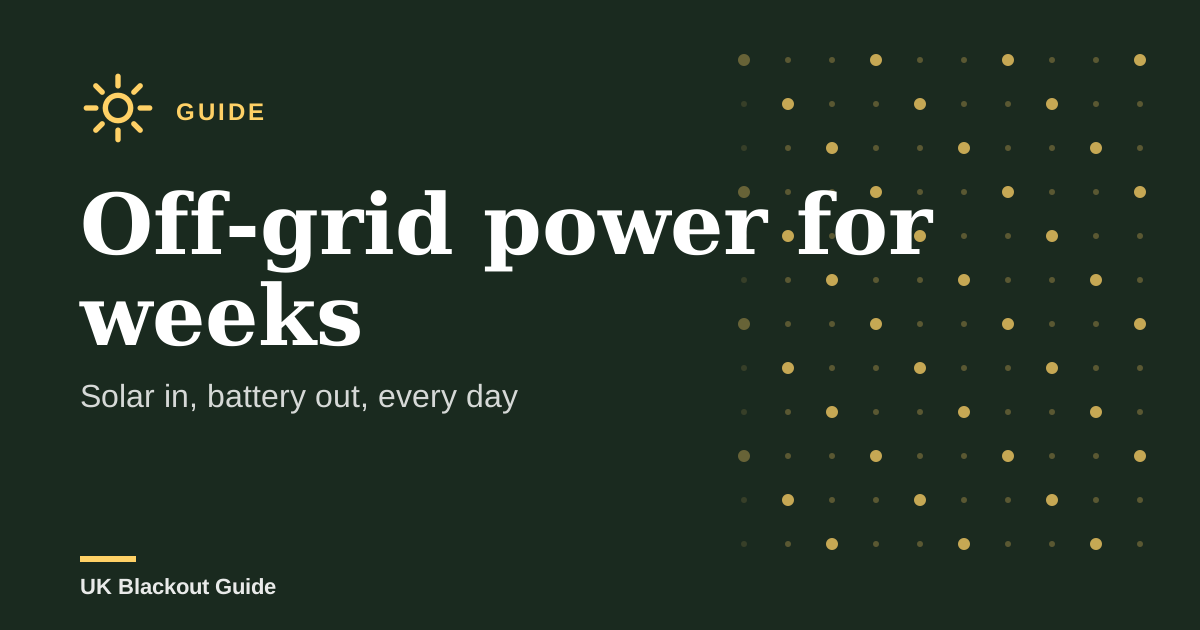
For weeks without mains, which is optional planning beyond the official three days, pair a portable power station with solar panels and run only low-power essentials. In the UK a 100 W panel typically yields 300 to 400 Wh on a clear summer day but often just 30 to 80 Wh on a dull winter day. That covers phones, LED lights and a radio all year.
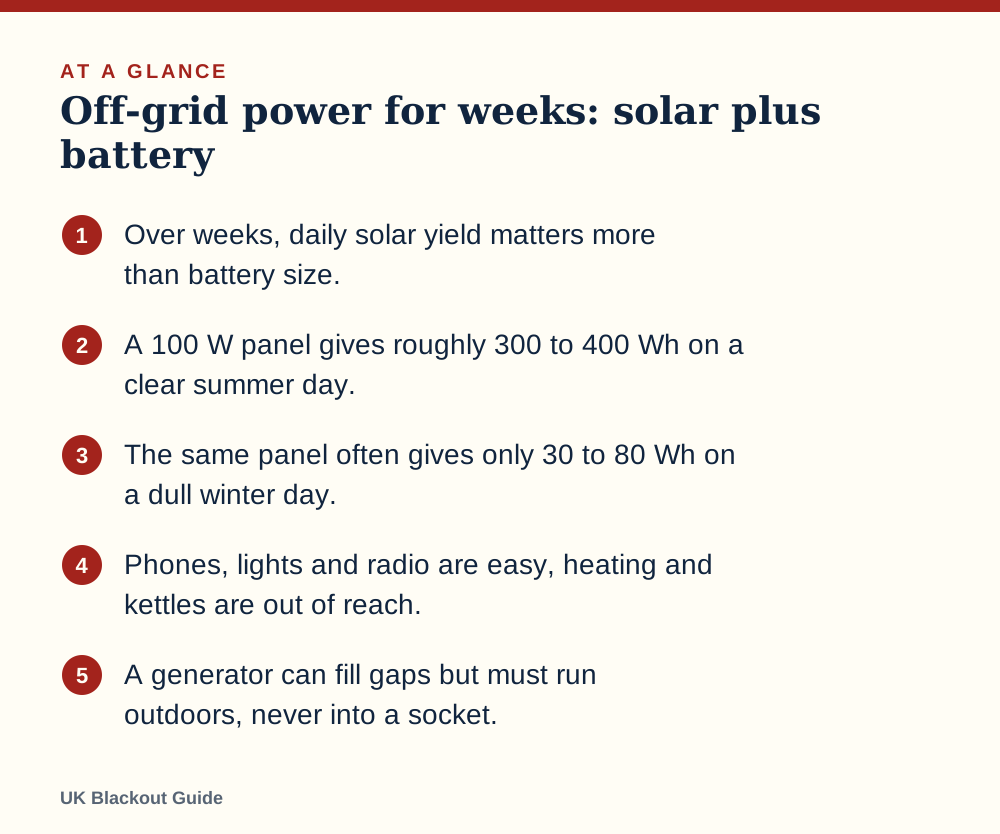
- Over weeks, daily solar yield matters more than battery size.
- A 100 W panel gives roughly 300 to 400 Wh on a clear summer day.
- The same panel often gives only 30 to 80 Wh on a dull winter day.
- Phones, lights and radio are easy, heating and kettles are out of reach.
- A generator can fill gaps but must run outdoors, never into a socket.
Think in daily budgets, not battery size
The government has not asked households to prepare for weeks without mains power and has not suggested an outage of that length is expected. The official Be Ready guidance is three days, and its kit list asks only for a charged power bank. This page is optional planning beyond that.
For a short power cut you buy a battery big enough to last. For weeks, that approach fails, because any battery runs out. What counts is energy in against energy out, every day, like a household budget.
The sums are simple. Energy is measured in watt-hours (Wh): a 10 W lamp on for 5 hours uses 50 Wh. A portable power station delivers about 85% of its rated capacity, so a 1,000 Wh unit gives roughly 850 Wh of use.
What a day of essentials adds up to
| Device | Typical draw | Daily use | Energy per day |
|---|---|---|---|
| Two phones, one charge each | 10 to 20 W while charging | About 1.5 hours each | About 45 Wh |
| Two LED lamps | 5 to 10 W each | 5 hours | About 75 Wh |
| Radio | A few watts | 3 hours | About 10 Wh |
| Router | 10 to 15 W | 6 hours | About 75 Wh |
| Laptop | 45 to 65 W | 3 hours | About 165 Wh |
| CPAP without humidifier | 30 to 60 W | 8 hours | About 360 Wh |
| Fridge-freezer | 40 to 80 W average | 24 hours | About 1,000 to 1,900 Wh |
The first three rows are the core: about 130 Wh a day keeps a household lit, informed and in contact. Add a router and laptop and you are near 370 Wh. A fridge-freezer on its own uses several times more than everything above it combined.
What UK sunshine really gives you
A panel's rating is its output in ideal test conditions. In practice a 100 W portable panel in the UK typically yields roughly 300 to 400 Wh across a clear summer day, and often only 30 to 80 Wh on a dull winter day.
Set that beside the table. One 100 W panel in summer covers the core loads with plenty to spare, and most of a laptop and router too. The same panel in a grey December covers a phone charge and a few hours of one lamp. Angle, shade and cloud all change the result, which is the whole story of portable solar charging in UK conditions.
Sizing the battery to match the panels
The battery's job over weeks is to store a good day's sun and carry you through a few poor ones. Three days of your essential budget is a sensible reserve. For the 130 Wh core, that is under 400 Wh of usable storage. For 370 Wh a day it is about 1,100 Wh usable, so one of the large power stations rated near 1,300 Wh.
Check two figures on the specification beyond capacity. The maximum solar input sets how fast the unit can refill, and a low limit wastes a sunny day. The battery chemistry affects lifespan, and LiFePO4 cells tolerate many more charge cycles than older lithium types, which matters if you cycle the unit daily.
The fridge question
Keeping a fridge-freezer running for weeks takes roughly 1,000 to 1,900 Wh every day, plus a station able to supply the 600 W or more that the compressor needs to start. In a good summer spell that means around 400 W of panels and a large battery. In winter it is not realistic with portable equipment.
Most households are better off letting the freezer go and eating from the cupboard, because running a fridge-freezer on backup power takes so much energy. If refrigeration matters to you, for medicines for example, a small efficient portable fridge uses far less. For medicines, follow your pharmacist's or clinician's advice on storage.
What solar and battery will not do
Anything that makes heat is out of scope, and that includes the common question of whether a power station can run a heater. A kettle draws 2,000 to 3,000 W and a fan heater about 2,000 W. One hour of a fan heater uses about 2,000 Wh, which is five or six clear summer days of output from a 100 W panel. Heat water on a stove outdoors and keep warm with clothing and bedding.
Gas central heating needs 100 to 150 W for its controls and pump, and wiring a boiler to a power station is a job for a qualified person, not a household improvisation.
Where a generator fits
A petrol generator produces in an hour what a portable panel gathers in days. When you weigh up a power station against a generator, that makes it a useful partner in winter: run it briefly to refill the power station, then switch it off. The limit is fuel. HSE rules let you keep up to 30 litres of petrol at home without notifying anyone, in suitable containers, in a garage or shed.
Run a generator outdoors only, well away from doors, windows and vents. Never use one in a house, garage or tent, because carbon monoxide has no smell and can kill. Never plug a generator into a house socket. Connecting to house wiring needs a changeover switch fitted by a qualified electrician.
Running the system day to day
Put portable solar panels out early and turn them towards the sun two or three times a day. Keep them clear of shade, since a shadow across one corner can cut output sharply. Charge phones and power banks in the middle of the day, when the panel can feed them directly, and save the battery for the evening.
Keep the power station indoors, dry and off the floor, with space around its vents. If you have rooftop solar, be aware that most home systems shut off in a power cut unless they have battery backup able to run independently of the grid.
Common questions
How many solar panels do I need to live off-grid in the UK?
For phones, lights and a radio, one 100 W panel is enough in most conditions. For a fridge-freezer you need around 400 W of panels in summer, and it is not practical in winter.
Can I charge a power station from my car?
Yes, most accept a 12 V car input, though it is slow and you should run the engine to protect the car battery. It is a useful backup on dull days.
Do solar panels work through a window?
They produce far less behind glass. Put them outside, angled at the sun, and run the cable in through a slightly open window.
Is a solar setup worth it just for power cuts?
For short cuts a power bank is enough. A panel and power station make sense if you want cover for a week or more, or will also use them for camping.
Reviewed against these sources on 18 November 2026. If official advice has changed since, follow the official advice.
General information only. This page is not professional, safety, medical, legal or financial advice, and it is not official guidance. No national blackout has been forecast or announced, and nothing here suggests one is expected. We are independent and have no connection to the government or any energy company. Always check the official sources linked on this page. Full disclaimer
Keep reading
 Question
Can portable solar keep a household going in a long power cut?
What portable solar panels can and cannot power in a UK home during a long outage, with realistic summer and winter output and example daily loads.
Read: Can portable solar keep a household going in Guide
How to manage 30 days without mains power
Optional planning for 30 days without mains power, far beyond the three days UK guidance asks for: what water, food, energy and health would need.
Read: How to manage 30 days without mains power Guide
Preparing for 90 days: stock, rotation and routine
An honest look at preparing for 90 days: why it is far beyond official UK planning, what stock and rotation would involve, and where its limits are.
Read: Preparing for 90 days: stock, rotation and Guide
A week without power: what changes after day three
Optional planning beyond the official three days: what changes by day seven of a power cut for water, cooking, freezer food, phone charging and cash.
Read: A week without power: what changes after day