On this page
Choose a portable power station if you want quiet, fume-free power indoors for electronics, lights and medical devices over hours. Choose a generator only if you need to run heavier loads for days, have safe outdoor space and will store fuel. For most UK homes, the power station is the better fit.
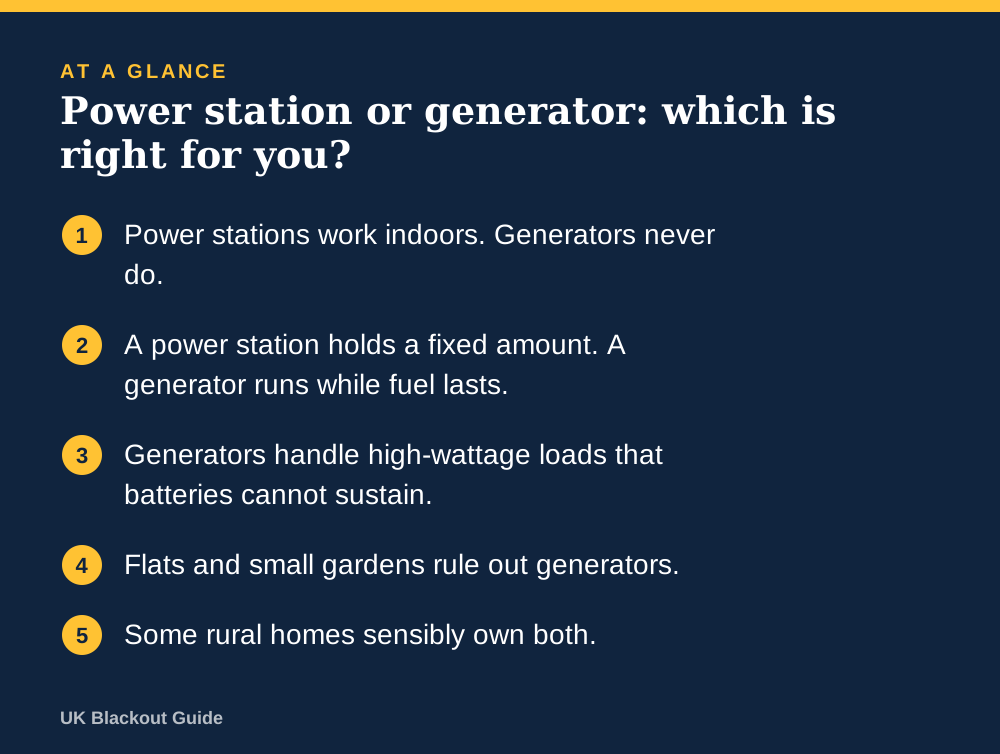
- Power stations work indoors. Generators never do.
- A power station holds a fixed amount. A generator runs while fuel lasts.
- Generators handle high-wattage loads that batteries cannot sustain.
- Flats and small gardens rule out generators.
- Some rural homes sensibly own both.
The difference in one paragraph
A portable power station is a store of electricity. You fill it from the mains in advance and draw it down during the cut. A generator is a maker of electricity. It burns petrol or gas to produce power on demand. Almost every other difference, from safety to noise to cost, follows from that. If you are still deciding whether you need a generator for a blackout at all, settle that first.
A stored supply is silent, clean and limited. A made supply is loud, produces deadly exhaust and lasts as long as the fuel does. The question to ask is which set of drawbacks you can live with, given your home and the length of cut you are planning for.
How they compare point by point
| Power station | Petrol generator | |
|---|---|---|
| Where it runs | Indoors, any room | Outdoors only, away from doors and windows |
| Fumes | None | Carbon monoxide in exhaust |
| Noise | Near silent | Clearly audible, even inverter types |
| Endurance | Fixed by capacity | As long as fuel lasts |
| Typical output | 300 to 2,000 W | 1,000 to 3,500 W and above |
| Refilling | Mains, car socket or solar | Petrol or LPG |
| Starting it | Press a button | Carry outside, fuel, pull cord, run leads |
| Upkeep | Top up charge every few months | Test runs, oil, fresh fuel |
| Storage | A cupboard | Dry shed or garage, fuel stored separately |
Runtime: a worked comparison
Suppose you want a router (12 W), two LED lamps (20 W), a laptop (60 W) and a fridge-freezer (60 W average). That is about 150 W.
A 1,000 Wh power station gives 850 Wh of usable energy, so it would carry that load for about 5.5 hours. A 2,000 Wh unit manages around 11 hours. Drop the laptop and fridge, and the 1,000 Wh unit runs the router and lamps for more than 26 hours. Battery power rewards rationing.
A generator supplies the same 150 W without effort and has a couple of thousand watts in reserve. Its endurance depends on the tank and your fuel store. HSE rules allow up to 30 litres of petrol at home in suitable containers. How much fuel a generator burns depends on the model and the load. Once the fuel is gone, you depend on being able to buy more, and whether petrol stations work in a power cut is one of the things a wide outage puts in doubt.
Safety is the biggest divide
A power station has no engine and makes no exhaust, which is the basis for using power stations safely indoors. You can use it in a bedroom next to a CPAP machine. The main precautions are ordinary ones for lithium batteries: a hard, dry surface, clear vents and no covering.
A generator must never be used indoors, in a garage, or in a tent. Carbon monoxide has no smell and can kill. It must never be plugged into a house socket, because back-feed can kill engineers working on the network.
Owning a generator means accepting the duties of generator safety: positioning it outside every time, running outdoor leads, refuelling only when it is cool, storing petrol correctly and fitting a carbon monoxide alarm to EN 50291. If that list sounds like more than you would reliably do in the dark and rain, a generator is not for you.
Which suits which home
Flats and homes without private outdoor space. A power station is the only option for a power cut in a flat. There is nowhere safe to run a generator, and petrol should not be stored in living space.
Urban and suburban houses. Cuts are usually short and neighbours are close. A power station covers the realistic risk without noise or fuel storage.
Rural homes with a history of long cuts. This is where a home backup generator earns its keep. After Storm Arwen in 2021, some rural homes in northern England and Scotland were without power for more than a week, far beyond what a battery can cover without recharging. A generator can keep a freezer cold, run boiler controls and recharge everything else.
Anyone relying on powered medical equipment. Start with a power station, because it works indoors at night without supervision, and register with the Priority Services Register. Follow your clinician's advice on backup.
Using both together
The two are not rivals. In a long outage, the most fuel-efficient pattern is to run a generator for a couple of hours once or twice a day and use that time to re-chill the freezer, run the boiler and recharge a power station and power banks. The power station then supplies quiet power indoors through the evening and night, with the generator switched off.
This cuts fuel use, noise and the hours of carbon monoxide risk, which matters most when you are planning for a week without power.
Making the choice
If you are unsure, buy a portable power station first. It handles the common cases, needs almost no upkeep and remains useful even if you later add a generator.
If your circumstances point to a generator for power cuts, plan where it will stand and where the fuel will live before you order.
Common questions
Is a solar generator the same as a generator?
No. Solar generator is a marketing name for a power station sold with a solar panel. It stores electricity and has no engine.
Which is cheaper?
It depends on size. Compare the full cost of each, including fuel, cans, leads and an alarm for a generator, and any solar panel for a power station.
Can a generator charge a power station?
Yes. Plug the power station's mains charger into the generator's socket, with the generator outdoors. Check the power station's charging draw is within the generator's output.
Which is better for a three-hour rota cut?
A power station. It is ready instantly, runs indoors and recharges from the mains between cuts.
Reviewed against these sources on 18 November 2026. If official advice has changed since, follow the official advice.
General information only. This page is not professional, safety, medical, legal or financial advice, and it is not official guidance. No national blackout has been forecast or announced, and nothing here suggests one is expected. We are independent and have no connection to the government or any energy company. Anything involving electricity, gas, fuel or food safety should be checked with a qualified professional or the relevant official body before you act on it. Always check the official sources linked on this page. Full disclaimer
Keep reading
 Question
Do I need a generator for a blackout?
Do you need a generator for a blackout? Most UK homes do not. It is not on the government's Be Ready list. When one makes sense, and the safer options.
Read: Do I need a generator for a blackout? Guide
Backup power for your home: every option compared
Power banks, power stations, generators, solar panels, cars and UPS units compared: what each can run in a UK power cut, for how long, and who needs which.
Read: Backup power for your home: every option Question
Are power stations safe to use indoors in a power cut?
Battery power stations are safe to use indoors because they burn no fuel and give off no fumes. The sensible rules for charging, placing and storing one.
Read: Are power stations safe to use indoors in a Buying guide
Best generators for power cuts
Petrol inverter generators for UK power cuts, from 1,200 W to 5,500 W, chosen from Amazon UK listings, with the carbon monoxide and wiring rules.
Read: Best generators for power cuts