On this page

Run a generator outdoors only, well away from doors, windows and vents, never in a garage, porch or tent. Fit an audible carbon monoxide alarm indoors. Let the engine cool before refuelling, store no more than 30 litres of petrol at home, and never plug a generator into a house socket.
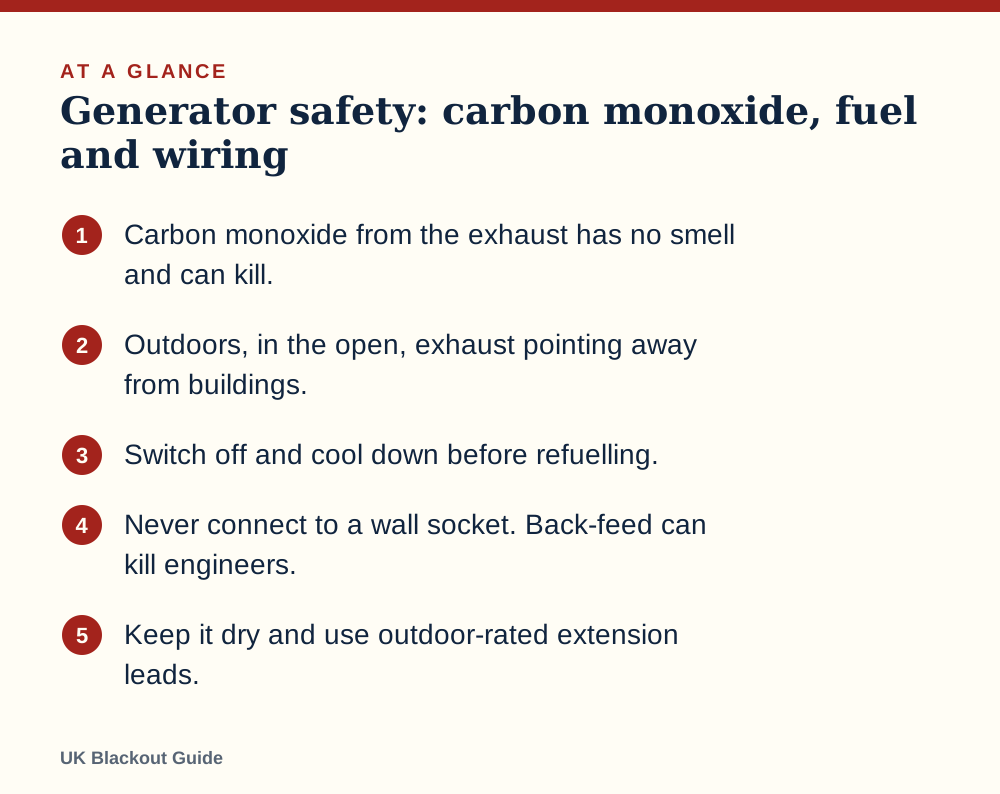
- Carbon monoxide from the exhaust has no smell and can kill.
- Outdoors, in the open, exhaust pointing away from buildings.
- Switch off and cool down before refuelling.
- Never connect to a wall socket. Back-feed can kill engineers.
- Keep it dry and use outdoor-rated extension leads.
Carbon monoxide is the main danger
A petrol engine produces carbon monoxide (CO) in its exhaust. You cannot see, smell or taste it. In an enclosed or partly enclosed space it builds up quickly to levels that cause collapse, and people have died running generators in garages and outbuildings during power cuts.
Never run a generator indoors, in a garage, shed, porch, conservatory, carport or tent. An open door or window does not make it safe, which is the answer to whether a generator can ever be used indoors.
The early symptoms of carbon monoxide poisoning are easy to mistake for a cold or tiredness: headache, dizziness, nausea and breathlessness. If anyone feels unwell while a generator is running, get everyone into fresh air, switch the generator off if you can do so without going back into fumes, and call 999.
Where to put the generator
Choose the spot before you need it, in daylight. It should be in the open air, on firm level ground, as far from the house as your extension lead sensibly allows, and well clear of doors, windows, air bricks and boiler flues. Think about your neighbours' windows as well as your own.
Point the exhaust away from all buildings. Check which way the wind is carrying the fumes and move the machine if they drift back towards the house. Keep children and pets away, because the exhaust and engine casing get hot enough to burn.
Fit a carbon monoxide alarm in the room closest to where the generator runs, and another near bedrooms if you plan to run it into the evening. It is safer to switch the generator off overnight and rely on torches and blankets.
Rain, damp and electric shock
A generator makes mains-voltage electricity, and water and electricity do not mix. Do not run it in rain or snow unprotected, and do not touch it with wet hands. Equally, do not solve the rain problem by moving it into a garage.
The answer is an open-sided cover that keeps rain off while leaving air free to move on all sides, such as a purpose-made generator canopy. Stand the machine on a dry surface, not in a puddle.
Use extension leads that are rated for outdoor use and for the load, fully unwound so they do not overheat. Check them for cuts and damage. Run them where they will not be tripped over or trapped in a closing door, and keep the connections off wet ground. Follow the manual on earthing, which varies between models.
Handling and storing petrol
Refuelling is when most fires start, which makes it the part of fire safety during power cuts that matters most with a generator. Petrol spilled on a hot exhaust can ignite. Switch the engine off and let it cool for several minutes before opening the fuel cap. Refuel outdoors, use a funnel or spout, wipe up spills, and never smoke or use a naked flame nearby. Fill the tank before dark if you can, so you are not pouring petrol by torchlight.
At home, HSE rules on how much petrol you can store at home allow up to 30 litres without notifying anyone. It must be in suitable containers: plastic ones of up to 10 litres or metal ones of up to 20 litres. Keep them in a garage or shed, never in the living space, away from heat and anything that could spark. Those points are the core of storing fuel at home safely.
Keep a fire extinguisher suitable for flammable liquids where you can reach it.
Never plug a generator into a house socket
Connecting a generator to a wall socket with a plug-to-plug lead sends power backwards through your consumer unit and out into the street cables. This is called back-feed, and it is why you must not plug a generator into a socket. Engineers repairing what they believe is a dead line can be electrocuted, and when mains power returns it meets the generator's output, which can destroy the generator and start a fire.
There are two safe ways to use the power. The simple one is to plug appliances directly into the generator's own sockets using extension leads. The other is a changeover switch (also called a transfer switch) fitted by a qualified electrician, which physically disconnects the house from the network before connecting the generator.
Do not overload the machine. Add up the watts, start the largest appliance first, and remember that a fridge-freezer needs 600 W or more for a moment each time it starts.
Keeping it ready between power cuts
A generator that fails to start is a different kind of safety problem, because it tempts people into shortcuts. Run it for a short while every month or two with a small load attached. Check the oil level, and keep the fuel fresh by rotating stored petrol into your car and refilling the cans.
Store the machine dry, with the fuel tap off. Keep the manual, a funnel, spare oil and your extension leads together so the whole set comes out in one go. If you are still choosing a machine, our guide to generators for home backup compares the types. The generators we suggest for power cuts favour models with a low-oil shut-off.
Checklist
Generator safety: carbon monoxide, fuel and wiring
- Generator positioned outdoors, in the open, away from doors, windows and vents
- Exhaust pointing away from all buildings
- Battery carbon monoxide alarm (EN 50291) fitted and tested indoors
- Outdoor-rated extension leads, fully unwound and undamaged
- Engine off and cooled before refuelling
- No more than 30 litres of petrol stored, in approved containers, in a garage or shed
- Appliances plugged into the generator, never the generator into a wall socket
- Fire extinguisher within reach
- Generator switched off overnight
Common questions
How far from the house should a generator be?
As far as your extension lead sensibly allows, in the open, with the exhaust pointing away and clear of any door, window or vent. Follow the distance given in the manufacturer's manual.
Can I run a generator in the garage with the door open?
No. Carbon monoxide still builds up to dangerous levels and can seep into the house.
Is it safe to leave a generator running overnight?
It is safer to switch it off. A closed freezer holds its cold for many hours, and nobody is awake to notice a fault or an alarm outside.
Who do I call if I smell gas or suspect carbon monoxide from a gas appliance?
Call the gas emergency number on 0800 111 999. For anyone with symptoms of carbon monoxide poisoning, call 999.
Reviewed against these sources on 18 November 2026. If official advice has changed since, follow the official advice.
General information only. This page is not professional, safety, medical, legal or financial advice, and it is not official guidance. No national blackout has been forecast or announced, and nothing here suggests one is expected. We are independent and have no connection to the government or any energy company. Anything involving electricity, gas, fuel or food safety should be checked with a qualified professional or the relevant official body before you act on it. Always check the official sources linked on this page. Full disclaimer
Keep reading
 Guide
Generators for home backup: types, cost and safety
The types of generator for home backup in the UK, what they really cost to own, how much they can run, and the safety rules you must follow.
Read: Generators for home backup: types, cost and Buying guide
Best generators for power cuts
Petrol inverter generators for UK power cuts, from 1,200 W to 5,500 W, chosen from Amazon UK listings, with the carbon monoxide and wiring rules.
Read: Best generators for power cuts Question
Can I plug a generator into a house socket in a power cut?
No. Plugging a generator into a house socket back-feeds the network and can kill an engineer. The two safe ways to connect a generator to your home.
Read: Can I plug a generator into a house socket in Question
Can I run a generator indoors or in a garage during a power cut?
No. A generator must never run indoors, in a garage, shed, porch or tent, even with doors open. Why carbon monoxide builds so fast, and where to put it.
Read: Can I run a generator indoors or in a garage