On this page

A portable petrol inverter generator of around 2,000 W is the usual choice for home backup. It can run a fridge-freezer, boiler controls, lights and chargers together for as long as you have fuel. It must run outdoors, away from doors and windows, and must never be plugged into a house socket.
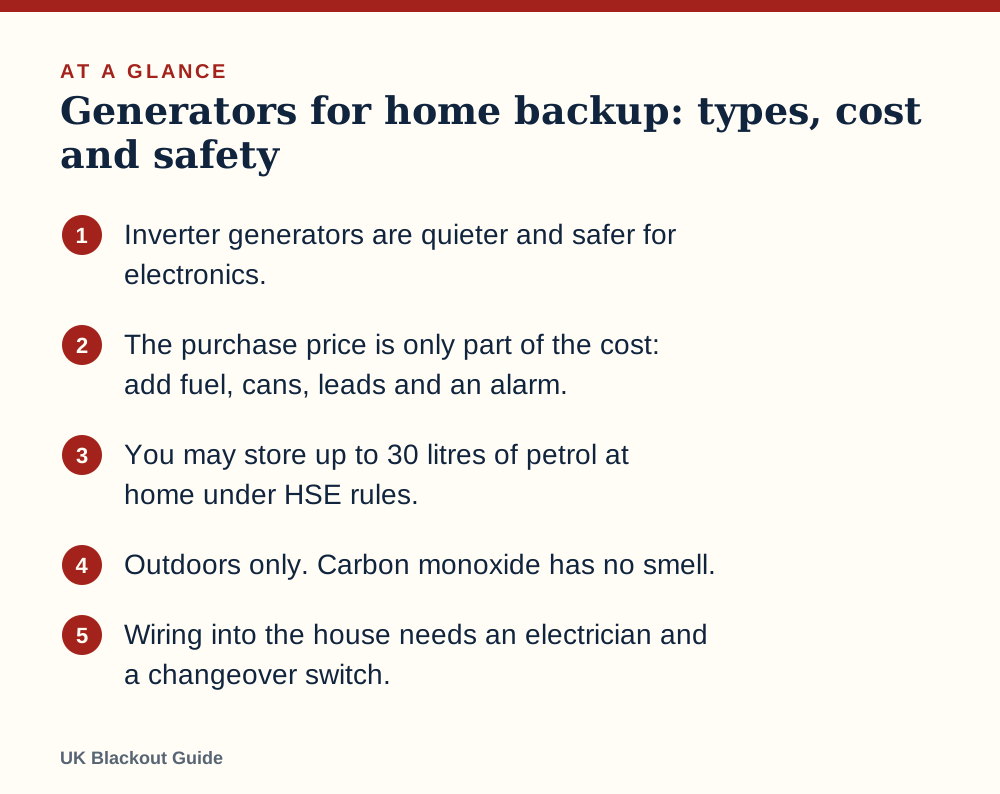
- Inverter generators are quieter and safer for electronics.
- The purchase price is only part of the cost: add fuel, cans, leads and an alarm.
- You may store up to 30 litres of petrol at home under HSE rules.
- Outdoors only. Carbon monoxide has no smell.
- Wiring into the house needs an electrician and a changeover switch.
Who a generator makes sense for
For most UK homes a generator is more than the risk calls for, which is the short answer to whether you need a generator for a blackout. Typical power cuts end within hours, and a power bank, torches and a radio cover them. A generator earns its place when cuts last days, which happens mostly in rural areas after severe storms. Storm Arwen in November 2021 left about 1 million customers without power, and some homes in northern England and Scotland were off for more than a week.
You also need the right property. A generator needs open outdoor space well away from the house and from neighbours, a dry place to store it, and somewhere suitable for fuel. Flats and terraced houses with small yards are usually better served by batteries, as we set out in choosing between a power station and a generator.
The main types
Inverter generators produce electricity, convert it electronically and deliver a smooth output close to mains quality. They are enclosed, quieter, lighter and vary engine speed with demand, which saves fuel at low loads. Most are in the 1,000 to 3,500 W range. This is the type to choose for running electronics, boiler controls and modern appliances.
Conventional open-frame generators run at a fixed speed in a tubular frame. They give more watts for the money and are common on building sites, but they are loud and their output is rougher, which some sensitive electronics dislike.
Dual-fuel models run on petrol or bottled gas (LPG). Gas keeps for years without going stale, which suits a machine that may sit unused for a long time.
Standby generators are permanently installed outside and start automatically. They are a building project involving an electrician and often a gas engineer, and are rare in ordinary UK homes.
How much generator you need
Add up the running watts of what you want to power at once, then check the biggest starting surge. A fridge-freezer averages 40 to 80 W but needs 600 W or more to start. Gas boiler controls and pump take 100 to 150 W. A router is 10 to 15 W, LED lamps 5 to 10 W each, and a laptop 45 to 65 W.
All of that together runs at well under 500 W, with a surge below 1,000 W when the fridge starts. A 2,000 W inverter generator handles it with room to spare. It could also boil a low-wattage travel kettle, but a standard 3,000 W kettle is beyond it. Bigger generators burn more fuel even when lightly loaded, so resist the urge to oversize.
What it really costs to own
Prices change, so we do not quote them here; our generator recommendations for power cuts show live prices. What matters is that the generator is only one line on the bill.
- Fuel and containers. You need approved cans and fresh petrol. Petrol goes stale over months, so stored fuel should be rotated into the car and replaced.
- Outdoor-rated extension leads. Heavy enough for the load and long enough to keep the machine away from the house.
- A carbon monoxide alarm. Not optional. Choose an audible carbon monoxide alarm marked EN 50291.
- Maintenance. Engine oil, a spare spark plug and a test run every month or two.
- A changeover switch. Only if you want it connected to the house wiring, and fitted by a qualified electrician.
Running costs depend on load. A generator's specification gives hours per tank at a stated load, and we explain how to read it in how much fuel a generator uses.
Fuel is the real limit
A generator runs for as long as you can feed it. Under HSE rules on how much petrol you can store at home, you can keep up to 30 litres without notifying anyone, in suitable containers (plastic up to 10 litres, metal up to 20 litres), in a garage or shed and never in the living space.
In a wide outage you may not be able to buy more, because fuel supply is one of the services a major power failure can disrupt. That means rationing. You do not need to run a generator constantly: a few hours morning and evening is enough to re-chill a freezer, charge power banks and run the boiler for a while.
Safety rules that are not negotiable
Never use a generator indoors, in a garage, in a porch or in a tent, even with doors open. Carbon monoxide has no smell. Symptoms are headache, dizziness, nausea, breathlessness and collapse. Get into fresh air and call 999 if you suspect it.
Place the generator outside on level ground, away from doors, windows and vents, with the exhaust pointing away from buildings. Fit an audible carbon monoxide alarm to EN 50291 in the house, because the fumes that mean a generator can never run indoors can also drift in from outside.
Never plug a generator into a wall socket to feed the house. This back-feeds the network and can kill engineers working on the lines, as well as damaging your home. Run appliances from the generator's own sockets by extension lead, or have an electrician fit a changeover switch. Our full guide to generator safety covers refuelling, wet weather and storage.
Common questions
Can a generator run my whole house?
A portable one cannot sensibly do so. It runs selected appliances by extension lead, or selected circuits through a changeover switch fitted by an electrician.
How loud is a home generator?
Inverter models are the quietest type, but all petrol generators are clearly audible outdoors. Check the decibel rating and think about neighbours, especially at night.
Do I need to tell my network operator?
Not for a generator running appliances directly by extension lead. Any connection to your house wiring must be done by a qualified electrician, who will advise on what is required.
How often should I test it?
Run it under a small load every month or two, and keep the oil and fuel fresh. A generator that has sat for two years may not start when you need it.
Reviewed against these sources on 18 November 2026. If official advice has changed since, follow the official advice.
General information only. This page is not professional, safety, medical, legal or financial advice, and it is not official guidance. No national blackout has been forecast or announced, and nothing here suggests one is expected. We are independent and have no connection to the government or any energy company. Anything involving electricity, gas, fuel or food safety should be checked with a qualified professional or the relevant official body before you act on it. Always check the official sources linked on this page. Full disclaimer
Keep reading
 Guide
Generator safety: carbon monoxide, fuel and wiring
How to use a generator safely in a power cut: where to put it, carbon monoxide, storing and handling petrol, wet weather and house wiring rules.
Read: Generator safety: carbon monoxide, fuel and Buying guide
Best generators for power cuts
Petrol inverter generators for UK power cuts, from 1,200 W to 5,500 W, chosen from Amazon UK listings, with the carbon monoxide and wiring rules.
Read: Best generators for power cuts Question
Can I plug a generator into a house socket in a power cut?
No. Plugging a generator into a house socket back-feeds the network and can kill an engineer. The two safe ways to connect a generator to your home.
Read: Can I plug a generator into a house socket in Question
Can I run a generator indoors or in a garage during a power cut?
No. A generator must never run indoors, in a garage, shed, porch or tent, even with doors open. Why carbon monoxide builds so fast, and where to put it.
Read: Can I run a generator indoors or in a garage