On this page
A good-quality power bank will still hold most of its charge after three to six months in a drawer, but it drains slowly all the time and faster in heat or if it is old. Do not trust one you charged a year ago. Top it up every three months and you will always have a usable bank when the lights go out.
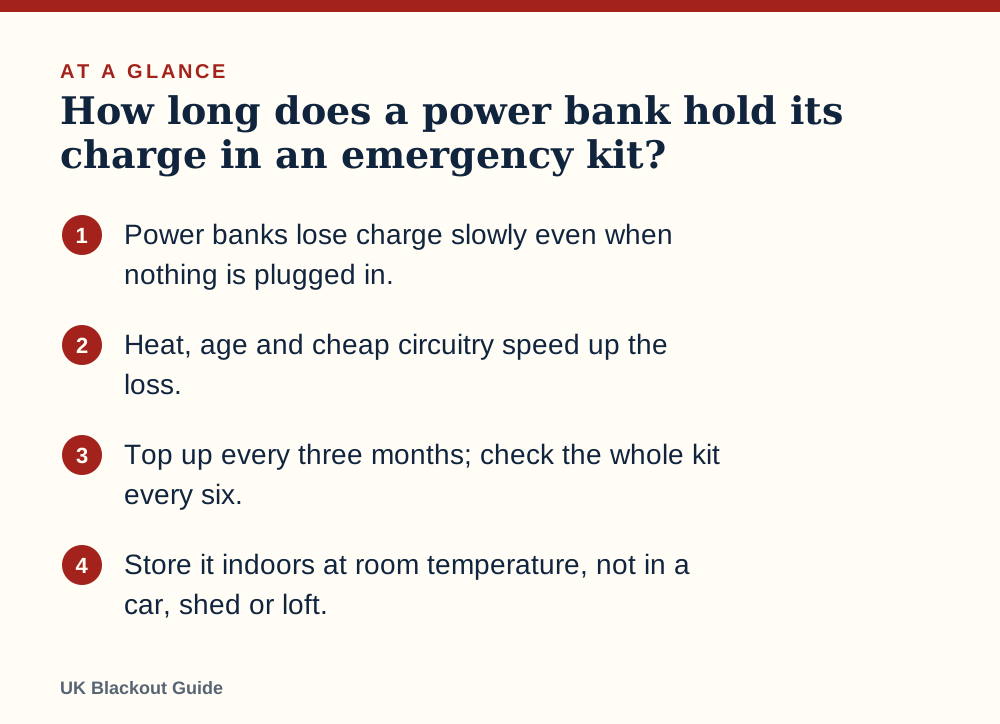
- Power banks lose charge slowly even when nothing is plugged in.
- Heat, age and cheap circuitry speed up the loss.
- Top up every three months; check the whole kit every six.
- Store it indoors at room temperature, not in a car, shed or loft.
What happens to a power bank left in a drawer
The lithium cells described in our power bank explainer leak a little charge on their own, and the bank's protection circuit and display sip a little more. In a decent power bank the combined loss is small, so one charged in September should still be mostly full at Christmas.
The trouble is that you cannot see the loss, and it is not the same for every bank. A cheap or elderly unit can be half empty after a few months. One left completely flat for a long time may refuse to charge at all, because the cells have dropped below the level the safety circuit allows.
What makes the charge disappear faster
Heat is the main enemy. A power bank kept in a car glovebox, on a sunny windowsill or next to a radiator loses charge faster and ages faster. Very cold storage is unkind too, so a shed or loft is a poor home for it.
Age matters as well. Every power bank loses capacity over the years, whether or not you use it, so a five-year-old 20,000 mAh bank will not deliver what it did new. If you want to know what yours really gives, charge it fully, run a phone from it and compare the result with the sum in how many times a power bank can charge a phone.
A top-up routine that takes five minutes
Set a reminder for every three months. Press the button, read the level, and plug the bank in until it is full. That is the whole routine.
The Be Ready campaign advises checking your emergency kit every six months, and the power bank is the item most likely to have changed since you last looked. Tie the top-up to something you already do, such as the clocks changing or paying a quarterly bill. Our six-month kit check lists what else to look at while you are there.
An easier method is to use the bank. Take it out on day trips, then recharge it the same evening. A power bank in regular use is one you know works.
Storing it so it lasts for years
Keep the bank indoors at room temperature, somewhere dry, with its cable wrapped around it. A kitchen drawer or the box with your torches is ideal. For an emergency bank, storing it full and topping up quarterly is the practical choice, even though cells kept part-charged age a little more slowly.
Stop using any power bank that is swollen, cracked, hot when idle or smells odd. Take it to a household recycling centre or a shop battery collection point, and never put it in the bin.
The power banks we recommend for power cuts were chosen with drawer storage in mind.
Common questions
Should I leave a power bank plugged in all the time?
It is better not to. Charge it to full, unplug it, and top it up every three months. Constant charging adds heat and wear for no benefit.
Do alkaline batteries hold their charge longer than a power bank?
Yes. Unopened alkaline AA and AAA batteries keep for years, which is why a battery torch and radio belong alongside a power bank in a kit.
Can a power bank go flat permanently?
It can. If it sits fully empty for a long time, the cells can fall too low for the safety circuit to allow charging. Regular top-ups prevent this.
Reviewed against these sources on 18 November 2026. If official advice has changed since, follow the official advice.
General information only. This page is not professional, safety, medical, legal or financial advice, and it is not official guidance. No national blackout has been forecast or announced, and nothing here suggests one is expected. We are independent and have no connection to the government or any energy company. Anything involving electricity, gas, fuel or food safety should be checked with a qualified professional or the relevant official body before you act on it. Always check the official sources linked on this page. Full disclaimer
Keep reading
 Guide
Backup power for your home: every option compared
Power banks, power stations, generators, solar panels, cars and UPS units compared: what each can run in a UK power cut, for how long, and who needs which.
Read: Backup power for your home: every option Buying guide
Best phone chargers for a blackout
Nine ways to keep a phone charged in a blackout: power banks, crank and solar chargers, car chargers and cables from Amazon UK, compared honestly.
Read: Best phone chargers for a blackout Buying guide
Best power banks for power cuts and blackouts
Seven 20,000 mAh power banks from Amazon UK for keeping phones charged through a power cut or blackout, with the sums on how many charges you really get.
Read: Best power banks for power cuts and blackouts Guide
How to charge your phone in a blackout
Five ways to charge a phone with the mains off, from power banks and cars to solar and laptops, with the sums for how many charges each one really gives.
Read: How to charge your phone in a blackout