On this page
No. Never run a generator indoors, in a garage, shed, porch or tent, even with the doors and windows open. The exhaust contains carbon monoxide, which has no smell and can kill within minutes in an enclosed space. Run it outdoors, well away from doors, windows and vents, with the exhaust pointing away from the house.
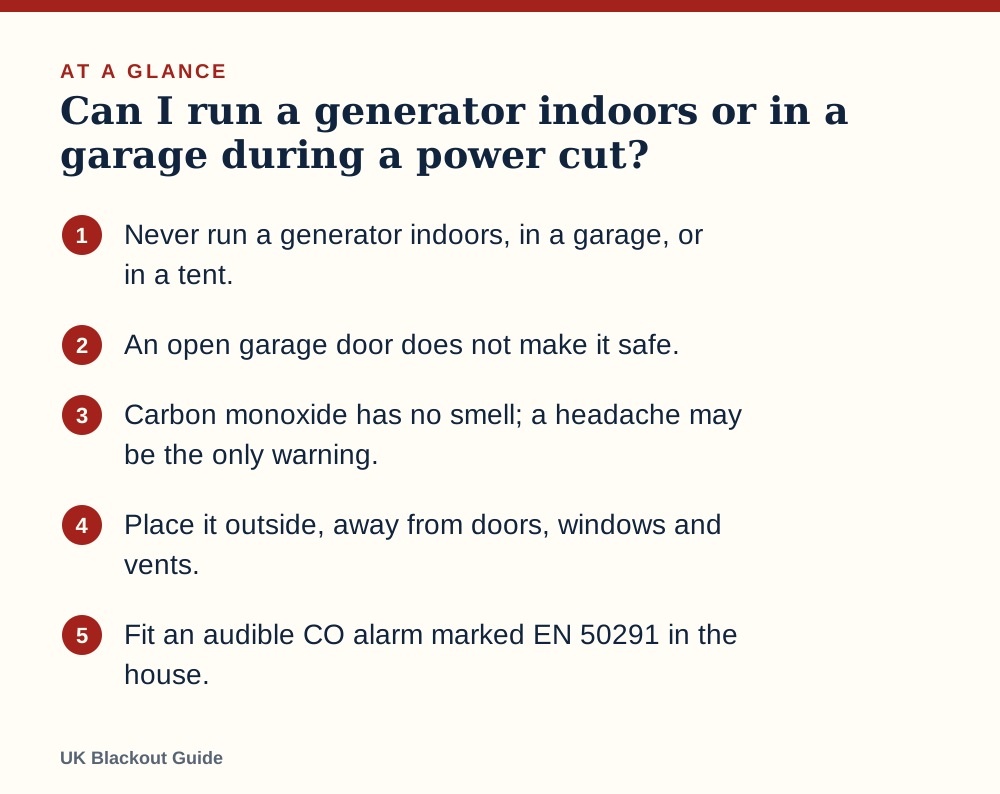
- Never run a generator indoors, in a garage, or in a tent.
- An open garage door does not make it safe.
- Carbon monoxide has no smell; a headache may be the only warning.
- Place it outside, away from doors, windows and vents.
- Fit an audible CO alarm marked EN 50291 in the house.
Why an open door is not enough
A petrol generator produces carbon monoxide (CO) continuously while it runs. Outdoors, the gas disperses. Inside four walls it accumulates faster than a doorway can clear it, and it drifts through connecting doors, gaps and floor voids into the rooms where people are sitting or sleeping.
That is why the rule covers garages as firmly as kitchens. A garage attached to the house is the most common place people are tempted to use, because it is dry and the generator is already stored there. The official guidance is plain: never use generators, barbecues, camping stoves or patio heaters indoors, in garages or in tents.
How carbon monoxide poisoning shows itself
You cannot see, smell or taste CO. The early symptoms are easy to mistake for tiredness or a virus: headache, dizziness, nausea and breathlessness. At higher levels people collapse and lose consciousness, sometimes before they realise anything is wrong.
If anyone feels unwell while a generator or any fuel-burning appliance is running, switch it off if you can do so quickly, get everyone into fresh air and call 999. For a suspected gas emergency, call 0800 111 999.
In a blackout the risk rises because people improvise in the dark and the cold. Carbon monoxide in power cuts covers every source, from generators to barbecues.
Where a generator can go
Outside, on firm level ground, as far from the house as your extension lead sensibly allows, with the exhaust pointing away from every door, window, air brick and vent, including your neighbours'. Keep windows on that side of the house shut.
A generator also has to stay dry, since it is making mains-voltage electricity. Use a purpose-made generator cover or an open-sided shelter with free air flow on all sides. A shed with the door open does not count. Let the engine cool before refuelling, and store the petrol can away from it, two of the points in the full generator safety checklist.
Run a heavy-duty outdoor extension lead from the generator to the appliances you need. Do not connect it to the house wiring through a socket: plugging a generator into a house socket is dangerous for a different reason.
An alarm is your backstop
Even with the generator outside, fumes can blow back in. An audible CO alarm in the room nearest the generator, and another where people sleep, gives a warning that your senses cannot.
Our list of the best carbon monoxide alarms explains the markings to look for.
The indoor-safe alternative
If you live in a flat, or have nowhere outdoors to put a generator, a battery power station is the option that can sit in your living room. It has no engine and no exhaust. It holds less energy than a tank of petrol, but it will run lights, a router and phone charging through a typical cut. Power station or generator compares the two. If you do have outdoor space, the generators we list for power cuts are quiet inverter models.
Common questions
Can I run a generator in a garage with the door fully open?
No. Carbon monoxide still builds up and can seep into the house. The generator must be fully outdoors.
Can I run a generator on a balcony?
It is not a safe place. Fumes can drift into your flat and your neighbours' through doors and windows. A battery power station is the better choice for a flat.
Will a carbon monoxide alarm make indoor use safe?
No. An alarm is a last line of defence for fumes that drift in from outside. It does not make it safe to run an engine in an enclosed space.
Reviewed against these sources on 18 November 2026. If official advice has changed since, follow the official advice.
General information only. This page is not professional, safety, medical, legal or financial advice, and it is not official guidance. No national blackout has been forecast or announced, and nothing here suggests one is expected. We are independent and have no connection to the government or any energy company. Anything involving electricity, gas, fuel or food safety should be checked with a qualified professional or the relevant official body before you act on it. Always check the official sources linked on this page. Full disclaimer
Keep reading
 Guide
Generator safety: carbon monoxide, fuel and wiring
How to use a generator safely in a power cut: where to put it, carbon monoxide, storing and handling petrol, wet weather and house wiring rules.
Read: Generator safety: carbon monoxide, fuel and Guide
Generators for home backup: types, cost and safety
The types of generator for home backup in the UK, what they really cost to own, how much they can run, and the safety rules you must follow.
Read: Generators for home backup: types, cost and Guide
Backup power for your home: every option compared
Power banks, power stations, generators, solar panels, cars and UPS units compared: what each can run in a UK power cut, for how long, and who needs which.
Read: Backup power for your home: every option Buying guide
Best car inverters for power cuts
Car inverters for power cuts: six units from Amazon UK listings that run a laptop, router or lamp from your car's 12V socket, with the limits explained.
Read: Best car inverters for power cuts