On this page
No. Never plug a generator into a house socket. Power can flow backwards through your wiring and out into the street cables, where it can kill an engineer repairing the fault, and it can wreck your generator and wiring when the mains returns. Either run extension leads straight to appliances or have an electrician fit a changeover switch.
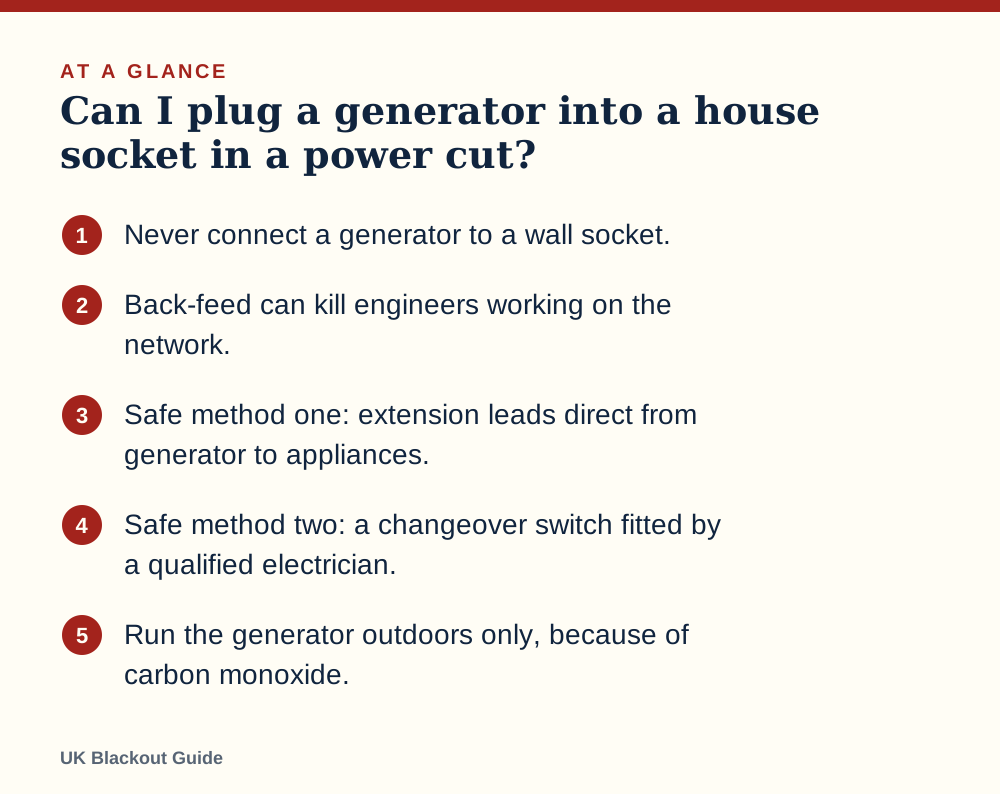
- Never connect a generator to a wall socket.
- Back-feed can kill engineers working on the network.
- Safe method one: extension leads direct from generator to appliances.
- Safe method two: a changeover switch fitted by a qualified electrician.
- Run the generator outdoors only, because of carbon monoxide.
What back-feed is and why it kills
Your house wiring is a two-way street. If you push power into a socket, it travels back through the consumer unit, out through the meter and into the cable in the road. The local transformer can then step your 230 volts up to thousands of volts on the lines beyond.
During a power cut, engineers work on lines that have been made dead. A generator plugged into a socket a few streets away can make those lines live again without anyone knowing. That is the reason for the rule, and it applies to every size of generator.
The risks inside your own home
The lead needed to do this has a plug on both ends. Once the generator is running, the pins of the loose plug are live and exposed. Touching them can be fatal.
The generator would also be trying to power every circuit in your house, and possibly your neighbours' houses, far beyond what it can supply. When the grid comes back, mains power meets generator power head on. The likely results are a destroyed generator, damaged wiring or a fire. Your fuses and RCDs are not designed to protect against a supply coming from the wrong direction.
Never make, buy or use a lead with a plug on both ends. There is no safe use for one.
Safe method one: extension leads to appliances
For most households, the answer is the simple one, and the best generators for power cuts are all models suited to it. Put the generator outside, run a heavy-duty outdoor extension lead in through a slightly opened window or letterbox, and plug appliances directly into it. The house wiring is never involved.
Unplug each appliance from its wall socket first, then plug it into the lead. A fridge-freezer, a few lamps, a router and phone chargers are a realistic load for a 2,000 W inverter generator. Add up the wattages using our list of appliance watts, and remember a fridge-freezer needs 600 W or more for a moment when it starts.
Safe method two: a changeover switch
If you want the generator to feed your house circuits, including a hard-wired gas boiler, the only safe route is a changeover (transfer) switch fitted by a qualified electrician. It physically disconnects your house from the grid before it connects the generator, so both can never be joined at once.
The electrician will also fit a proper inlet for the generator lead and advise which circuits the generator can carry. Have this done well before winter. It is not an emergency job. Generators for home backup explains what to ask for.
Wherever it is connected, it runs outside
Connection is one hazard and exhaust is the other. A generator must never run indoors or in a garage, because carbon monoxide has no smell and builds up fast.
Common questions
Is it safe if I switch off the main switch first?
No. It relies on nobody ever forgetting or flipping the switch back, and the live exposed plug remains. A changeover switch makes the mistake physically impossible.
Can I plug a portable power station into a wall socket to power the house?
No. The same back-feed danger applies to any power source. Plug appliances into the power station directly.
Who can fit a changeover switch?
A qualified, registered electrician. They will check your consumer unit, fit the switch and inlet, and test that the generator and mains can never be connected together.
Reviewed against these sources on 18 November 2026. If official advice has changed since, follow the official advice.
General information only. This page is not professional, safety, medical, legal or financial advice, and it is not official guidance. No national blackout has been forecast or announced, and nothing here suggests one is expected. We are independent and have no connection to the government or any energy company. Anything involving electricity, gas, fuel or food safety should be checked with a qualified professional or the relevant official body before you act on it. Always check the official sources linked on this page. Full disclaimer
Keep reading
 Guide
Backup power for your home: every option compared
Power banks, power stations, generators, solar panels, cars and UPS units compared: what each can run in a UK power cut, for how long, and who needs which.
Read: Backup power for your home: every option Buying guide
Best generators for power cuts
Petrol inverter generators for UK power cuts, from 1,200 W to 5,500 W, chosen from Amazon UK listings, with the carbon monoxide and wiring rules.
Read: Best generators for power cuts Guide
Generator safety: carbon monoxide, fuel and wiring
How to use a generator safely in a power cut: where to put it, carbon monoxide, storing and handling petrol, wet weather and house wiring rules.
Read: Generator safety: carbon monoxide, fuel and Guide
Generators for home backup: types, cost and safety
The types of generator for home backup in the UK, what they really cost to own, how much they can run, and the safety rules you must follow.
Read: Generators for home backup: types, cost and