On this page
For most UK homes a charged power bank per phone covers a typical power cut. A portable power station adds Wi-Fi, lamps, a laptop and medical devices for hours. A generator is the only portable option that runs heavy appliances for days, but it needs fuel, outdoor space and strict carbon monoxide precautions.
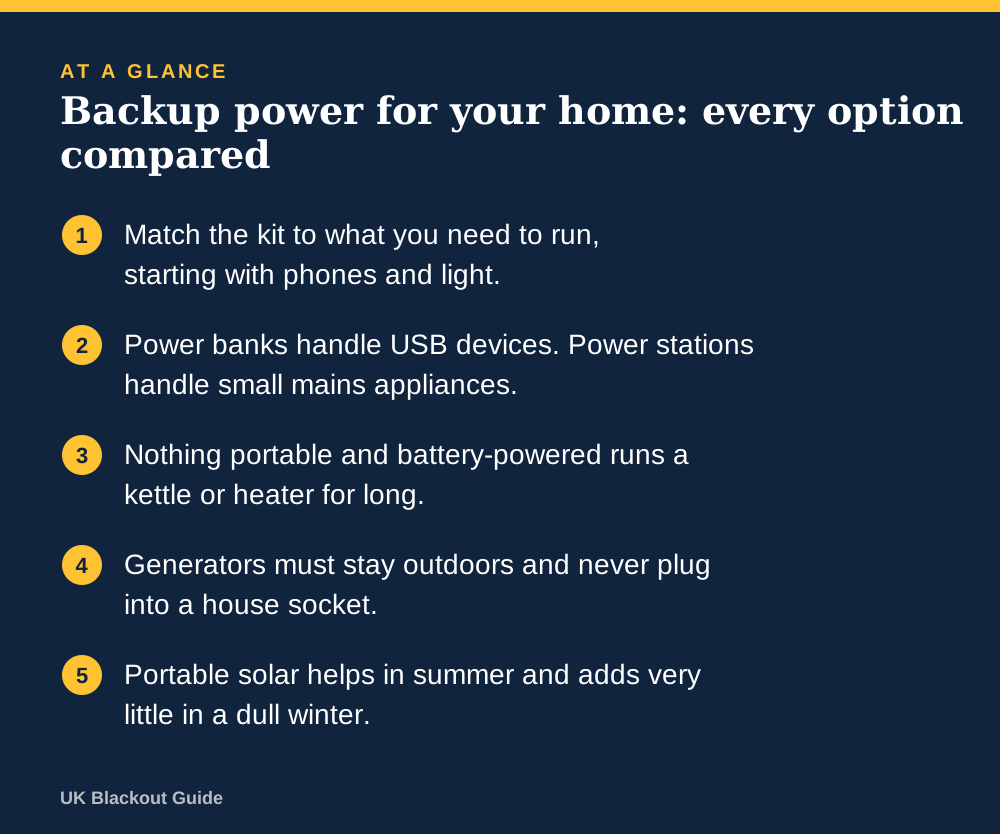
- Match the kit to what you need to run, starting with phones and light.
- Power banks handle USB devices. Power stations handle small mains appliances.
- Nothing portable and battery-powered runs a kettle or heater for long.
- Generators must stay outdoors and never plug into a house socket.
- Portable solar helps in summer and adds very little in a dull winter.
Start with what you need to keep running
Backup power is easier to choose if you ignore the products at first and write down what you would miss. For most households the list is short: phones, some light, the radio, perhaps the Wi-Fi router. A few homes add something that matters more, such as a CPAP machine, a fridge holding medicines or the pump and controls of a gas boiler.
The Be Ready campaign asks households to be able to manage for three days, and its kit list includes one backup power item: a charged power bank. Everything beyond that is a choice about comfort, work or medical need, not an official requirement.
Heat is the dividing line. A kettle draws 2,000 to 3,000 W and a fan heater about 2,000 W, which empties batteries in minutes. Plan on keeping warm without mains power by using layers and blankets, and save stored electricity for the low-power things it does well.
The options side by side
| Option | Good for | Typical endurance | Main limit |
|---|---|---|---|
| Power bank | Phones, USB lights, small radios | 3 to 4 phone charges from 20,000 mAh | USB devices only |
| Power station | Router, lamps, laptop, CPAP, sometimes a fridge | A 500 Wh unit runs a 12 W router for about 35 hours | Finite until recharged |
| Generator | Fridge-freezer, boiler controls, tools, several items at once | As long as you have fuel | Outdoors only, noise, fuel storage |
| Portable solar panel | Refilling a power station or power bank | 300 to 400 Wh on a clear summer day from 100 W | Often 30 to 80 Wh on a dull winter day |
| Car | Phone charging, a small inverter | Depends on fuel in the tank | Engine must run outdoors |
| UPS | Bridging short cuts for a router or PC | Minutes to a few hours | Small battery |
Power banks cover the official advice
A power bank is a battery with USB sockets. Once you know what mAh and watts mean on a power bank, the useful sum is simple: usable charges are roughly the capacity in mAh, times 0.65, divided by your phone's battery size. A 20,000 mAh bank gives about 3 to 4 charges of a typical phone, which is enough for one person to get through three days if they are careful with the screen.
One per adult is a sensible target, chosen by capacity from the power banks we recommend for power cuts.
Power stations run small mains appliances indoors
A portable power station is a much larger battery with 13 amp sockets as well as USB. It makes no fumes, so it can sit in the living room. Runtime in hours is roughly the capacity in watt-hours, times 0.85, divided by the watts you are drawing.
A 500 Wh unit therefore gives about 425 Wh of usable energy. That is around 7 hours of a 60 W laptop, or a full night of a 40 W CPAP machine with some to spare. The answer to whether a power station can boil a kettle is that a unit this size will not make tea.
Generators give the most power and ask the most of you
A petrol generator can run a fridge-freezer, boiler controls and lights together, and keeps going for as long as you can refuel it. That made generators valuable in rural areas after Storm Arwen in 2021, when some homes were off for more than a week.
Never run a generator indoors, in a garage or in a tent. Carbon monoxide has no smell and can kill. Never plug a generator into a house socket: connection to house wiring needs a changeover switch fitted by a qualified electrician.
Fuel is the other constraint and a large part of generator safety. HSE rules let you keep up to 30 litres of petrol at home in suitable containers, in a garage or shed.
Solar, cars and UPS units play supporting roles
A folding solar panel does not power anything directly with much reliability. Its job is to refill a battery, and portable solar charging in British weather swings with the season. In June a 100 W panel can put a useful 300 to 400 Wh into a power station; in December you may get 30 to 80 Wh.
Your car is a generator you already own for phone charging, as long as the engine runs outside and never in a garage. A UPS is different again: it switches over instantly, so it suits a router or desktop PC during short cuts.
A sensible order to buy in
Buy in the order of likelihood. Short local power cuts are far more common than long ones, and no national blackout is planned or predicted. A power bank each, a torch and a battery radio, as listed in our household emergency kit list, deal with the great majority of cuts.
Add one of our recommended portable power stations if you work from home, rely on a powered medical device, or simply want light and internet through an evening. Consider a generator only if you live somewhere that has seen multi-day cuts, have safe outdoor space, and are willing to store fuel and test the machine regularly.
Common questions
What is the cheapest useful backup power?
A power bank. It is the only backup power item on the official Be Ready kit list, and a 20,000 mAh model gives about 3 to 4 phone charges.
Can any battery backup run my heating?
A power station can run the controls and pump of a gas boiler, which draw about 100 to 150 W, if the boiler has a suitable plug or an electrician has fitted a safe connection. No portable battery will run electric heaters for long.
Is a home battery the same as a power station?
No. A home battery is wired into the house, usually alongside solar panels, and only works in a power cut if it was installed with backup capability.
Do I need backup power at all?
Most power cuts end within hours and can be handled with torches, a radio and a charged power bank. Larger kit is worth it mainly for medical equipment, home working or homes prone to long cuts.
Reviewed against these sources on 18 November 2026. If official advice has changed since, follow the official advice.
General information only. This page is not professional, safety, medical, legal or financial advice, and it is not official guidance. No national blackout has been forecast or announced, and nothing here suggests one is expected. We are independent and have no connection to the government or any energy company. Anything involving electricity, gas, fuel or food safety should be checked with a qualified professional or the relevant official body before you act on it. Always check the official sources linked on this page. Full disclaimer
Keep reading
 Question
Do I need a generator for a blackout?
Do you need a generator for a blackout? Most UK homes do not. It is not on the government's Be Ready list. When one makes sense, and the safer options.
Read: Do I need a generator for a blackout? Guide
Power station or generator: which is right for you?
Power station or generator for UK power cuts: how they differ on runtime, safety, noise and upkeep, and which suits flats, houses and rural homes.
Read: Power station or generator: which is right Guide
Do solar panels work in a power cut?
Why most UK rooftop solar switches off in a power cut, which battery systems keep working, and how portable panels can still give you power.
Read: Do solar panels work in a power cut? Question
Are power stations safe to use indoors in a power cut?
Battery power stations are safe to use indoors because they burn no fuel and give off no fumes. The sensible rules for charging, placing and storing one.
Read: Are power stations safe to use indoors in a