On this page
A portable power station is a large rechargeable battery with mains sockets and USB ports. It runs low-power appliances silently and safely indoors. Runtime in hours is roughly its watt-hours times 0.85, divided by the watts you draw, so a 500 Wh unit runs a 60 W laptop for about 7 hours.
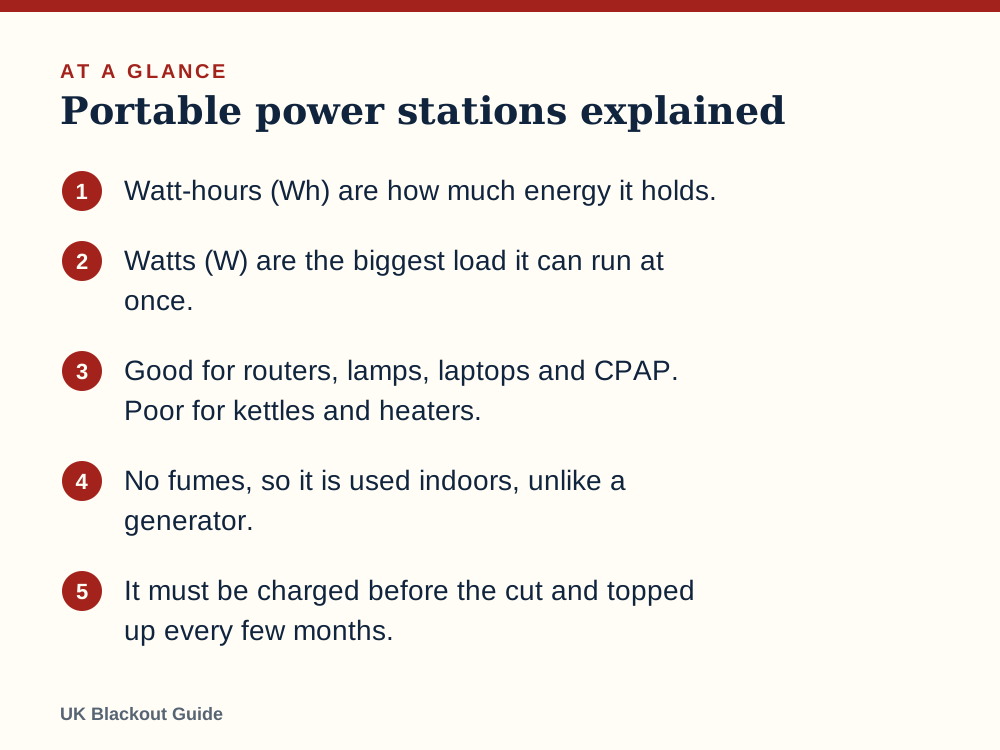
- Watt-hours (Wh) are how much energy it holds.
- Watts (W) are the biggest load it can run at once.
- Good for routers, lamps, laptops and CPAP. Poor for kettles and heaters.
- No fumes, so it is used indoors, unlike a generator.
- It must be charged before the cut and topped up every few months.
What is inside the box
A portable power station has three main parts. The battery stores energy as direct current. An inverter turns that into the 230 V alternating current your sockets normally supply. A charge controller manages power coming in from the wall, a car socket or a solar panel.
Around those sit the outlets: one or more 13 amp sockets, USB-A and USB-C ports, and often a 12 V car-style socket. A screen shows the charge left and the watts going in and out, which is the most useful feature of all in a power cut because it tells you how long you have.
Two numbers matter: watt-hours and watts
Watt-hours (Wh) are capacity, the size of the tank. Watts (W) are output, the width of the pipe. A unit described as 500 Wh and 600 W holds 500 Wh of energy and can supply up to 600 W at any moment.
You need both to be big enough. The watts must exceed whatever you plug in, or the unit will switch itself off, so it helps to know how many watts common appliances use. The watt-hours decide how long it lasts.
Many units also quote a surge or peak rating. This is the brief extra output available for a second or two while a motor starts. A fridge-freezer averages only 40 to 80 W but needs 600 W or more for that first kick, so the surge figure decides whether it starts at all.
Working out how long one will last
Not all the stored energy reaches your appliance. The inverter and electronics use some, so allow 85%. The sum is: capacity in Wh, times 0.85, divided by the watts of the device.
Take a 500 Wh station, which gives about 425 Wh of usable energy:
- Wi-Fi router at 12 W: about 35 hours
- LED lamp at 10 W: about 42 hours
- Laptop at 60 W: about 7 hours
- CPAP at 40 W without humidifier: about 10 hours
- Gas boiler controls and pump at 125 W: under 3.5 hours
Run several things together and you add the watts. A router, two lamps and a laptop come to about 92 W, which gives a little over 4.5 hours. That comfortably covers a rota cut of about three hours, and the same sum is how you go about choosing the right size of power station for your own home.
What a power station will not do
Anything that makes heat is a poor match, which is the short answer to whether a power station can run a heater. A kettle draws 2,000 to 3,000 W, which is beyond the output of small and mid-sized units. A 2,000 W fan heater on a large 2,000 Wh station would drain it in about 50 minutes.
The practical answer is to make heat another way and keep electricity for light, communication and medical needs. Blankets, layers and a hot water bottle filled from a flask do more for warmth than any battery.
A power station also does not power your house wiring. You plug appliances into it directly, using an extension lead if needed. Never try to feed one into a wall socket.
Battery chemistry, safety and where to keep it
Most current models use one of two lithium chemistries. LiFePO4 (lithium iron phosphate) cells are heavier for the same capacity but tolerate many more charge cycles and are considered more thermally stable. Other lithium-ion cells are lighter. For a unit that will mostly sit waiting for a power cut, LiFePO4 is a sensible default.
Because there is no engine, there is no exhaust and no carbon monoxide. That is the big advantage over a generator. Using a power station safely indoors still means keeping the unit on a hard, dry surface with space around its vents, away from bedding and radiators.
Look for a pure sine wave inverter, which gives power like the mains. Cheaper modified sine wave output can upset motors and some medical devices.
Recharging it during a long outage
From the wall, most units refill in a few hours, so a brief return of power between rota cuts is enough to recover a good part of the charge. Some can also charge from a car's 12 V socket while you drive, though slowly.
Solar input is the option for longer outages. A 100 W folding panel typically yields 300 to 400 Wh on a clear summer day, close to a full refill of a 500 Wh unit. On a dull winter day expect 30 to 80 Wh, enough for phones and a few hours of router time only.
In storage, lithium batteries slowly lose charge. Check the level every three months or so and follow the maker's advice on the level to store it at.
Who gets the most from one
Three groups benefit most. People who work from home through power cuts can keep a laptop and router going for a working day. Households with powered medical equipment gain a buffer, though you should follow your clinician's and equipment supplier's advice. And anyone wanting to protect a freezer through a long cut needs a large unit with a high surge rating.
If your needs stop at phones and a torch, a power bank is enough. For a freezer or a longer cut, look at the large power stations for fridges and longer cuts.
Common questions
Can I use a power station while it is charging?
Most allow this, which is called pass-through charging. Check the manual, as some makers advise against doing it routinely.
How long does a power station hold its charge in a cupboard?
Most lose charge slowly over months. Check every three months and top up so it is ready when a cut comes.
Is a power station the same as a UPS?
Not quite. A UPS switches over instantly when the mains fails. Only some power stations have a UPS mode fast enough to keep a desktop PC running without a restart.
Can I take a power station out in the rain to charge from solar?
Most are not waterproof. Keep the unit under cover and run the panel cable to it.
Reviewed against these sources on 18 November 2026. If official advice has changed since, follow the official advice.
General information only. This page is not professional, safety, medical, legal or financial advice, and it is not official guidance. No national blackout has been forecast or announced, and nothing here suggests one is expected. We are independent and have no connection to the government or any energy company. Anything involving electricity, gas, fuel or food safety should be checked with a qualified professional or the relevant official body before you act on it. Always check the official sources linked on this page. Full disclaimer
Keep reading
 Guide
Running a fridge or freezer on backup power
When a fridge or freezer needs backup power in a power cut, what size power station or generator will start one, and how long it will keep running.
Read: Running a fridge or freezer on backup power Guide
What size power station do I need?
A step-by-step way to size a portable power station for a UK power cut, with worked examples for home working, CPAP machines and fridge-freezers.
Read: What size power station do I need? Question
Are power stations safe to use indoors in a power cut?
Battery power stations are safe to use indoors because they burn no fuel and give off no fumes. The sensible rules for charging, placing and storing one.
Read: Are power stations safe to use indoors in a Buying guide
Best power stations to run a fridge freezer in a blackout
Large 1 to 3 kWh power stations that can start and run a fridge-freezer through a blackout, picked from Amazon UK listings with estimated runtimes.
Read: Best power stations to run a fridge freezer