On this page
A fridge-freezer averages 40 to 80 W but needs 600 W or more for a moment each time it starts. A 1,000 Wh power station with enough surge output runs one for roughly 14 hours, and a 2,000 Wh unit for about a day. For most short cuts, keeping the doors shut is enough.
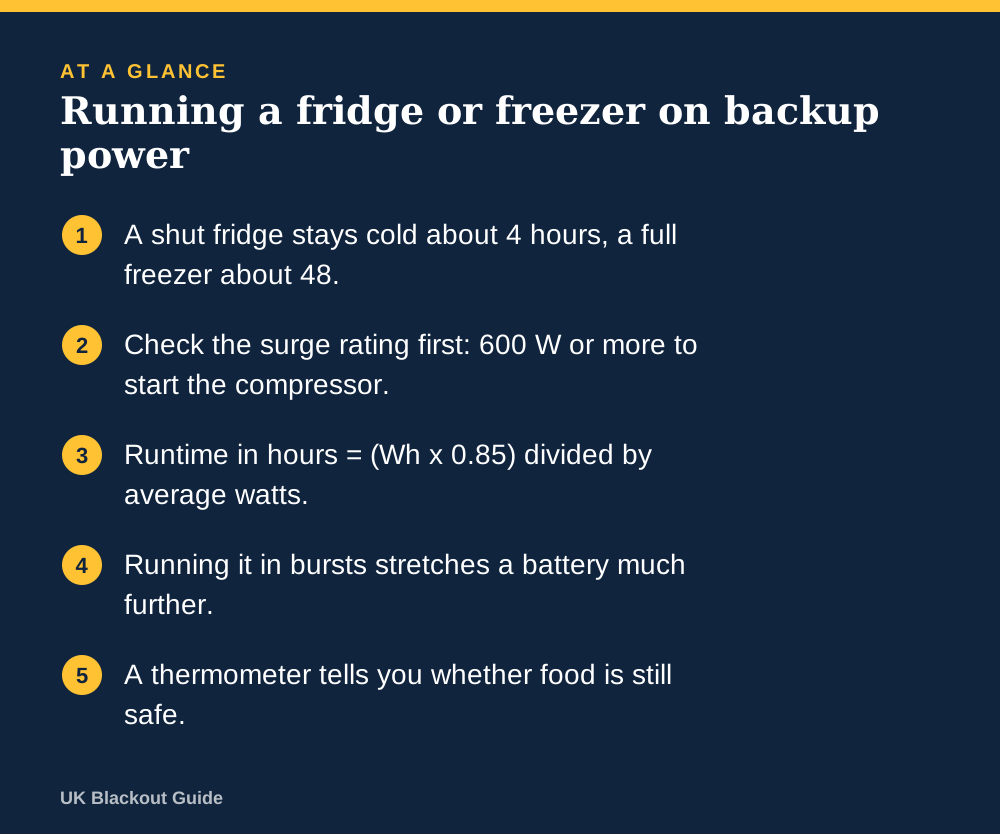
- A shut fridge stays cold about 4 hours, a full freezer about 48.
- Check the surge rating first: 600 W or more to start the compressor.
- Runtime in hours = (Wh x 0.85) divided by average watts.
- Running it in bursts stretches a battery much further.
- A thermometer tells you whether food is still safe.
Most power cuts need no backup at all
Start with what the appliance does by itself. According to the Food Standards Agency, a fridge should stay cold for around 4 hours if you leave the door shut. A full freezer typically stays frozen for about 48 hours, and a half-full one for about 24 hours.
That covers the great majority of UK power cuts, including a rota cut of about three hours. The best thing you can do in those is nothing: keep the doors closed and resist checking, which is also the first rule of food safety in a power cut.
Backup power becomes worth thinking about when a cut looks likely to run past those times, when the freezer holds a lot of food you cannot afford to lose, or when the fridge holds medicines. For medicines, follow your pharmacist's advice on keeping medicines cool without a fridge.
Why a fridge is harder to run than its wattage suggests
A fridge-freezer does not draw power steadily. Its compressor runs for a while, stops, then starts again when the temperature creeps up. Averaged over a day, most draw 40 to 80 W, which sounds easy.
The difficulty is the start. Each time the compressor kicks in, it needs a brief surge of 600 W or more. If your backup cannot deliver that, the fridge will click, fail to start and may trip the power source. A small power station with a 300 W output has plenty of energy for a fridge and still cannot run one.
So there are two tests. The continuous and surge output in watts must be high enough to start the compressor. The capacity in watt-hours then decides how long it runs.
How long a power station will run one
To see whether a power station can run a fridge for long enough, use the standard sum: capacity in Wh, times 0.85, divided by the average draw in watts.
| Power station | Usable energy | At 40 W average | At 60 W average | At 80 W average |
|---|---|---|---|---|
| 500 Wh | 425 Wh | 10.5 hours | 7 hours | 5 hours |
| 1,000 Wh | 850 Wh | 21 hours | 14 hours | 10.5 hours |
| 2,000 Wh | 1,700 Wh | 42 hours | 28 hours | 21 hours |
The 500 Wh row assumes the unit can produce the starting surge, which many of that size cannot. Check before relying on one, or choose from the large power stations built for the job. An old or large American-style fridge-freezer may also average more than 80 W. A plug-in energy monitor left on for a day will show you your own appliance's real average.
Run it in bursts, not continuously
You do not need to power the fridge for every hour of a cut. A well-filled freezer has a great deal of stored cold, and the aim is only to top that up before it runs out.
A practical pattern is to leave the appliance unpowered with the doors shut, then connect the backup for an hour or two a few times a day so the compressor can pull the temperature back down. If you run it for 2 hours in every 8, a 60 W average over those running periods uses far less than the 1,440 Wh a full day would take, although the compressor will work harder than usual while it catches up.
This only works safely if you can see the temperature on a fridge and freezer thermometer. The fridge should stay at 5°C or below.
Using a generator instead
For a cut lasting several days, a generator is the more realistic way to save a freezer, because it keeps going as long as you have fuel. A 2,000 W inverter generator starts a domestic fridge-freezer without difficulty and can charge power banks and run lamps at the same time.
The burst method suits a generator well. A couple of hours morning and evening re-chills the freezer and saves fuel, and you can keep the machine switched off overnight.
The first of the generator safety rules is that it must run outdoors, never in a garage or porch, because of carbon monoxide. Run an outdoor-rated extension lead to the fridge and never plug the generator into a house socket.
Connecting the fridge safely
Pull the fridge out carefully and plug it directly into the power station, or into a single good-quality extension lead, fully unwound. Avoid thin, long leads, which can drop the voltage enough to stop the compressor starting.
If the compressor has just stopped, wait several minutes before reconnecting. Starting again straight away against built-up pressure makes the surge even higher. Many fridges have a built-in delay for this reason.
Put only the fridge on the backup while it starts. Once it is running, small loads such as phone chargers can share the output.
When backup is not available or runs out
If you have no backup, or it is exhausted, you still have options. Move the most valuable chilled food into a cool box with ice packs or frozen food from the freezer. In winter, an unheated room or a secure box outdoors may be colder than the dead fridge.
For the freezer, pack gaps with newspaper or towels, cover the cabinet with blankets (keeping vents clear if it may restart), and keep the lid shut, the basics of saving a freezer in a long power cut.
If food does spoil, the FSA's rule is simple: if in doubt, throw it out. Some home insurance policies cover freezer contents, so it is worth checking whether your insurance covers freezer food.
Common questions
Will a 300 W power station run a mini fridge?
Possibly, if the mini fridge's starting surge is within the power station's peak rating. Check both figures, as even small compressors need several times their running watts to start.
Should I turn the fridge to its coldest setting before a planned cut?
Lowering the setting a few hours beforehand and filling empty freezer space with bottles of water gives you more stored cold. Do not set the fridge so low that fresh food freezes.
Can I run the fridge from my car with an inverter?
Not through the dashboard socket, which supplies far less than the 600 W or more a fridge needs to start.
Is it worth buying a power station just for the freezer?
Compare the cost with the value of what is in the freezer and how often you have long cuts. For many homes, keeping the door shut for 48 hours is enough.
Reviewed against these sources on 18 November 2026. If official advice has changed since, follow the official advice.
General information only. This page is not professional, safety, medical, legal or financial advice, and it is not official guidance. No national blackout has been forecast or announced, and nothing here suggests one is expected. We are independent and have no connection to the government or any energy company. Anything involving electricity, gas, fuel or food safety should be checked with a qualified professional or the relevant official body before you act on it. Always check the official sources linked on this page. Full disclaimer
Keep reading
 Guide
Portable power stations explained
How portable power stations work, what watt-hours and watts mean, what one can and cannot run in a UK power cut, and the features that matter.
Read: Portable power stations explained Guide
What size power station do I need?
A step-by-step way to size a portable power station for a UK power cut, with worked examples for home working, CPAP machines and fridge-freezers.
Read: What size power station do I need? Question
Are power stations safe to use indoors in a power cut?
Battery power stations are safe to use indoors because they burn no fuel and give off no fumes. The sensible rules for charging, placing and storing one.
Read: Are power stations safe to use indoors in a Buying guide
Best power stations to run a fridge freezer in a blackout
Large 1 to 3 kWh power stations that can start and run a fridge-freezer through a blackout, picked from Amazon UK listings with estimated runtimes.
Read: Best power stations to run a fridge freezer