On this page
Leave refrigerated medicines in the fridge with the door shut. An unopened fridge should stay cold for around four hours. If the cut lasts longer, move them to a cool box with ice packs, wrapped so they cannot freeze, and note the times. Before using or binning anything that got warm, ask your pharmacist or NHS 111.
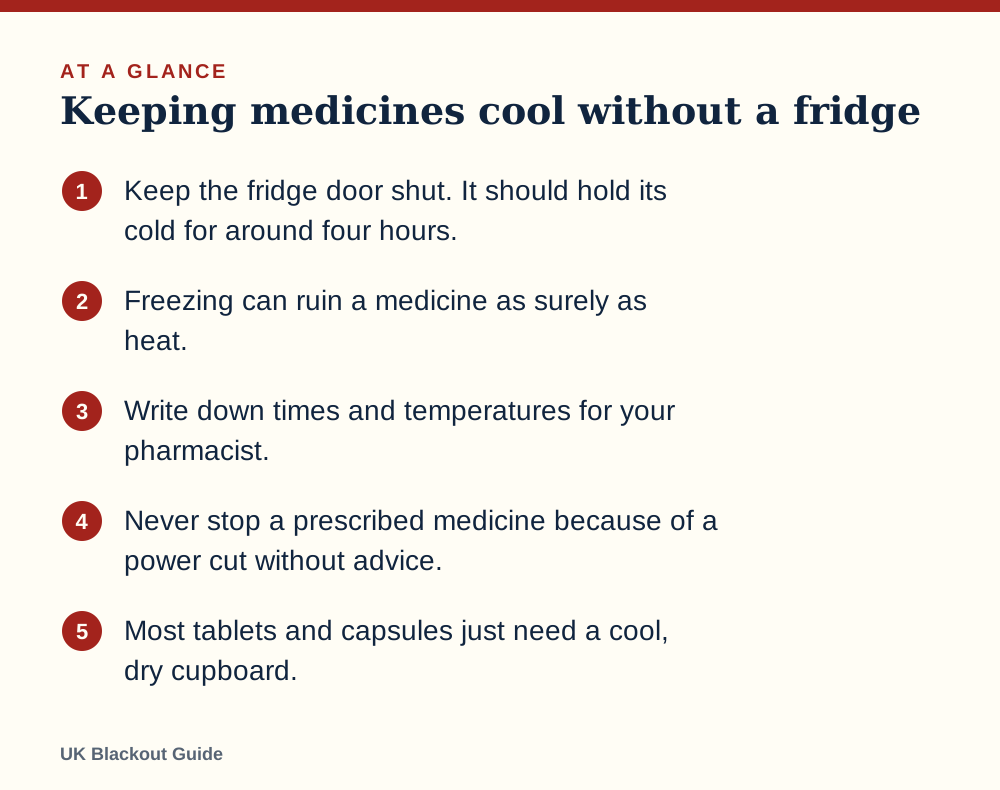
- Keep the fridge door shut. It should hold its cold for around four hours.
- Freezing can ruin a medicine as surely as heat.
- Write down times and temperatures for your pharmacist.
- Never stop a prescribed medicine because of a power cut without advice.
- Most tablets and capsules just need a cool, dry cupboard.
Which medicines this affects
Most medicines in a typical home are tablets, capsules and inhalers that live in a cupboard. A power cut makes no difference to them unless the house becomes very hot or damp.
The ones to think about are those labelled 'store in a refrigerator'. Common examples include insulin, some other injectable medicines, certain eye drops, some liquid antibiotics once made up, and some vaccines held at home for a clinic visit. The label or the leaflet in the box will say. If you are not sure, ask your pharmacist now and write 'fridge' on your medication list.
Fridge medicines are normally kept between 2°C and 8°C. The printed leaflet often says what happens outside that range, and whether a short spell at room temperature is acceptable. Keep the leaflet, because you may not be able to look it up online during a cut.
The first four hours: do nothing
The Food Standards Agency says a fridge should stay cold for around four hours if the door stays shut. That guidance is written for food, but the physics is the same for the medicine shelf. Every time the door opens, cold air falls out.
So for a short cut, the best thing to do is leave the medicines where they are. Take out the dose you need in one quick visit, and tell the rest of the household not to open the door for milk. The same rule protects your food, as explained in how long food lasts in a fridge without power.
A fridge and freezer thermometer turns guesswork into a number. The kind with a display outside the door, or a maximum and minimum memory, lets you see how warm it got without opening anything.
After four hours: move them to a cool box
If there is no sign of the power returning, move the medicines to an insulated cool box with frozen ice packs from the freezer. This is the point where people make the most common mistake, which is putting the medicine directly against the ice.
Do not let medicines freeze. Many injectable medicines, including insulin, are damaged by freezing and must not be used afterwards. Wrap ice packs in a tea towel and keep the medicine in its box, away from direct contact.
Put the thermometer in with them if you can. Keep the cool box in the coolest room, out of sunlight and off a warm floor. In winter an unheated room may already be cool, but do not leave medicines on an outside windowsill or in a car, where they can freeze overnight or be taken.
Longer cuts and powered options
Ice packs run out. If you depend on a refrigerated medicine and want cover for a day or more, there are two powered routes.
The first is a small compressor portable fridge that runs from a 12-volt supply or a portable power station. These draw little power once cold and hold a set temperature, which an ordinary thermoelectric 'cooler' cannot do reliably in a warm room.
The second is running the kitchen fridge on backup power from a battery. That takes a larger power station than most people expect because of the surge when the compressor starts.
There is also a third route that needs no power. A relative, neighbour or pharmacy in an area that still has electricity may be able to hold your medicine in their fridge. Work out who that could be before you need them.
Hot weather changes the picture
A cut in July is harder on medicines than a cut in January. Room temperature medicines are usually meant to be kept below 25°C, and a closed-up house during a power cut in a heatwave can pass that. Move them to the coolest, darkest spot you have, low down and away from windows.
If a medicine got warm or froze
Do not guess, and do not throw it away on your own judgement either. Write down three things: what the medicine is, how long it was out of the fridge and the warmest or coldest temperature you recorded. Then ring your pharmacist, or NHS 111 if the pharmacy is shut.
They can check the manufacturer's stability information and tell you whether it is still usable. Sometimes it is fine. Sometimes it needs replacing, and they can arrange an emergency supply.
Do not skip or delay a prescribed dose because you are unsure about storage without getting advice first. If someone becomes unwell and you think it is linked to a missed or damaged medicine, call 111, or 999 in an emergency.
Set this up before the next cut
Keep two ice packs permanently in the freezer and a cool box where you can find it in the dark. Mark fridge medicines on your written medication list, which is one part of wider planning for medical needs in a power cut.
If insulin is the medicine you depend on, the steps for keeping insulin cool without power are worth learning now, while the fridge is still running.
Common questions
Can I put medicine outside in winter to keep it cold?
It is risky. Outdoor temperatures swing and can drop below freezing, which damages many medicines. A cool box indoors with wrapped ice packs is easier to control.
Can I use medicine that has been frozen by accident?
Assume not until a pharmacist tells you otherwise. Freezing can damage a medicine without changing how it looks.
Do tablets need special storage in a power cut?
Usually not. Keep them in their packaging in a cool, dry place away from direct heat and sunlight.
Reviewed against these sources on 18 November 2026. If official advice has changed since, follow the official advice.
General information only. This page is not professional, safety, medical, legal or financial advice, and it is not official guidance. No national blackout has been forecast or announced, and nothing here suggests one is expected. We are independent and have no connection to the government or any energy company. Nothing here is medical advice: follow your own clinician, pharmacist or equipment supplier. Always check the official sources linked on this page. Full disclaimer
Keep reading
 Question
How do I keep insulin cool without power?
How to keep insulin cool in a power cut: leave the fridge shut, when to move it to a cool box, why it must never freeze and who to ask if it gets warm.
Read: How do I keep insulin cool without power? Buying guide
Best battery smoke alarms that work in a power cut
Battery smoke alarms that work in a power cut, chosen from Amazon UK listings on sealed battery life, stated standards, pack size and buyer ratings.
Read: Best battery smoke alarms that work in a Buying guide
Best CPAP battery backups for power cuts
CPAP battery backups for a power cut at night, chosen from Amazon UK listings on stated watt-hours, voltage and machine compatibility, with runtime maths.
Read: Best CPAP battery backups for power cuts Buying guide
Best rechargeable fans for a summer power cut
Rechargeable fans that run from their own battery in a summer power cut and top up from a power bank. Seven Amazon UK listings compared on stated runtime.
Read: Best rechargeable fans for a summer power cut