On this page
If you rely on powered medical equipment, plan before a cut happens. Ask whoever supplied the device what it does when the mains fails and how long any built-in battery lasts, join the free Priority Services Register, and agree a backup plan with your clinician. If a cut puts someone's health in immediate danger, call 999.
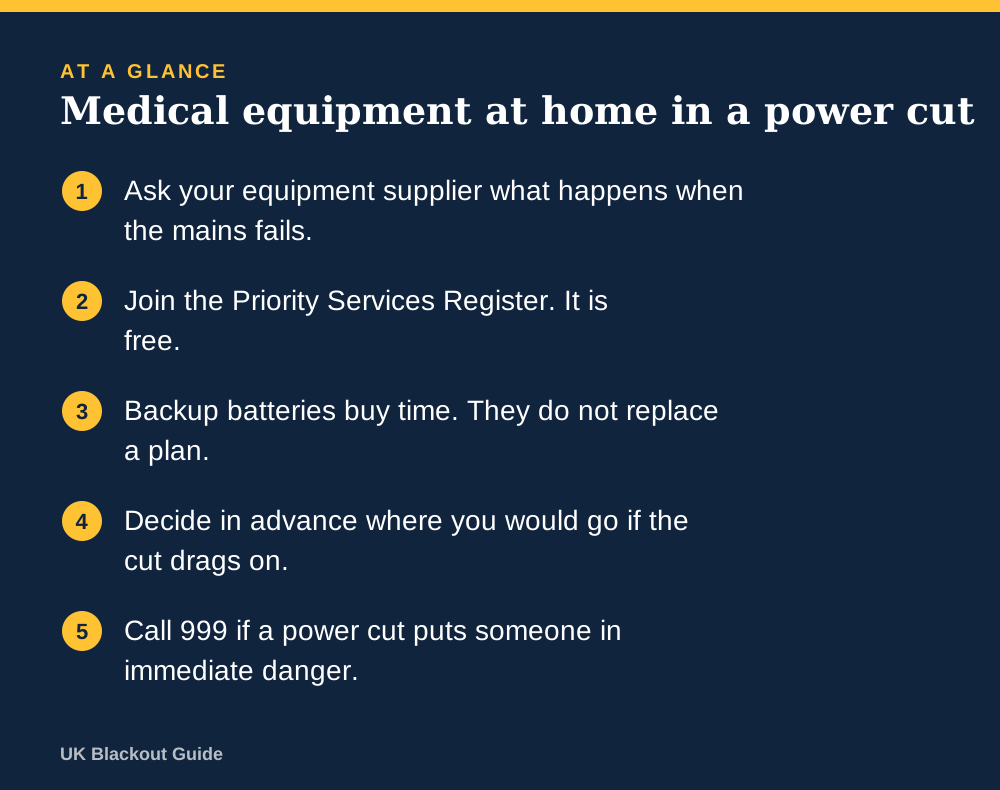
- Ask your equipment supplier what happens when the mains fails.
- Join the Priority Services Register. It is free.
- Backup batteries buy time. They do not replace a plan.
- Decide in advance where you would go if the cut drags on.
- Call 999 if a power cut puts someone in immediate danger.
Sort your equipment into three groups first
Not every device is equally urgent. Before you buy anything, write down each piece of powered equipment in the house and put it in one of three groups. Your clinical team or equipment supplier can tell you which group a device belongs in if you are unsure.
| Group | Examples | What a cut means |
|---|---|---|
| Cannot stop | Ventilators, some oxygen equipment, feeding pumps, home dialysis | You need a backup that takes over straight away, and a plan agreed with your care team |
| Can pause for a while | CPAP, nebulisers, airflow mattresses, hoists, medicine fridges | A few hours is usually manageable with preparation, but ask how long is safe for you |
| Runs on its own battery | Powerchairs, mobility scooters, many stairlifts, insulin pumps | Keeps working until its battery runs down, so charging is the issue |
The table is a starting point, not medical advice. The same machine can be a convenience for one person and life-sustaining for another.
Five questions for whoever supplied the device
The NHS service, hospital team or company that provided your equipment knows it far better than any website. Ring them on an ordinary weekday, not during a storm, and ask:
- Does it have a built-in battery, and roughly how long does it last at my settings?
- What does it do when power returns? Does it restart by itself or need resetting?
- Is there an approved external battery, and can it run from a portable power station?
- How many watts does it draw? (You need this for any backup sums.)
- Who do I call out of hours if it stops working?
Write the answers on a card and tape it to the machine. Add the out-of-hours number to the written contact list that the government's Be Ready campaign asks every household to keep.
Each type of machine behaves differently, and home oxygen in a power cut is the clearest case for getting these answers from your supplier in advance.
Register for priority help
The Priority Services Register is free and open to anyone who relies on powered medical equipment. In England, Scotland and Wales you can sign up at thepsr.co.uk or through your supplier or network operator. Northern Ireland has Customer Care Registers that do the same job.
Registration means your network operator knows you are there. You should get notice of planned work, and in a long fault they can prioritise welfare contact. It does not keep your power on, and it does not promise you are reconnected first. Treat it as one layer of your plan.
Know the moment the power fails
A cut at 2am can go unnoticed for hours. That matters if a medicine fridge is warming up, an airflow mattress is slowly deflating or a device has switched to a small internal battery.
A plug-in power failure alarm solves this cheaply. It sits in a socket and sounds when the mains drops.
Backup power: do the sums before you buy
A portable power station is a large rechargeable battery with ordinary sockets. It is silent, produces no fumes and is safe to use indoors, which a generator never is. A rough runtime in hours is the station's watt-hours multiplied by 0.85, divided by the watts your device draws.
So a 500 Wh station running a 50 W machine gives about eight and a half hours on paper. That is the sum behind running a CPAP machine through a power cut. Real figures vary with settings, heaters, humidifiers and the age of the battery, so check the number with your supplier and test it on a normal night.
Some devices have a battery made for them, and for sleep apnoea machines a purpose-built CPAP battery backup is the usual example.
Never run a petrol generator indoors, in a garage or near an open window to power medical equipment. Carbon monoxide has no smell and can kill. Never use candles or any naked flame near oxygen.
Plan where you would go
Batteries buy hours, not days. Most power cuts are fixed within a few hours, but Storm Arwen in November 2021 left some rural homes off for more than a week. Agree in advance where you would go if the power is not coming back soon: a relative in a different area, a friend with power, or wherever your care team advises.
Pack a small bag with the device, its leads and mask or tubing, medicines, your written prescription list and the supplier's number. If medicines need to stay cold, add whatever you use for keeping medicines cool without a fridge.
Remember the equipment around the equipment. A stairlift may run on its own battery for a few trips, while an electric bed or hoist may be stuck in position. Ask about manual overrides.
When to call for help
Report the cut on 105 (03457 643643 in Northern Ireland) and tell the operator that someone in the house depends on medical equipment. For advice that is not an emergency, use your care team's number or NHS 111.
Call 999 if someone is struggling to breathe, a life-sustaining device has stopped, or you cannot keep the person safe. Do not wait to see if the power returns. Work out beforehand how you would go about reaching 999 during a power cut, whether by mobile, landline or text.
Checklist
Medical equipment at home in a power cut
- List every powered medical device in the home
- Ask the supplier about built-in battery life and wattage
- Tape the out-of-hours number to each machine
- Join the Priority Services Register
- Fit a power failure alarm
- Test any backup battery on a normal night
- Agree where you would go in a long cut
- Keep a go-bag with leads, medicines and prescription list
Common questions
Will my power be restored first if I use medical equipment?
No. Being on the Priority Services Register means your network operator knows about you and can offer support, but faults are fixed in the order the network allows.
Can I use a generator for medical equipment?
Only outdoors, well away from doors and windows, and only if the equipment supplier says the device can run from one. A battery power station is the safer choice for use inside the home.
Does the NHS provide backup batteries?
It depends on the device and the service that supplied it. Some equipment comes with a backup as standard. Ask your equipment supplier or clinical team what you are entitled to.
Should I go to hospital in a power cut?
Follow the plan agreed with your care team. If someone's health is in immediate danger, call 999. Otherwise NHS 111 can advise.
Reviewed against these sources on 18 November 2026. If official advice has changed since, follow the official advice.
General information only. This page is not professional, safety, medical, legal or financial advice, and it is not official guidance. No national blackout has been forecast or announced, and nothing here suggests one is expected. We are independent and have no connection to the government or any energy company. Nothing here is medical advice: follow your own clinician, pharmacist or equipment supplier. Always check the official sources linked on this page. Full disclaimer
Keep reading
 Question
How do I run a CPAP machine in a power cut?
How to keep a CPAP machine running in a power cut using a dedicated battery or portable power station, how to estimate runtime and what to ask your clinic.
Read: How do I run a CPAP machine in a power cut? Buying guide
Best CPAP battery backups for power cuts
CPAP battery backups for a power cut at night, chosen from Amazon UK listings on stated watt-hours, voltage and machine compatibility, with runtime maths.
Read: Best CPAP battery backups for power cuts Buying guide
Best power cut alarms for freezers and medical equipment
Power cut alarms that sound or send an alert when the mains drops, for freezers, fish tanks and medical equipment. Four Amazon UK listings compared.
Read: Best power cut alarms for freezers and Question
Powered wheelchairs and mobility scooters in a power cut: what to plan for
Whether a powerchair or mobility scooter needs backup power in a power cut, how to stay charged, charging from a power station and what else to plan for.
Read: Powered wheelchairs and mobility scooters in