On this page
For most homes a power station of about 1,000 Wh is the right size for a power cut: it runs a router, lights, phones and a laptop for a day or more, and can keep a fridge-freezer going for several hours. If you only need Wi-Fi, phones and a lamp, a 300 Wh unit at around £200 is enough.
- Wh is how long it lasts. W is what it can run.
- Runtime in hours = Wh x 0.85, divided by the device's watts.
- A UPS function means it takes over by itself when the mains fails.
- Power stations are safe indoors. Petrol generators are not.
- Keep it charged, and top it up every few months.
A portable power station is a large rechargeable battery with ordinary mains sockets on the front. It is silent, makes no fumes and can be used in the living room, which is why it has become the default power cut backup for flats and family homes. How they work is covered in portable power stations explained.
This list is ordered for power cuts, not camping. It favours units sold for home backup, ones that switch over automatically, and bundles with a solar panel that can add charge when the mains stays off. The right one depends on what you want to keep on, so do the sums in what size power station you need before spending several hundred pounds. If you are weighing a battery against petrol, see power station versus generator.
Our picks for a power cut, at a glance


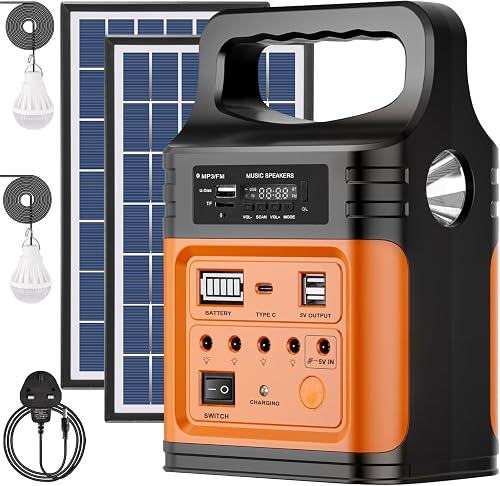
Anker SOLIX C1000 Gen 2, 1024Wh 2000W
★ 4.7 from 1,700 buyers · About £599 when checked 18 November 2026The listing gives 1,024 Wh and a 2,000 W output. By the standard sum that is about 70 hours for a 12 W router, or about 14 hours for a fridge-freezer averaging 60 W. It is rated 4.7 from about 1,700 buyers, the most on this list, and costs about £600.
- 2,000 W output handles most single appliances
- Strong rating from a large number of buyers
- Capacity suits a cut lasting a day
- A 2,000 W appliance would drain it in under half an hour
Anker SOLIX S2000, 2010Wh 1500W, UPS
★ 4.7 from 485 buyers · About £849 when checked 18 November 2026The listing describes a 10 ms UPS function and is sold for home backup. That means it can sit between the wall and your router, computer or fridge and take over when the mains fails, with nobody needing to find it in the dark. With 2,010 Wh listed, it would run a 12 W router and a 55 W laptop for roughly 25 hours. Rated 4.7 from about 485 buyers, at about £850.
- Built-in UPS switchover
- About 2 kWh of storage
- High rating
- 1,500 W output is lower than some 2 kWh rivals
- A large outlay
BLUETTI Elite 200 V2 with 200W Solar Panel, 2073.6Wh
★ 4.7 from 251 buyers · About £1198 when checked 18 November 2026This bundle pairs a 2,073.6 Wh LFP power station with a 200 W panel, and the title names power outages among its uses and lists two 2,600 W AC outlets. The extra money buys roughly twice the storage of the 1 kWh picks and a way to add charge with no mains. Rated 4.7 from about 250 buyers, at about £1,200.
- About 2 kWh with a 200 W panel included
- 2,600 W outlets listed
- High rating
- The dearest pick here
- On a dull winter day a panel adds little, so it stretches the battery and does not replace the mains
Jackery Solar Generator 1000 v2 with 100W Panel
★ 4.6 from 142 buyers · About £699 when checked 18 November 2026A 1 kWh power station sold with a 100 W panel, so the connectors are certain to match. Rated 4.6 from about 140 buyers at about £700. In the UK a 100 W panel typically adds 300 to 400 Wh on a clear summer day and far less in winter.
- Panel included and compatible
- 1 kWh capacity
- One panel will not refill it in a day, even in summer
- Fewer ratings than the Anker
EcoFlow DELTA 3 Classic, 1024Wh LiFePO4
★ 4.3 from 169 buyers · About £499 when checked 18 November 2026The listing gives 1,024 Wh and a LiFePO4 battery for about £500, which is the lowest price here for a full kilowatt-hour. By the standard sum that is about 70 hours of router time or about 14 hours for a fridge-freezer averaging 60 W. Rated 4.3 from about 170 buyers.
- Lowest price for 1 kWh on this list
- LiFePO4 battery
- Output wattage is not in the title, so confirm it on the listing
- Rating is lower than the Anker picks
ALLPOWERS R600, 299Wh 600W LiFePO4
★ 4.2 from 1,100 buyers · About £200 when checked 18 November 2026At around £200 this covers the basics of an evening without power. The listed 299 Wh works out at about 21 hours for a 12 W router, or four to five hours of laptop charging at 55 W. The listing states a LiFePO4 battery. Rated 4.2 from about 1,100 buyers.
- Low price
- LiFePO4 battery chemistry
- 600 W output is plenty for electronics
- Too small for a fridge-freezer for any useful time
- Rating is lower than the Anker and Jackery picks
75Wh LiFePO4 Power Station, 12V 9V USB-C, 10W Panel
★ 4.0 from 212 buyers · About £96 when checked 18 November 2026A small unit listed at 75 Wh with 12 V, 9 V and USB-C outputs and a 10 W solar panel, at under £100. Many routers run on 12 V, so check the label on yours. By the standard sum, 75 Wh is about five hours for a 12 W router. Rated 4.0 from about 210 buyers.
- Low price
- Low-voltage outputs suit routers and phones
- Small panel included
- No mains socket is mentioned in the title, so it will not run ordinary plug-in appliances
- A 10 W panel adds very little in a UK winter
- Middling 4.0 rating
How we chose
These were chosen from Amazon UK listings on 18 November 2026 on the capacity and output stated in each listing, the price and the verified buyer ratings. This site has not hands-on tested any of them. Runtimes below are estimates worked out from the listed capacity, not measurements. Prices on power stations move a lot with sales, so check the listing.
Do the runtime sum before you choose
Runtime in hours is roughly the capacity in Wh times 0.85, divided by the watts your device draws. A router takes 10 to 15 W, an LED lamp 5 to 10 W, phone charging 10 to 20 W and a laptop 45 to 65 W. Add up what you want on at once and divide.
The things that eat batteries are anything that makes heat. A kettle takes 2,000 to 3,000 W and a fan heater 2,000 W, so even a 1,000 Wh unit lasts minutes, as explained in whether a power station can run a heater.
Check the output watts as well as the capacity
Output in watts is the limit on what you can plug in at one time. Electronics need very little. A fridge-freezer averages only 40 to 80 W but needs a surge of 600 W or more to start its compressor, so a small 300 W unit will not start one. If keeping food cold is the main goal, look at the bigger units in the large power stations for fridges and freezers list.
Listings often quote a peak or surge figure alongside the continuous one. Use the continuous figure when deciding what you can leave running.
Battery chemistry and storage
Many newer power stations use LiFePO4 cells, which are generally rated for more charge cycles than older lithium-ion types. There is a plain explanation in what LiFePO4 means. Whatever the chemistry, a power station only helps if it is charged. Store it indoors at room temperature, top it up every three months and recharge after any use.
Power stations burn nothing and are fine to use in a living room, with the usual care for any large battery. The details are in whether power stations are safe indoors.
Recharging during a long cut
Once it is empty, a power station needs the mains, a car socket or a solar panel. In the UK a 100 W panel yields roughly 300 to 400 Wh on a clear summer day and often 30 to 80 Wh on a dull winter day, so solar stretches a battery in summer but will not carry you through December. Backup power options compared sets out when a generator makes more sense.
During rota cuts of about three hours at a time, the simpler answer is to recharge from the wall each time the mains comes back.
How much to spend on a power station for a power cut
At the budget end, £100 to £250 buys 75 to 300 Wh. That keeps a router, phones and a lamp going for an evening or a night, which covers a rota cut of about three hours many times over. It will not run a fridge-freezer for a useful time.
The middle tier, about £500 to £700, buys roughly 1,000 Wh and, on most models, enough output for a single large appliance. This is the size that carries a household through a day, and the bundles in this band add a panel.
The high end, £850 to £1,200, buys about 2,000 Wh, UPS switchover or a larger panel. It is worth it if you work from home, need to protect a full freezer or live where cuts last days. For a household whose cuts are short, it is overkill, and the difference would be better spent on the rest of the kit.
Common questions
Can I use a power station indoors?
Yes. It burns no fuel and gives off no fumes. Keep it on a hard surface away from heat and do not cover it.
Will a 1,000 Wh power station run my fridge-freezer?
For roughly 10 to 20 hours, depending on the appliance, provided its output can handle the 600 W or more starting surge.
Can it power my gas boiler?
Boiler controls and pump take 100 to 150 W, but most boilers are hard-wired. Any connection to fixed wiring needs a qualified electrician.
How long does a power station hold its charge?
Months, with slow loss. Check and top it up every three months.
Reviewed against these sources on 18 November 2026. If official advice has changed since, follow the official advice.
General information only. This page is not professional, safety, medical, legal or financial advice, and it is not official guidance. No national blackout has been forecast or announced, and nothing here suggests one is expected. We are independent and have no connection to the government or any energy company. Products are chosen from retailer listings and buyer ratings and have not been tested by us; some links earn us a commission. Anything involving electricity, gas, fuel or food safety should be checked with a qualified professional or the relevant official body before you act on it. Always check the official sources linked on this page. Full disclaimer
Keep reading
 Question
Are power stations safe to use indoors in a power cut?
Battery power stations are safe to use indoors because they burn no fuel and give off no fumes. The sensible rules for charging, placing and storing one.
Read: Are power stations safe to use indoors in a Guide
Backup power for your home: every option compared
Power banks, power stations, generators, solar panels, cars and UPS units compared: what each can run in a UK power cut, for how long, and who needs which.
Read: Backup power for your home: every option Question
Can a power station run a fridge in a power cut?
A power station can run a fridge-freezer if it handles the 600 W start-up surge. Runtimes for 500, 1,000 and 2,000 Wh units, and how to stretch them further.
Read: Can a power station run a fridge in a power Question
Do I need a generator for a blackout?
Do you need a generator for a blackout? Most UK homes do not. It is not on the government's Be Ready list. When one makes sense, and the safer options.
Read: Do I need a generator for a blackout?