On this page
Most UK households do not need a generator for a blackout. A generator is not on the government's Be Ready list, which asks for a torch, an FM radio and a charged power bank, and no blackout is planned or forecast. A generator suits a few homes, such as rural properties with long storm outages, and it carries real safety risks.
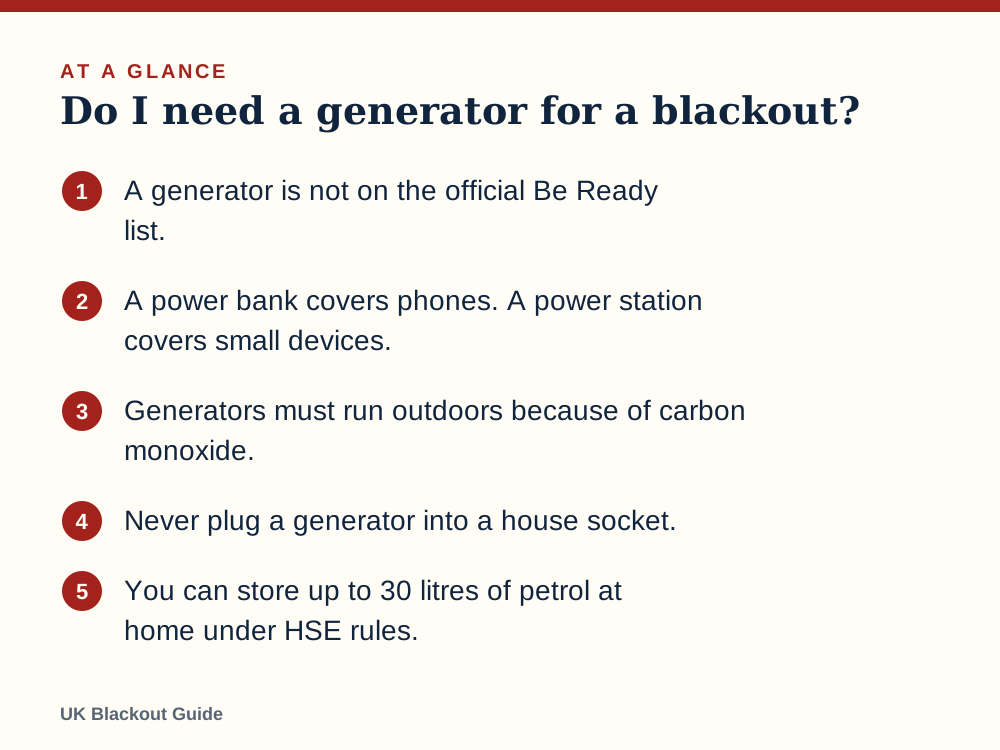
- A generator is not on the official Be Ready list.
- A power bank covers phones. A power station covers small devices.
- Generators must run outdoors because of carbon monoxide.
- Never plug a generator into a house socket.
- You can store up to 30 litres of petrol at home under HSE rules.
Most homes do not need one
You do not need a generator for a blackout in most UK homes. The government's Be Ready campaign asks households to be able to manage for three days, and the powered items it lists are a torch, a battery or wind-up FM radio and a charged power bank. It does not mention generators, and no blackout has been announced or forecast.
For three days, the official approach is to do without mains power, not to replace it: food that needs no cooking, layers and blankets for warmth, torches for light. Our overview of backup power options shows where each kind of kit fits.
What a power bank or power station covers
A 20,000 mAh power bank gives a typical phone about 3 to 4 charges. For a router, a lamp, a laptop or a CPAP machine, a portable power station is the quieter choice. It has no fuel and no fumes, so it can be used indoors.
Runtime in hours is roughly the capacity in watt-hours times 0.85, divided by the device's watts. A 500 Wh station runs a 12 W router for about 35 hours, or a 50 W laptop for about 8.
A power station will not run a kettle or a fan heater for any useful time, since those draw 2,000 W or more. Loads of that size are the dividing line in power station versus generator.
When a generator does make sense
A home generator earns its place where outages are long and the load is large. After Storm Arwen in November 2021, some rural homes in northern England and Scotland were off for more than a week. Homes with a well pump, a large freezer of home-produced food, or a business run from the premises are the usual cases.
If someone depends on powered medical equipment, speak to their clinician or equipment supplier first and join the Priority Services Register. Do not assume a generator is the answer.
Sizing and fuel decide the rest, and both are worked through in choosing a generator for home backup.
The safety rules if you buy one
Never run a generator indoors, in a garage, or in a tent. Carbon monoxide has no smell and can kill. Symptoms include headache, dizziness, nausea and breathlessness. Fit an audible alarm marked EN 50291.
Never plug a generator into a house socket. Back-feed can kill engineers working on the network and damage your home. Connecting to house wiring needs a changeover switch fitted by a qualified electrician, as explained in why you cannot plug a generator into a socket.
HSE rules, one part of wider generator safety, allow up to 30 litres of petrol at home without notifying anyone, in suitable containers, kept in a garage or shed and not in the living space.
Common questions
Does the government recommend buying a generator?
No. Generators are not on the Be Ready list. It lists a torch, an FM radio and a charged power bank.
Can a generator run my whole house?
Only a large one wired in through a changeover switch by a qualified electrician. A portable 2,000 W unit runs selected appliances through extension leads.
Is a power station safer than a generator?
It has no fuel or exhaust, so there is no carbon monoxide risk and it can be used indoors. It stores far less energy than a tank of petrol.
Reviewed against these sources on 18 November 2026. If official advice has changed since, follow the official advice.
General information only. This page is not professional, safety, medical, legal or financial advice, and it is not official guidance. No national blackout has been forecast or announced, and nothing here suggests one is expected. We are independent and have no connection to the government or any energy company. Anything involving electricity, gas, fuel or food safety should be checked with a qualified professional or the relevant official body before you act on it. Always check the official sources linked on this page. Full disclaimer
Keep reading
 Guide
Backup power for your home: every option compared
Power banks, power stations, generators, solar panels, cars and UPS units compared: what each can run in a UK power cut, for how long, and who needs which.
Read: Backup power for your home: every option Guide
Power station or generator: which is right for you?
Power station or generator for UK power cuts: how they differ on runtime, safety, noise and upkeep, and which suits flats, houses and rural homes.
Read: Power station or generator: which is right Buying guide
Best generators for power cuts
Petrol inverter generators for UK power cuts, from 1,200 W to 5,500 W, chosen from Amazon UK listings, with the carbon monoxide and wiring rules.
Read: Best generators for power cuts Buying guide
Best portable power stations for power cuts
Portable power stations for UK power cuts, from a 75 Wh unit for the router to 2 kWh solar bundles, picked from Amazon UK listings with runtime sums.
Read: Best portable power stations for power cuts