On this page
Only a large one. A standard UK kettle draws 2,000 to 3,000 W, so the power station's inverter must be rated above that, which rules out most models under about 2,000 Wh. Even then, each litre boiled uses roughly 5 to 6 per cent of a 2,000 Wh battery. A gas camping stove or a flask is usually the better answer.
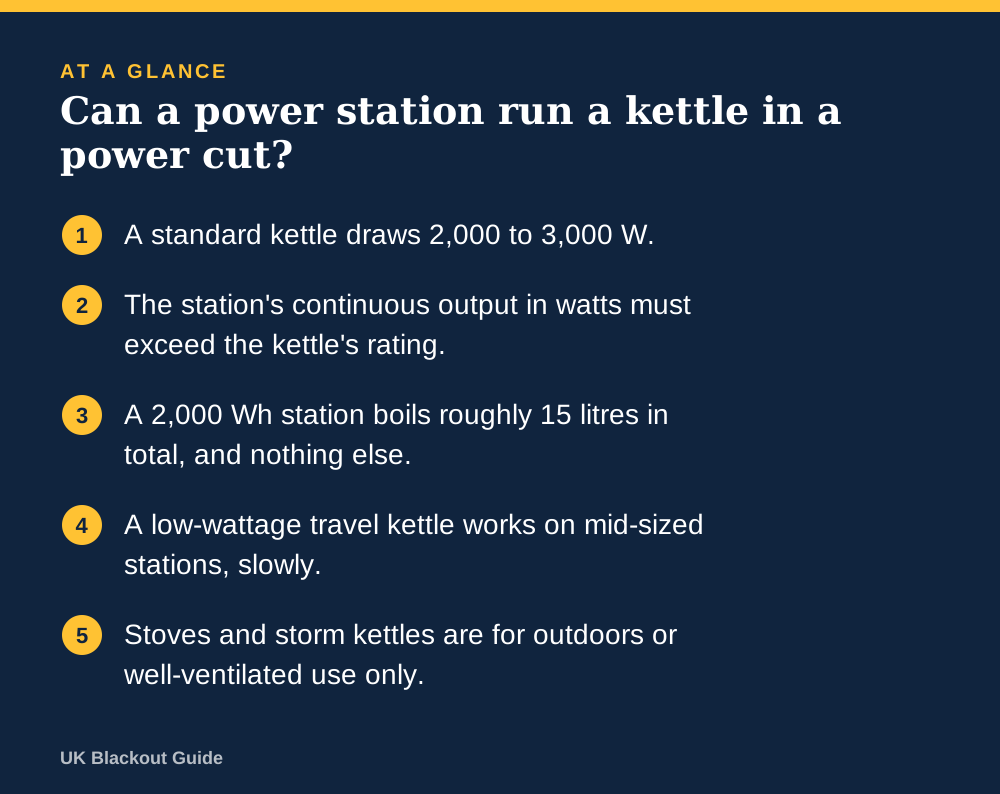
- A standard kettle draws 2,000 to 3,000 W.
- The station's continuous output in watts must exceed the kettle's rating.
- A 2,000 Wh station boils roughly 15 litres in total, and nothing else.
- A low-wattage travel kettle works on mid-sized stations, slowly.
- Stoves and storm kettles are for outdoors or well-ventilated use only.
Two numbers decide it: watts and watt-hours
A power station has an output rating in watts (how much it can deliver at once) and a capacity in watt-hours (how much it stores). A kettle is a hard test of the first number. Check the base of yours: most UK kettles are marked between 2,000 and 3,000 W.
If the station's continuous output is lower than the kettle's rating, it will cut out within a second or two. A 500 Wh station with a 500 W outlet has no chance, however full it is. You need a large station whose continuous output is higher than the figure on the kettle. Our table of appliance watts shows why heating appliances are always the problem.
What each boil costs in battery
Runtime in hours is roughly watt-hours times 0.85, divided by the device's watts. A 2,000 Wh station, a size found among the best large power stations, has about 1,700 Wh to give. A 3,000 W kettle would drain that in 34 minutes of boiling, and a 2,000 W kettle in 51 minutes.
Bringing one litre of cold water to the boil takes roughly 100 to 110 Wh whatever the kettle's wattage, so that 2,000 Wh station can boil around 15 litres and then it is empty. Put another way, six mugs of tea for the family (about 1.5 litres) costs nearly a tenth of the battery. The same energy would run a router and two LED lamps for about five hours.
Boil only the water you need, and pour any spare into a flask straight away.
A low-wattage kettle changes the picture
Travel and caravan kettles are often rated between about 600 and 1,000 W. They use the same energy per litre but draw it more gently, so a mid-sized station with a 1,000 W output can run one. The boil takes two or three times as long.
If hot drinks are your main reason for buying a station, pairing a mid-sized unit with a small kettle is cheaper than buying a very large station to run the kettle you already own, and what size power station you need works through the sums.
Cheaper ways to get boiling water
If you have a gas hob, it will usually light with a match when the electric ignition is dead, and a pan of water is all you need. Without one, a single-burner camping stove boils a litre for pennies of gas and no battery at all, one of several methods in how to boil water without electricity.
Never use a camping stove, storm kettle or barbecue indoors, in a garage or in a tent. They produce carbon monoxide, which has no smell and can kill. Use them outside and carry the hot water in.
Fill a good flask with each boil and you may only need to heat water twice a day, the routine described in hot drinks without power.
Common questions
Can a 1,000 Wh power station boil a kettle?
Only if its continuous output is higher than the kettle's wattage. Many 1,000 Wh units supply 1,000 to 1,500 W, which suits a low-wattage travel kettle but not a 3,000 W household one.
Will a kettle damage a power station?
No. If the kettle asks for more than the station can supply, the overload protection switches the output off. Reset it and unplug the kettle.
Is it worth using a power station for hot drinks in a three-hour rota cut?
Not really. Fill a flask with boiling water before a planned cut and it will stay hot for the whole period.
Reviewed against these sources on 18 November 2026. If official advice has changed since, follow the official advice.
General information only. This page is not professional, safety, medical, legal or financial advice, and it is not official guidance. No national blackout has been forecast or announced, and nothing here suggests one is expected. We are independent and have no connection to the government or any energy company. Anything involving electricity, gas, fuel or food safety should be checked with a qualified professional or the relevant official body before you act on it. Always check the official sources linked on this page. Full disclaimer
Keep reading
 Buying guide
Best power stations to run a fridge freezer in a blackout
Large 1 to 3 kWh power stations that can start and run a fridge-freezer through a blackout, picked from Amazon UK listings with estimated runtimes.
Read: Best power stations to run a fridge freezer Guide
Portable power stations explained
How portable power stations work, what watt-hours and watts mean, what one can and cannot run in a UK power cut, and the features that matter.
Read: Portable power stations explained Guide
Running a fridge or freezer on backup power
When a fridge or freezer needs backup power in a power cut, what size power station or generator will start one, and how long it will keep running.
Read: Running a fridge or freezer on backup power Guide
What size power station do I need?
A step-by-step way to size a portable power station for a UK power cut, with worked examples for home working, CPAP machines and fridge-freezers.
Read: What size power station do I need?