On this page
Small electronics use very little: a phone charger 10 to 20 W, a router 10 to 15 W, an LED lamp 5 to 10 W and a laptop 45 to 65 W. Anything that makes heat uses a great deal: a kettle 2,000 to 3,000 W and a fan heater about 2,000 W.
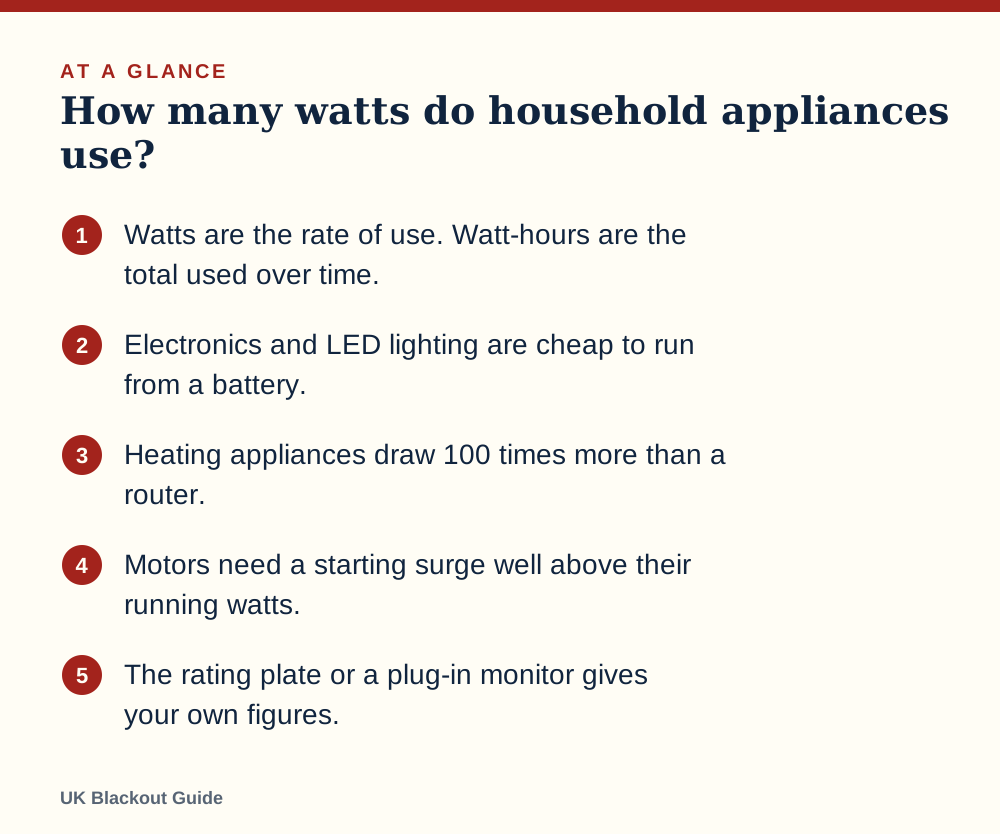
- Watts are the rate of use. Watt-hours are the total used over time.
- Electronics and LED lighting are cheap to run from a battery.
- Heating appliances draw 100 times more than a router.
- Motors need a starting surge well above their running watts.
- The rating plate or a plug-in monitor gives your own figures.
Typical wattages at a glance
| Appliance | Typical draw | Notes |
|---|---|---|
| LED lamp | 5 to 10 W | Per bulb |
| Phone charging | 10 to 20 W | Falls as the phone fills |
| Wi-Fi router | 10 to 15 W | On continuously |
| CPAP machine | 30 to 60 W | Without humidifier |
| Laptop | 45 to 65 W | Less once the battery is full |
| Fridge-freezer | 40 to 80 W average | Needs 600 W or more to start |
| Gas boiler controls and pump | 100 to 150 W | The gas provides the heat |
| Fan heater | 2,000 W | Continuous while on |
| Kettle | 2,000 to 3,000 W | For a few minutes |
These are typical figures for planning. Your own appliances may differ, so check them using the methods further down.
Watts and watt-hours are different things
A watt (W) measures how fast something uses electricity at a given moment. A watt-hour (Wh) measures how much it has used over time. A 10 W lamp left on for 5 hours uses 50 Wh. A 2,000 W fan heater uses the same 50 Wh in a minute and a half.
Both numbers matter when you plan backup power. The watts tell you whether a battery or generator can run the appliance at all. The watt-hours tell you how long it will last. Your electricity bill uses kilowatt-hours (kWh), which are simply 1,000 Wh.
Heat is what empties batteries
Look at the table again and the pattern is plain. Everything that communicates, computes or lights sits under 100 W. Everything that makes heat sits in the thousands. A single kettle draws as much as about 200 routers.
A kettle is at least brief. Boiling a litre takes roughly a tenth of a kilowatt-hour, about 100 Wh, which is a quarter of the usable energy in a 500 Wh power station gone on two mugs of tea, even if the power station could supply the watts. That is the short answer to whether a power station can run a kettle. A flask filled before a planned cut, or a camping stove used with proper ventilation and never left unattended, is the sensible way to make hot drinks without power.
Room heating is worse because it never stops. A 2,000 W fan heater would drain a large 2,000 Wh power station in about 50 minutes, which settles whether a power station can run a heater for most households. The practical answers for a cold house lie elsewhere, and our guide to heating a room without electricity goes through the ones that need no battery at all.
Never bring a barbecue, patio heater or generator indoors for heat or cooking. They produce carbon monoxide, which has no smell and can kill.
Starting surges on motors and compressors
Appliances with motors or compressors need a short burst of extra power to get going. A fridge-freezer that averages 40 to 80 W needs 600 W or more for a moment at each start. Pumps, freezers and power tools behave in a similar way.
This is why power stations and generators quote two figures, continuous output and surge (or peak) output, and why the power stations suited to fridge-freezers are the larger ones with higher surge ratings. The surge rating must exceed the appliance's starting demand, or it will not start. When several things share one power source, start the biggest motor first and add the small loads afterwards.
Finding the figure for your own appliance
Read the rating plate. Every mains appliance has a label, usually on the back or base, giving watts (W) or amps (A). If it gives amps only, multiply by 230 to get approximate watts. The plate shows the maximum the appliance can draw, which is often more than it uses in normal running.
Read the power adaptor. For routers, laptops and other electronics, the adaptor's output line gives volts and amps. Multiply them: 12 V at 1.5 A is 18 W at most.
Measure it. A plug-in energy monitor sits between the appliance and the socket and shows the live draw and the total over time. It is the only reliable way to find the true average of something that cycles, like a fridge or a boiler. Leave it connected for a full day.
Turning watts into a backup plan
Once you have the figures, the sum for a portable power station is simple: runtime in hours is capacity in Wh, times 0.85, divided by the watts. The 0.85 allows for losses in the unit's electronics.
Take a 500 Wh unit, which gives 425 Wh of usable energy. A 12 W router and two 10 W lamps total 32 W, which it runs for about 13 hours. Add a 60 W laptop and the load becomes 92 W, giving about 4.5 hours. A 40 W CPAP machine alone runs for a little over 10 hours, though anyone running a CPAP machine in a power cut should follow their clinician's advice.
Gas central heating is a common question. The boiler burns gas for heat, but its controls and pump need 100 to 150 W of electricity, which is why a gas boiler stops in a power cut.
To go from your list to a specific capacity, use our guide to working out what size power station you need.
Common questions
How many watts does a house use in total?
It varies from under 100 W overnight to several thousand when a kettle, oven or shower is on. For backup planning, add up only the items you would run in a cut.
Does a phone charger use power when nothing is plugged into it?
A tiny amount, usually a fraction of a watt. It is not worth worrying about on battery backup, but unplugging it costs nothing.
What is the difference between running watts and starting watts?
Running watts are the steady draw. Starting watts are the brief, higher surge that motors and compressors need when they switch on.
How do I convert amps to watts?
Multiply amps by volts. On UK mains that is amps times 230, so a 13 amp socket can supply about 3,000 W.
Reviewed against these sources on 18 November 2026. If official advice has changed since, follow the official advice.
General information only. This page is not professional, safety, medical, legal or financial advice, and it is not official guidance. No national blackout has been forecast or announced, and nothing here suggests one is expected. We are independent and have no connection to the government or any energy company. Anything involving electricity, gas, fuel or food safety should be checked with a qualified professional or the relevant official body before you act on it. Always check the official sources linked on this page. Full disclaimer
Keep reading
 Question
Are power stations safe to use indoors in a power cut?
Battery power stations are safe to use indoors because they burn no fuel and give off no fumes. The sensible rules for charging, placing and storing one.
Read: Are power stations safe to use indoors in a Buying guide
Best portable power stations for power cuts
Portable power stations for UK power cuts, from a 75 Wh unit for the router to 2 kWh solar bundles, picked from Amazon UK listings with runtime sums.
Read: Best portable power stations for power cuts Question
Can a power station run a fridge in a power cut?
A power station can run a fridge-freezer if it handles the 600 W start-up surge. Runtimes for 500, 1,000 and 2,000 Wh units, and how to stretch them further.
Read: Can a power station run a fridge in a power Question
Do I need a generator for a blackout?
Do you need a generator for a blackout? Most UK homes do not. It is not on the government's Be Ready list. When one makes sense, and the safer options.
Read: Do I need a generator for a blackout?