On this page
No. A modern gas boiler stops working in a power cut, even though the gas itself keeps flowing. The controls, ignition, fan and circulation pump all run on mains electricity, typically drawing 100 to 150 W. Heating and hot water come back when the power does, though some boilers need a reset first.
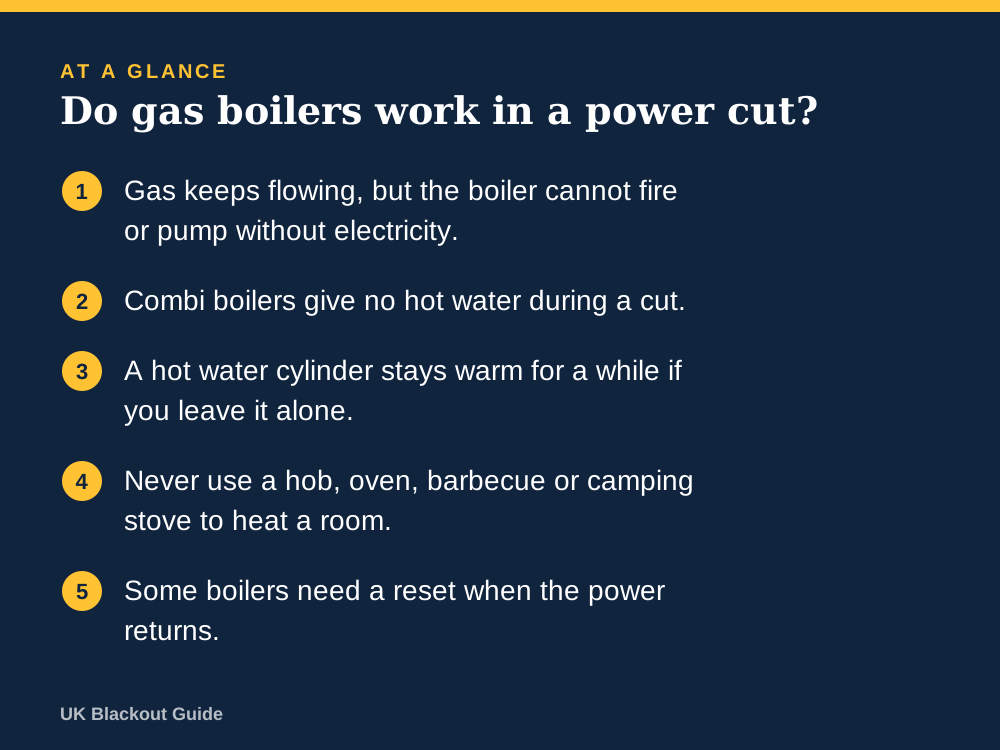
- Gas keeps flowing, but the boiler cannot fire or pump without electricity.
- Combi boilers give no hot water during a cut.
- A hot water cylinder stays warm for a while if you leave it alone.
- Never use a hob, oven, barbecue or camping stove to heat a room.
- Some boilers need a reset when the power returns.
Why a gas boiler needs electricity
The gas is only the fuel. Everything that makes it useful is electric: the circuit board and thermostat that decide when to fire, the spark that lights the burner, the fan that pushes fumes out through the flue, and the pump that moves hot water round the radiators.
Together the controls and pump draw about 100 to 150 W, less than many televisions. It is a small load, but with no supply at all the boiler shuts down safely and waits. The same applies to oil and LPG boilers, and to most of the systems covered in whether central heating works without electricity.
A combi boiler heats water only as you run the tap, so hot water stops at once. If you have a hot water cylinder, the water already in it stays warm for some hours, so use it sparingly.
What you should not use for heat instead
A gas hob may still light with a match if it has no electric safety cut-off, and that makes it useful for cooking. It is not a room heater, and using a gas hob for heat is no substitute for the boiler.
Never bring a barbecue, camping stove, patio heater or generator indoors to warm the house. They produce carbon monoxide, which has no smell and can kill. Headache, dizziness, nausea and breathlessness are symptoms. Get into fresh air and call the gas emergency line on 0800 111 999.
Staying warm until the heating returns
A house cools slowly. Official advice on keeping warm in a power cut is to put on layers, use blankets, and close doors and curtains to hold the heat you already have. Gather everyone in one room, ideally a small one. The NHS advises keeping the rooms you use at 18°C or above, so in a long winter cut check on anyone older, very young or unwell first.
Heating the person is far cheaper than heating the room. If you have any way to heat water safely, a hot water bottle under a blanket does a surprising amount.
Nights are the hard part. A sleeping bag traps far more warmth than a duvet on its own, and the sleeping bags suited to a cold house do not need to be expensive expedition models.
Running a boiler from backup power, and what happens afterwards
Because the draw is so low, a portable power station can in theory keep a boiler's controls and pump running. In practice most boilers are hard-wired into a fused switch, not plugged into a socket, so any backup connection is a job for a qualified electrician. Never plug a generator into a house socket to feed the boiler. The back-feed can kill engineers working on the network.
When the power returns, many boilers restart by themselves. If yours shows a fault light or stays cold, the next step is resetting the boiler after a power cut. Timers and programmers may also have lost the clock.
Common questions
Will my gas fire work in a power cut?
Older gas fires with a manual or battery spark often do, while models with electric controls or fans will not. Check the manual, and have any gas fire serviced by a Gas Safe registered engineer.
Does a gas hob work in a power cut?
Many light with a match because the gas supply is unaffected, but hobs with an electric safety valve will not. Use it for cooking only, with a window open, and never to heat the room.
Is it dangerous when a boiler loses power?
No. Boilers are designed to shut down safely when the supply fails, and the gas valve closes.
Reviewed against these sources on 18 November 2026. If official advice has changed since, follow the official advice.
General information only. This page is not professional, safety, medical, legal or financial advice, and it is not official guidance. No national blackout has been forecast or announced, and nothing here suggests one is expected. We are independent and have no connection to the government or any energy company. Always check the official sources linked on this page. Full disclaimer
Keep reading
 Explainer
Storm Arwen: when rural homes lost power for over a week
Storm Arwen cut power to about 1 million customers in November 2021, and some rural homes waited more than a week. What happened and what official guidance says.
Read: Storm Arwen: when rural homes lost power for Guide
Storms and power cuts: what past UK storms teach us
Storms cause the UK's longest power cuts. What Storm Arwen and Storm Desmond showed about how long rural cuts last, and how to prepare before a warning.
Read: Storms and power cuts: what past UK storms Guide
How to keep warm in a power cut
How to keep warm in a UK power cut: layers, one heated room, hot drinks, safe heat sources and the carbon monoxide rules you must not break.
Read: How to keep warm in a power cut Guide
Power cut in winter: a cold-weather plan
How to cope with a winter power cut in the UK: keep people warm before rooms, hold heat in one room, sleep safely and avoid carbon monoxide and frozen pipes.
Read: Power cut in winter: a cold-weather plan