On this page
- Your heating has almost certainly stopped
- Dress first, while you are still warm
- Shrink the house to one room
- Hot drinks, hot food and hot water bottles
- What you must never use for heat indoors
- Getting through the night
- Know who is at risk and what hypothermia looks like
- Protect the pipes if the freeze continues
- Common questions
In a winter power cut, warm the people, not the house. Put on layers early, move everyone into one small room, close doors and curtains, and use blankets, sleeping bags and hot water bottles. Most gas boilers stop without electricity. Never bring a barbecue, camping stove or patio heater indoors for heat.
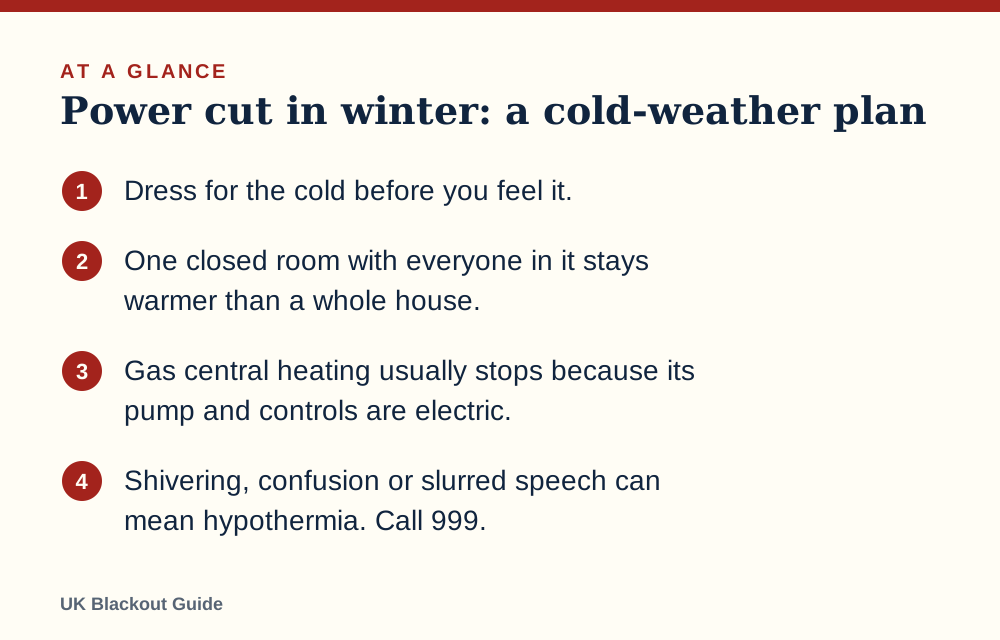
- Dress for the cold before you feel it.
- One closed room with everyone in it stays warmer than a whole house.
- Gas central heating usually stops because its pump and controls are electric.
- Shivering, confusion or slurred speech can mean hypothermia. Call 999.
Your heating has almost certainly stopped
Electric heaters and heat pumps obviously go off. So, in most homes, does gas or oil central heating. The boiler burns gas, but its controls, fan and pump run on electricity, typically drawing 100 to 150 watts. No mains, no heat. We cover the exceptions in whether gas boilers work in a power cut.
A house does not go cold at once. A well-insulated home may stay comfortable for several hours, and an older draughty one will cool much faster. Either way, the warmth already in the building is all you have, so the plan is to slow its escape and to insulate the people inside it.
Dress first, while you are still warm
It is much easier to stay warm than to get warm again. Put extra layers on in the first half hour, before the house has cooled.
Several thin layers trap more air than one thick jumper. Start with a close-fitting layer next to the skin, add a fleece or wool layer, and finish with something loose on top. Wear a hat indoors, thick socks and slippers or shoes. Cold floors pull heat out through your feet. The detail is in how to layer clothes for warmth.
Our list of the best thermal base layers covers adults and children.
Shrink the house to one room
Pick one room and move everyone into it, pets included. The best choice is small, has few outside walls, has a door that closes and ideally has carpet. Bodies give off heat, and four people in a small sitting room will keep it noticeably warmer than the hall outside.
Then follow the official Be Ready advice: close doors and curtains. Shut every internal door in the house, draw all the curtains at dusk, and roll a towel along the bottom of your room's door. In daylight, open curtains on windows that get direct sun and close them again as soon as it goes.
Our guide to setting up one warm room goes through the choice of room and what to bring into it.
Hot drinks, hot food and hot water bottles
If you have a gas hob that lights with a match, you can still heat water and food. Use it for cooking, then turn it off. A hob left burning to warm the kitchen is a carbon monoxide and fire risk, as we explain in whether you can use a gas hob for heat.
Boil a full pan once and get everything from it: a hot drink each, a flask for later and a hot water bottle. A hot water bottle against your body under a blanket is one of the most effective warmers there is for the energy it uses.
See the hot water bottles we recommend, including long ones that wrap around your back.
What you must never use for heat indoors
Never use a barbecue, camping stove, patio heater or generator inside your home, garage or a tent. All of them produce carbon monoxide. It has no smell and no colour. Symptoms are headache, dizziness, nausea, breathlessness and collapse. If you suspect it, get everyone into fresh air and call 999. The gas emergency number is 0800 111 999.
This is the most serious risk in a cold-weather cut, because the colder people get, the more tempting a bad idea becomes. An audible carbon monoxide alarm marked EN 50291 belongs in any home with a gas appliance, open fire or wood burner.
If you have a wood burner or open fire that is swept and in regular use, it will work without power and is a real asset. Candles are not heating. They add a fire risk for almost no warmth.
Getting through the night
Night is the hardest part. The NHS advises heating the rooms you use to at least 18°C, and an unheated bedroom in January can fall well below that.
Sleep in your one warm room if you can, or share beds. Wear a base layer, socks and a hat. Put as much underneath you as on top: a duvet or folded blanket under the sheet stops the mattress drawing heat away. A sleeping bag inside the bed, with the duvet over it, is warmer than either on its own.
Our picks of the best sleeping bags for cold homes explain the ratings.
Know who is at risk and what hypothermia looks like
Babies, older people and anyone with a long-term health condition lose heat faster and may not notice or say that they are cold. Check on them, and on older neighbours, more often than feels necessary.
Hypothermia means body temperature has dropped below 35°C. The NHS lists shivering, cold and pale skin, slurred speech, confusion and tiredness as signs. It is a medical emergency, so call 999. Our page on recognising hypothermia at home explains what to do while you wait.
If someone vulnerable is in a house that is getting steadily colder with no restoration time in sight, move them to a relative, friend or neighbour who has power. During Storm Arwen in November 2021, some rural homes in northern England and Scotland were off for more than a week. Our account of the Storm Arwen power cuts shows why leaving early is sometimes the sensible decision.
Protect the pipes if the freeze continues
A day without heating will not usually freeze the pipes in an occupied house. Several days of hard frost can. Know where your stopcock is, leave the loft hatch open so warmer air from the house reaches pipes and tanks up there, and open the cupboard doors under sinks on outside walls. The full steps are in keeping pipes from freezing.
Common questions
How long will my house stay warm without heating?
It depends on insulation and the weather. A modern, well-insulated home can hold useful warmth for many hours, while an older draughty one cools quickly.
Is it safe to sit in the car to warm up?
Yes, outdoors with the engine running. Never run an engine in a garage, even with the door open, because of carbon monoxide.
Do foil blankets help indoors?
They reflect body heat and block draughts, so they help as one layer among several. They work best wrapped over clothing and under a normal blanket.
Can I leave my gas oven door open to heat the kitchen?
No. Ovens and hobs are not designed for room heating and doing so risks carbon monoxide poisoning.
Reviewed against these sources on 18 November 2026. If official advice has changed since, follow the official advice.
General information only. This page is not professional, safety, medical, legal or financial advice, and it is not official guidance. No national blackout has been forecast or announced, and nothing here suggests one is expected. We are independent and have no connection to the government or any energy company. Always check the official sources linked on this page. Full disclaimer
Keep reading
 Guide
How to keep warm in a power cut
How to keep warm in a UK power cut: layers, one heated room, hot drinks, safe heat sources and the carbon monoxide rules you must not break.
Read: How to keep warm in a power cut Question
Do gas boilers work in a power cut?
Gas boilers stop in a power cut because the controls, ignition, fan and pump all need mains electricity. Here is why, and how to stay warm until it returns.
Read: Do gas boilers work in a power cut? Buying guide
Best power cut essentials: the blackout kit worth buying
The blackout kit worth buying for a UK power cut: a battery torch, a lantern, a power bank, a wind-up radio, an automatic light and a flask, with picks.
Read: Best power cut essentials: the blackout kit Buying guide
Best surge protectors for power cuts
Surge protectors for power cuts: extension leads that guard a TV, computer or router from the spike when the mains returns, chosen from Amazon UK listings.
Read: Best surge protectors for power cuts