On this page
Pipes are only at risk when it is below freezing outside and the heating has been off for many hours. Find your stopcock, let the warmth left in the house reach the pipes by opening the loft hatch and cupboard doors, and insulate exposed runs. If you leave the house, turn the water off at the stopcock and drain the taps.
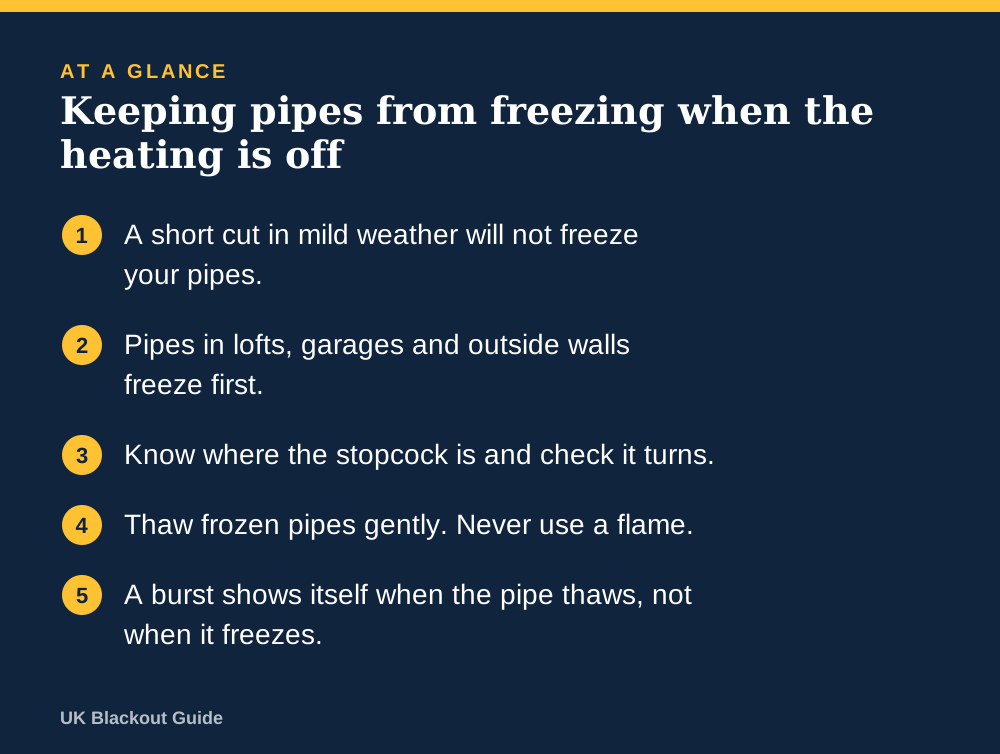
- A short cut in mild weather will not freeze your pipes.
- Pipes in lofts, garages and outside walls freeze first.
- Know where the stopcock is and check it turns.
- Thaw frozen pipes gently. Never use a flame.
- A burst shows itself when the pipe thaws, not when it freezes.
When frozen pipes become a real risk
Water freezes at 0°C, and a house holds its heat for a good while after the boiler stops. A three-hour rota cut will not freeze your plumbing, and neither will a day without heating when it is 5°C outside.
The risk is real when two things combine: outside temperatures below zero, and the heating off for long enough that unheated parts of the building fall to the same level. That means overnight and beyond in a hard frost, as some households found when Storm Arwen left rural homes without power for more than a week. If the forecast is cold and the cut looks long, act early.
Which pipes freeze first
Pipes freeze where the building is coldest, not where the water is used most. Check these places with a torch:
- the loft, including the cold water tank and the pipes running to and from it
- garages, outhouses and utility rooms with no heating
- pipes on the inside of outside walls, often under the kitchen sink
- outside taps and the pipe feeding them
- the boiler's condensate pipe, the plastic pipe that runs from a modern boiler to an outside drain
- under suspended ground floors
Modern loft insulation makes a loft colder than it used to be, because it stops the house's heat rising into it. Pipes and tanks up there need their own lagging.
Find the stopcock today
The inside stopcock (or stop tap) shuts off the mains water to the whole house. It is usually under the kitchen sink, but can be in a downstairs toilet, under the stairs, in a utility room or where the supply pipe enters the house. Turn it clockwise to close.
Try it now. A stopcock that has not moved in years may be stiff or seized, and the middle of a burst is the wrong time to discover that. Show everyone in the house where it is. Our guide on turning off your gas, water and electricity covers all three supplies and is worth ten minutes before winter.
Steps during a cold power cut
These cost nothing and use the heat already in the house.
- Open the loft hatch. Warmer air from the house rises into the loft and takes the edge off around the tank and pipes.
- Open cupboard doors under sinks on outside walls so room air can reach the pipes.
- Leave internal doors to unheated rooms ajar if they contain pipework, such as a utility room. This is the one exception to closing doors for warmth.
- Wrap exposed pipes with foam lagging if you have it, or with towels and old blankets held on with tape or string as a stopgap.
- Turn off and drain outside taps if they have their own isolating valve indoors.
You will be sealing up a single room to live in at the same time, as described in the one warm room method. The two jobs pull in different directions: keep your room shut tight, but let the rest of the house share what warmth it has with the pipes.
If you are leaving, or the house is getting very cold
If you have weighed up staying at home or leaving and decided to go somewhere warmer, or the indoor temperature is heading towards freezing, take the water out of the equation. Turn off the stopcock, then open the cold taps, starting at the top of the house, and let them run until they stop. Flush the toilets. With little water left in the pipes, there is little to freeze and far less to leak.
Turn off the boiler and any immersion heater at their switches before you drain anything, so nothing tries to heat an empty system when the power returns. Do not drain the central heating circuit itself unless you know how, as that is a separate sealed system. If you are unsure what kind of system you have, ask a plumber before winter.
Before you turn the water off, fill clean containers for drinking, since mains water can be disrupted in a power cut anyway. The water storage containers we list have taps for easy pouring.
How to thaw a frozen pipe safely
The usual sign is a tap that gives a trickle or nothing while others work. Do not wait for it to sort itself out.
- Turn off the water at the stopcock.
- Open the affected tap so melting water and pressure have somewhere to go.
- Look along the pipe for bulges or splits. If you find damage, leave the water off and call a plumber.
- Warm the pipe gently, starting at the tap end and working back. Use a covered hot water bottle or towels soaked in warm water. Without mains power you may need to fill a hot water bottle without a kettle.
- When water flows, turn the stopcock back on slowly and check for leaks.
Never use a blowtorch, heat gun, candle or any naked flame on a pipe. It can damage the pipe, start a fire in the surrounding timber and scald you when trapped water turns to steam.
When the power and heating come back
Ice blocks a split pipe, so a burst often only shows when things warm up. When the heating restarts, walk round the house, look in the loft and listen for running water. If you find a leak, turn off the stopcock, switch off electrics near the water if it is safe to reach them, catch what you can in buckets and call a plumber. Photograph any damage for your insurer.
If the boiler will not fire in freezing weather and shows a fault code, a frozen condensate pipe is a common cause. It can be thawed by pouring warm, not boiling, water along the outside section. Then follow the steps for resetting a boiler after a power cut. The rest of the restart is in our guide to what to do when the power comes back on.
Before next winter, lag exposed pipes and the loft tank properly, and look through draught excluders and insulation for the rooms that lose heat fastest.
Checklist
Keeping pipes from freezing when the heating is off
- Find the stopcock and check it turns
- Lag pipes and tanks in the loft and garage
- Open the loft hatch in a cold power cut
- Open cupboard doors under sinks on outside walls
- Isolate and drain outside taps
- Turn off water and drain taps if leaving the house
- Check for leaks when the heating returns
Common questions
At what temperature do pipes freeze?
Water freezes at 0°C. Pipes in unheated spaces are at risk once the air around them stays below freezing for several hours, and exposed or uninsulated pipes freeze soonest.
Should I leave a tap dripping?
It is sometimes suggested for a single vulnerable pipe, but it wastes water and can freeze the waste pipe. Insulating the pipe and letting house warmth reach it are better first steps.
How do I know if a pipe has burst?
Look for damp patches on ceilings and walls, dripping, the sound of running water, or a drop in water pressure. Bursts often appear only as the pipe thaws.
Who is responsible for a frozen pipe outside my home?
Pipes inside your property boundary are normally the owner's responsibility. Your water company's website explains where its responsibility starts.
Reviewed against these sources on 18 November 2026. If official advice has changed since, follow the official advice.
General information only. This page is not professional, safety, medical, legal or financial advice, and it is not official guidance. No national blackout has been forecast or announced, and nothing here suggests one is expected. We are independent and have no connection to the government or any energy company. Anything involving electricity, gas, fuel or food safety should be checked with a qualified professional or the relevant official body before you act on it. Always check the official sources linked on this page. Full disclaimer
Keep reading
 Question
Are portable gas heaters safe indoors in a power cut?
Portable gas heaters are safe indoors only if made for indoor use and run with ventilation and a CO alarm. The rules, and which heaters to keep outside.
Read: Are portable gas heaters safe indoors in a Buying guide
Best blankets for power cuts
Wool and fleece blankets for keeping warm in a power cut, picked from Amazon UK listings on material, size and price, with advice on how many to keep.
Read: Best blankets for power cuts Buying guide
Best carbon monoxide alarms for power cut heating and cooking
Carbon monoxide alarms for power cut heating and cooking: seven battery alarms from Amazon UK listings, with advice on EN 50291 and where to put them.
Read: Best carbon monoxide alarms for power cut Buying guide
Best draught excluders to keep heat in during a power cut
Draught excluders to keep heat in during a power cut: seven door excluders and window film kits from Amazon UK listings, with ventilation advice.
Read: Best draught excluders to keep heat in during