On this page
Turn electricity off at the main switch on your consumer unit, water off at the stopcock (usually under the kitchen sink, turned clockwise), and gas off at the emergency control valve beside the meter by moving the lever a quarter turn until it sits across the pipe. Find all three today, in daylight, before you need them.
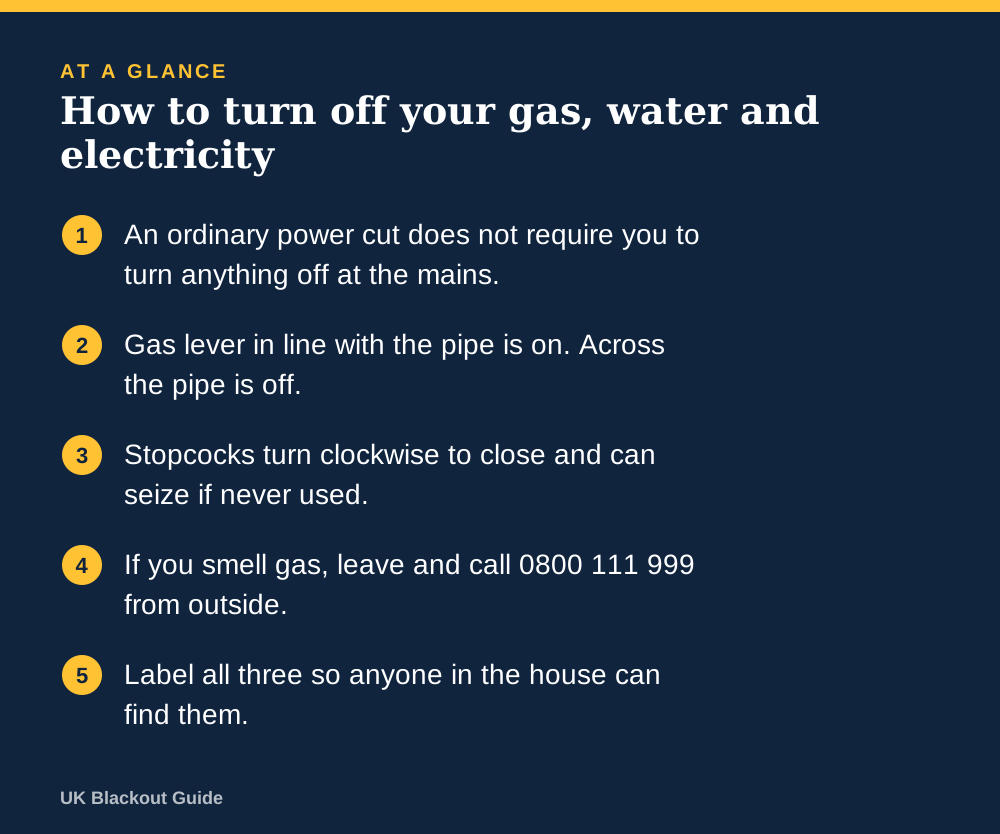
- An ordinary power cut does not require you to turn anything off at the mains.
- Gas lever in line with the pipe is on. Across the pipe is off.
- Stopcocks turn clockwise to close and can seize if never used.
- If you smell gas, leave and call 0800 111 999 from outside.
- Label all three so anyone in the house can find them.
When you would need to, and when you would not
In a normal power cut you do not need to shut off your gas, water or electricity at the mains. Official advice on what to unplug in a power cut is narrower: turn off appliances such as ovens, irons, electric fires and fryers, and unplug the TV and computer.
The mains controls are for specific problems. Turn water off for a burst or leaking pipe, or if you are leaving a cold house empty in a winter cut. Turn gas off if you smell gas or are told to by an engineer. Turn electricity off if water is getting into the electrics, if you see scorching or smell burning from a socket, or before any work on the wiring.
Knowing where the three controls are takes ten minutes and is one of the cheapest bits of preparation there is.
The three controls at a glance
| Supply | What to look for | Usual places | Off position |
|---|---|---|---|
| Electricity | Consumer unit (fuse box) with a large main switch, often red | Hall, under the stairs, garage, a cupboard by the front door | Main switch down or marked OFF |
| Water | Brass tap or lever on the incoming pipe | Under the kitchen sink, downstairs toilet, utility room, airing cupboard | Turned fully clockwise |
| Gas | Lever on the pipe next to the gas meter | Meter box outside, under the stairs, kitchen cupboard, garage | Lever at right angles to the pipe |
Homes vary, and flats vary most. In a block, the stopcock or meter may be in a shared cupboard or riser, and you may need to ask the landlord or managing agent, which is worth doing before you ever face a power cut in a flat.
Electricity: the main switch on the consumer unit
Open the cover of the consumer unit. You will see a row of small switches (circuit breakers), each protecting one circuit, and one larger switch, usually at one end and labelled "main switch". Pushing that to OFF cuts power to every circuit in the home.
You can also turn off single circuits, which is handy if one socket ring is the problem. If a breaker or RCD has tripped by itself, that is a different situation from a power cut, and why your power has gone off helps you tell them apart.
Older properties may have a fuse box with pull-out fuses and a main switch lever. The principle is the same.
Do not touch the consumer unit with wet hands or while standing in water. If the area is flooded, stay away and call 105. Never remove the unit's cover plate or touch the meter or the sealed supply fuse, which belong to the network and supplier.
You will often be doing this in the dark, so keep a torch from our pick of torches for power cuts within reach of the unit.
A head torch leaves both hands free, which is useful under a sink.
Water: the internal stopcock
The internal stopcock (or stop tap) sits where the mains water pipe enters your home. It looks like a garden tap without a spout, set into a pipe. Turn it clockwise until it stops. Then open the cold kitchen tap, and the flow should dwindle to nothing within a minute or so.
To turn the water back on, turn anticlockwise. Open it fully, then close it back by half a turn, which makes it less likely to seize in the open position.
Stopcocks that have not moved for years can be stiff. Test yours now. If it will not turn by hand, do not force it with all your weight, as old fittings can shear. A little penetrating oil and gentle pressure with an adjustable spanner or pliers often frees it. If not, ask a plumber to replace it before winter.
We compare sizes in our multi-tool round-up. There is also an outside stop valve, usually under a small cover in the pavement or drive, which belongs to the water company and may need a long key.
In a cold-weather power cut, shutting off and draining the system can prevent a burst, as part of stopping pipes from freezing. Remember too that mains water can be disrupted during and after power cuts.
Gas: the emergency control valve
The emergency control valve (ECV) is a lever on the gas pipe just before the meter. When the lever lies along the pipe, gas is on. Turn it a quarter turn so it sits across the pipe, and gas is off.
If your meter is in an outdoor box, you need the small triangular meter box key to open the door. Keep one somewhere known, since they are cheap and easy to lose.
If you smell gas: do not use light switches, naked flames or anything that could spark. Open doors and windows, turn the gas off at the ECV if it is safe to reach, get everyone out, and call the gas emergency number 0800 111 999 from outside or from a neighbour's home.
Do not turn the gas back on after a suspected leak until an engineer has said it is safe. After a routine shut-off, turning the lever back in line restores supply, but appliances with pilot lights may need relighting according to their instructions. Any repair work on gas appliances must be done by a Gas Safe registered engineer.
Gas appliances and improvised heating also carry a risk of carbon monoxide in power cuts. Fit an audible alarm to EN 50291.
Label them and show everyone
Tie a luggage tag to the stopcock and the gas lever saying what each is and which way is off. Stick a label inside the consumer unit door pointing at the main switch.
Then walk every adult and older child round the three points. Add the locations to your household emergency plan, so that a babysitter, lodger or neighbour could find them.
Repeat the stopcock test once a year. A quarter turn each way keeps it free.
Checklist
How to turn off your gas, water and electricity
- Find the consumer unit and identify the main switch
- Find the internal stopcock and check it turns
- Find the gas emergency control valve by the meter
- Get a meter box key if your meters are outside
- Hang a torch by the consumer unit
- Label all three controls
- Show everyone in the household
Common questions
Should I turn the electricity off at the mains during a power cut?
There is no need in an ordinary cut. Switch off heat-producing appliances and unplug sensitive electronics, and leave one light on so you know when power returns.
What if I cannot find my stopcock?
Check under the kitchen sink, then the downstairs toilet, utility room and any cupboard on the wall facing the street. In a flat, ask the landlord or managing agent. A plumber can trace it if all else fails.
Is it safe to turn the gas back on myself?
After a routine shut-off, yes, by returning the lever in line with the pipe. After any smell of gas or suspected leak, wait for the emergency engineer.
Who do I call if the main switch or meter looks damaged?
Call 105 for the cables, cut-out and network equipment, or your supplier for the meter itself. Do not touch damaged equipment.
Reviewed against these sources on 18 November 2026. If official advice has changed since, follow the official advice.
General information only. This page is not professional, safety, medical, legal or financial advice, and it is not official guidance. No national blackout has been forecast or announced, and nothing here suggests one is expected. We are independent and have no connection to the government or any energy company. Always check the official sources linked on this page. Full disclaimer
Keep reading
 Buying guide
Best multi-tools for home emergencies
Multi-tools for home emergencies: pliers, screwdrivers and a tin opener for the small jobs a power cut throws up. Seven Amazon UK listings compared.
Read: Best multi-tools for home emergencies Buying guide
Best cash boxes for emergency cash at home
Lockable cash boxes for keeping emergency notes and coins ready at home for when card payments fail in a power cut. Eight Amazon UK listings compared.
Read: Best cash boxes for emergency cash at home Buying guide
Best fireproof document bags for emergency paperwork
Fire-resistant document bags for emergency paperwork: keep passports, policies, contacts and cash ready to grab. Seven Amazon UK listings compared.
Read: Best fireproof document bags for emergency Question
Do smart locks work in a power cut?
Most smart locks run on batteries and still lock and unlock in a power cut, but remote app control stops. What keeps working and how to avoid a lockout.
Read: Do smart locks work in a power cut?