On this page
Small amounts can be stored safely if you follow the rules. For petrol, the Health and Safety Executive allows up to 30 litres at home without notifying anyone, in suitable containers (plastic up to 10 litres, metal up to 20 litres), kept in a garage or shed and never in the living space. Most households do not need to store any.
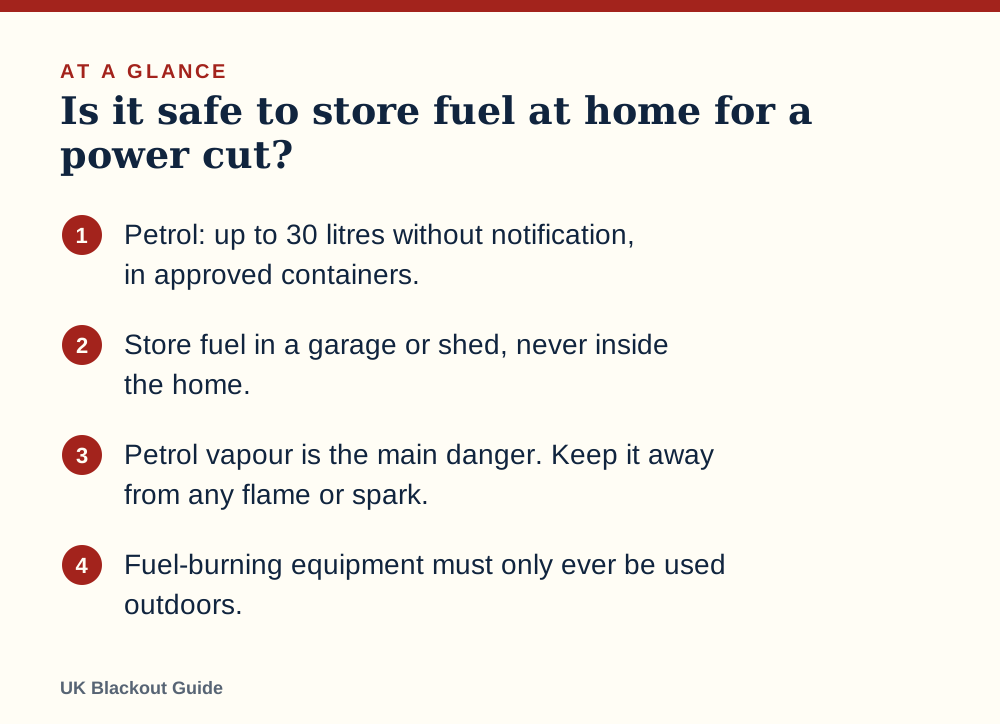
- Petrol: up to 30 litres without notification, in approved containers.
- Store fuel in a garage or shed, never inside the home.
- Petrol vapour is the main danger. Keep it away from any flame or spark.
- Fuel-burning equipment must only ever be used outdoors.
Decide whether you need any fuel at all
Start with what the fuel would be for. If you do not own a generator, or are still weighing up a power station against a generator, there is little reason to keep petrol at home. Keeping the car's tank at least half full gives you a reserve without a single can in the shed.
For the three days the government's Be Ready campaign asks households to plan for, light, warmth, phone charging and cold food can all be handled without burning anything, and our portable power station picks cover the fuel-free route.
The rules for petrol
Petrol is the fuel with specific legal limits, because its vapour ignites so easily. The Health and Safety Executive (HSE) guidance on how much petrol you can store at home is:
- Up to 30 litres can be kept without notifying anyone.
- Use containers designed for petrol: plastic ones of up to 10 litres, metal ones of up to 20 litres.
- Keep them in a garage or shed, not in the house or any room you live in.
Good practice goes with that. Keep containers closed and upright, away from boilers, freezers, tools that spark and direct sun. Fill and decant outdoors, with the engine off and cold. Never smoke nearby. Keep them where children cannot reach.
Petrol also goes stale over months, so label each can with the date and use it in the car or mower before refilling.
Diesel, gas canisters and other fuels
Diesel is less volatile than petrol, but the same common sense applies: proper containers, outside the living space, away from heat. If you plan to keep large quantities of any fuel, check the HSE's guidance and tell your home insurer.
Small butane canisters for a camping stove should be stored cool, dry and upright, away from anything hot, and never left attached to a stove in a cupboard. Larger gas cylinders for heaters or barbecues are best kept outdoors or in a well-ventilated outbuilding, following the supplier's instructions.
Follow the label on anything else, such as lamp oil or barbecue lighter fluid, and keep quantities small.
Storing fuel is the smaller risk. Burning it is the bigger one
More harm comes from using fuel-burning equipment in the wrong place than from a can sitting in a shed, and carbon monoxide in power cuts is the main reason.
Never run a generator, barbecue, camping stove or patio heater indoors, in a garage or in a tent. They produce carbon monoxide, which has no smell. Symptoms include headache, dizziness, nausea, breathlessness and collapse.
Fit an audible carbon monoxide alarm that meets EN 50291 anywhere fuel is burned, and read our generator safety guide before buying one.
Common questions
Can I keep a petrol can in the house?
No. HSE guidance is to keep petrol in a garage or shed, not in the living space.
Can I store petrol in any plastic container?
No. Use containers made and marked for petrol. Drinks bottles and ordinary jerry cans for water are not suitable.
Will petrol stations work in a power cut?
Pumps need electricity, so stations in an affected area usually cannot serve fuel. Keeping your tank above half is the simplest precaution.
Reviewed against these sources on 18 November 2026. If official advice has changed since, follow the official advice.
General information only. This page is not professional, safety, medical, legal or financial advice, and it is not official guidance. No national blackout has been forecast or announced, and nothing here suggests one is expected. We are independent and have no connection to the government or any energy company. Always check the official sources linked on this page. Full disclaimer
Keep reading
 Buying guide
Best cash boxes for emergency cash at home
Lockable cash boxes for keeping emergency notes and coins ready at home for when card payments fail in a power cut. Eight Amazon UK listings compared.
Read: Best cash boxes for emergency cash at home Buying guide
Best fireproof document bags for emergency paperwork
Fire-resistant document bags for emergency paperwork: keep passports, policies, contacts and cash ready to grab. Seven Amazon UK listings compared.
Read: Best fireproof document bags for emergency Buying guide
Best multi-tools for home emergencies
Multi-tools for home emergencies: pliers, screwdrivers and a tin opener for the small jobs a power cut throws up. Seven Amazon UK listings compared.
Read: Best multi-tools for home emergencies Guide
Cash in an emergency: how much to keep and where
Why cash belongs in a UK power cut kit, how to work out a sensible amount for three days, which notes and coins to hold and where to keep them at home.
Read: Cash in an emergency: how much to keep and