On this page
There is no official amount. A sensible target is enough to cover three days of essential spending for your household, which is the period the government's Be Ready campaign asks people to plan for. For many homes that works out at somewhere between £50 and £200, held in £5 and £10 notes and coins.
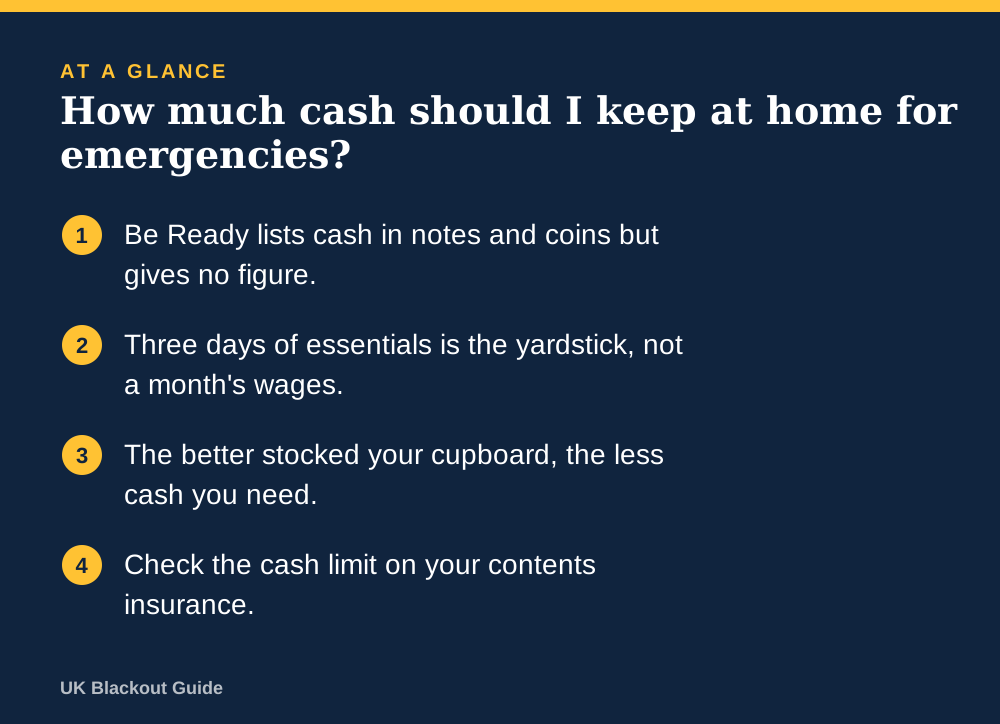
- Be Ready lists cash in notes and coins but gives no figure.
- Three days of essentials is the yardstick, not a month's wages.
- The better stocked your cupboard, the less cash you need.
- Check the cash limit on your contents insurance.
Start from what you would have to buy
The amount of cash to keep for an emergency depends on what you would need to pay for if card machines and cash machines were down for three days. Write the list for your own household. It is usually shorter than people expect.
Typical items are fresh food such as bread and milk, anything a baby or pet needs, a prescription charge, a taxi or bus fare, and some fuel. If you already hold three days of food and water at home, most of the list disappears. Cash is only for what you could not put off while card payments are not working in a power cut.
Example sums
These figures are illustrations to show the method. Swap in your own numbers.
| Household | Daily allowance | Three-day float |
|---|---|---|
| One adult, well-stocked cupboard | £15 | £45 |
| Couple | £15 each | £90 |
| Two adults, two children | £15 each | £180 |
| Add if you rely on a car | Enough for part of a tank, if a pump is working | |
If you live rurally, care for someone, or would need a taxi to reach a relative, lean towards the higher end. The same goes if anyone in the house has a prescription due or a baby needing nappies and formula. If you live two minutes from family and have a full larder, the lower end is fine.
Why more is not better
A large sum at home brings risks of its own. Cash can be stolen or destroyed in a fire, and home contents policies normally cap how much cash they cover. The cap differs between insurers, so check your schedule.
Cash also has limits in a real outage. Shops without power may close, and those that open may have little change, which is why small notes and coins matter more than the total. For anything beyond a few days, stored supplies do far more for you than extra notes. What runs out first in a blackout shows where the real pinch points are.
Where to keep it
Keep the float in one hidden place that every adult in the house knows, separate from everyday money so it does not get spent.
Options are compared in our guide to home cash boxes.
Common questions
Is it legal to keep cash at home in the UK?
Yes. There is no legal limit on holding your own cash at home. The practical limits are security and what your insurer will cover.
Should I keep coins as well as notes?
Yes. A few pounds in £1 and £2 coins helps when a shop has no change.
How often should I check my emergency cash?
Every six months, when you check the rest of your kit. Top it up if you have borrowed from it.
Reviewed against these sources on 18 November 2026. If official advice has changed since, follow the official advice.
General information only. This page is not professional, safety, medical, legal or financial advice, and it is not official guidance. No national blackout has been forecast or announced, and nothing here suggests one is expected. We are independent and have no connection to the government or any energy company. Always check the official sources linked on this page. Full disclaimer
Keep reading
 Buying guide
Best cash boxes for emergency cash at home
Lockable cash boxes for keeping emergency notes and coins ready at home for when card payments fail in a power cut. Eight Amazon UK listings compared.
Read: Best cash boxes for emergency cash at home Guide
Cash in an emergency: how much to keep and where
Why cash belongs in a UK power cut kit, how to work out a sensible amount for three days, which notes and coins to hold and where to keep them at home.
Read: Cash in an emergency: how much to keep and Question
Will my banking app work in a blackout?
Whether mobile banking apps keep working in a UK power cut or wider blackout, what they depend on, and how to make sure you can still pay for essentials.
Read: Will my banking app work in a blackout? Buying guide
Best fireproof document bags for emergency paperwork
Fire-resistant document bags for emergency paperwork: keep passports, policies, contacts and cash ready to grab. Seven Amazon UK listings compared.
Read: Best fireproof document bags for emergency