On this page
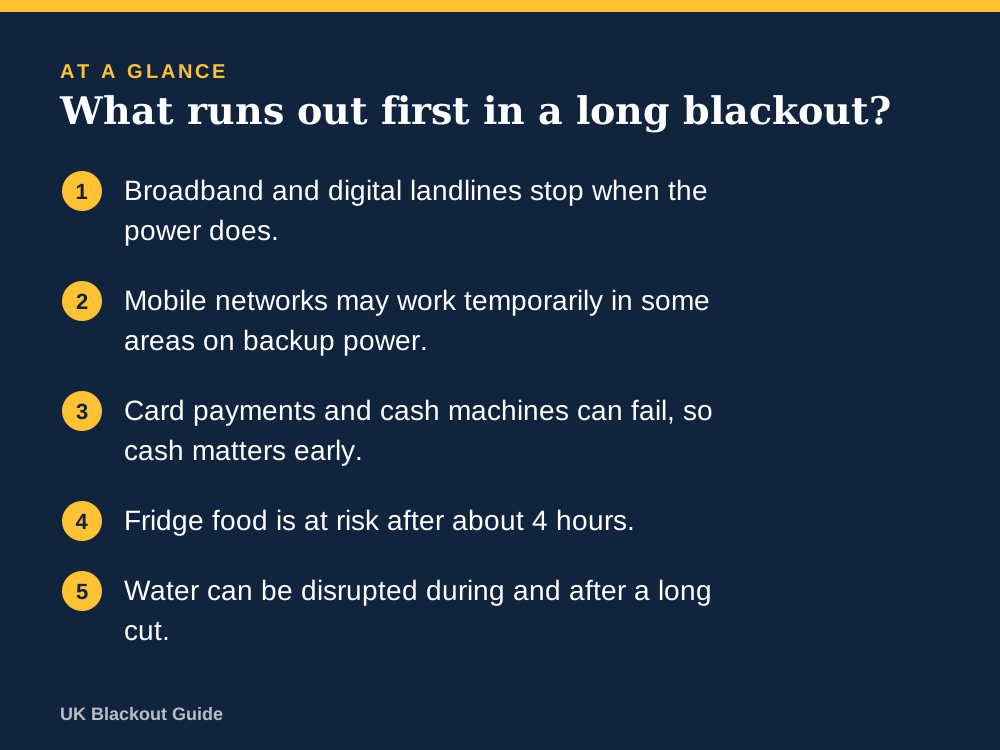
Connectivity usually goes first. Home broadband stops at once, and mobile networks may only work for a while on backup power. Card payments and cash machines can fail early too. Fridge food lasts about 4 hours, a full freezer about 48. Fuel and, in some areas, tap water follow. Stored water, cash and a radio cover the gaps.
- Broadband and digital landlines stop when the power does.
- Mobile networks may work temporarily in some areas on backup power.
- Card payments and cash machines can fail, so cash matters early.
- Fridge food is at risk after about 4 hours.
- Water can be disrupted during and after a long cut.
The first hours: information and payments
No national blackout has been forecast or announced. This page describes in general terms how services depend on electricity, using official advice and what happened in past cuts.
The things that go first are services, not supplies. Your router and any digital landline need mains power, so they stop immediately unless you have a battery backup. Official advice says mobile networks may work temporarily in some areas on backup power. Services failed in Lancaster in December 2015, when mobile, internet, cash machines and card payments all failed locally.
Payments go at the same time. Card payments in a power cut depend on tills, card readers and cash machines, which need both electricity and a data connection. During the blackout in Spain and Portugal on 28 April 2025, card payments were widely disrupted and cash proved useful.
The first day: phone charge and fridge food
A phone in normal use lasts about a day, and less if it is hunting for signal. A power bank extends that by days: a 20,000 mAh model gives about 3 to 4 charges of a typical phone.
The fridge is next. The Food Standards Agency says an unopened fridge should stay cold for around 4 hours. After that, perishable food starts to become unsafe, and the rule is: if in doubt, throw it out. A full freezer typically stays frozen for about 48 hours and a half-full one about 24, as long as the door stays shut.
Days two and three: fuel, shop stock and water
Petrol pumps need electricity, so in a wide-area cut a forecourt without backup power cannot serve fuel even though the tanks are full. Shops that cannot run tills or fridges may close or sell only for cash, which is the case for keeping some cash for an emergency.
Water is the one that worries people most. In most power cuts the taps keep running, but official advice says mains water can be disrupted during and after power cuts, and flats with booster pumps can lose pressure early. This is why the Be Ready kit list starts with 3 litres of bottled water per person per day for three days.
The National Risk Register lists these same knock-on effects for a national outage: water, mobile, internet, fuel, payments and transport, the services covered in what stops working in a blackout.
What lasts longer than you might expect
Some things hold up well. Mains gas often continues to flow, although modern boilers need electricity to run. The BBC has described how it would keep broadcasting on FM radio from an emergency studio with generator-backed transmitters and supplies for at least three days. Tinned and dry food is unaffected. Your car is a source of phone charging, and a radio, as long as it is parked outside and never run in a garage.
So the order to prepare in follows the order of failure: a radio and power bank for information, cash for payments, food that needs no fridge, then water, the same items that make up our list of power cut essentials.
Common questions
Would supermarkets run out of food in a blackout?
The earlier problem is that shops cannot run tills, lighting or fridges, so they may close or take cash only. Having three days of food at home means you do not need to find out.
Does the gas supply run out in a power cut?
Mains gas often keeps flowing, so a gas hob may light with a match. Central heating boilers need electricity for their controls and pump, so heating normally stops.
How long do mobile networks keep working?
It varies by mast and network. Official advice says only that mobile networks may work temporarily in some areas on backup power, so do not rely on them.
Reviewed against these sources on 18 November 2026. If official advice has changed since, follow the official advice.
General information only. This page is not professional, safety, medical, legal or financial advice, and it is not official guidance. No national blackout has been forecast or announced, and nothing here suggests one is expected. We are independent and have no connection to the government or any energy company. Always check the official sources linked on this page. Full disclaimer
Keep reading
 Guide
A week without power: what changes after day three
Optional planning beyond the official three days: what changes by day seven of a power cut for water, cooking, freezer food, phone charging and cash.
Read: A week without power: what changes after day Guide
A long-term water plan
How to plan water for a long outage in three layers: what to store, where to top up, and how to treat doubtful water by boiling, filtering or tablets.
Read: A long-term water plan Guide
Three days without power: the plan the government asks for
A day-by-day plan for three days without mains power, built on the UK government's Be Ready advice: water, food, light, radio, warmth and phone charge.
Read: Three days without power: the plan the Question
How much emergency water does a family of four need?
How much water a family of four should store for a power cut: 12 litres a day for drinking, 36 litres for three days, plus extra for cooking and washing.
Read: How much emergency water does a family of