On this page
Portable solar cannot run a whole house, but it can keep the essentials going. A 100 W panel in the UK typically yields 300 to 400 Wh on a clear summer day and often only 30 to 80 Wh on a dull winter day. That covers phones, LED lights and a radio, with a power station to store it.
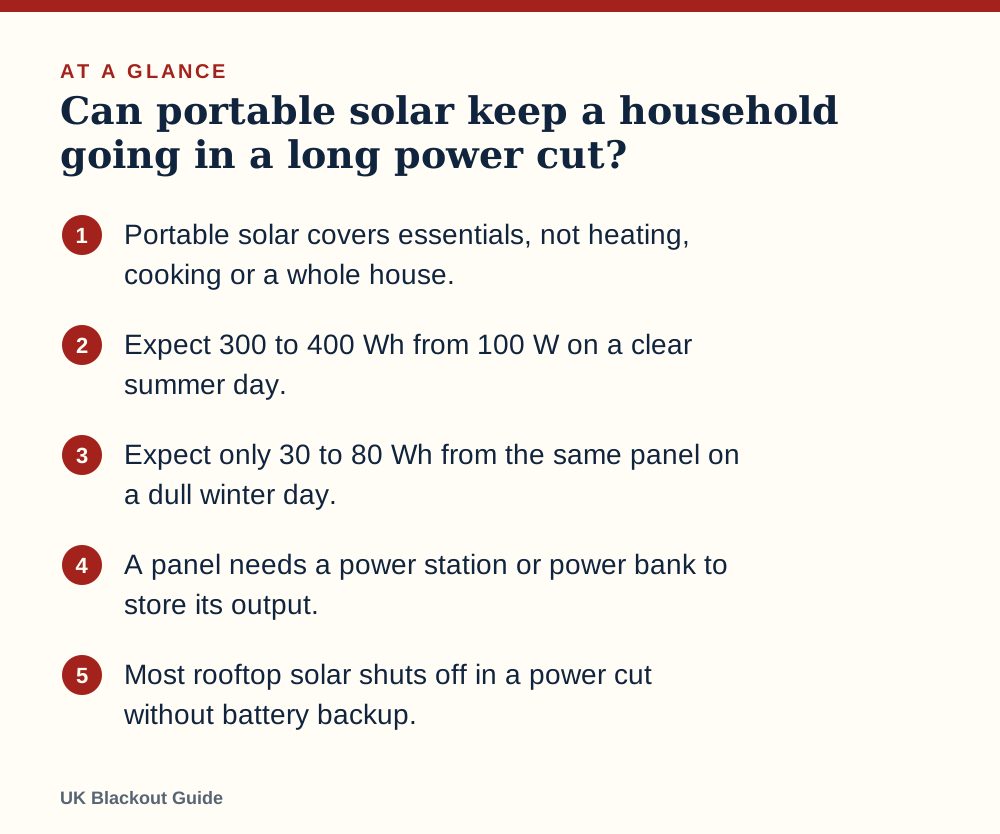
- Portable solar covers essentials, not heating, cooking or a whole house.
- Expect 300 to 400 Wh from 100 W on a clear summer day.
- Expect only 30 to 80 Wh from the same panel on a dull winter day.
- A panel needs a power station or power bank to store its output.
- Most rooftop solar shuts off in a power cut without battery backup.
What one portable panel covers
Compare what one of the best portable solar panels gathers in a day with what devices use. Charging a phone takes roughly 15 to 20 Wh. An LED lamp at 5 to 10 W for five hours uses up to 50 Wh. A router at 10 to 15 W uses up to 360 Wh if left on all day.
| Conditions | 100 W panel yield | What that runs for a day |
|---|---|---|
| Clear summer day | 300 to 400 Wh | Several phone charges, two lamps all evening, a radio and a few hours of laptop or router |
| Dull winter day | 30 to 80 Wh | One or two phone charges and a lamp for a few hours |
In summer a single panel keeps a household lit and connected indefinitely. In winter it keeps you in contact and little more. Planning around the winter figure avoids disappointment, and our guide to portable solar in UK weather explains how to get the most from short days.
What it will not run
Anything that makes heat is beyond portable solar. A kettle draws 2,000 to 3,000 W and a fan heater about 2,000 W. Boiling one kettle uses a noticeable share of a full summer day's yield from a 100 W panel, and an hour of a fan heater would use about five days' worth.
A fridge-freezer averages 40 to 80 W, which is around 1,000 to 1,900 Wh a day, and needs 600 W or more to start. That takes about 400 W of panels in good summer weather and one of the best large power stations. Gas boiler controls and pump, at 100 to 150 W, are a similar stretch. Ovens, showers, washing machines and tumble dryers are out of the question.
You need a battery as well as a panel
A panel only produces in daylight, and its output rises and falls with every cloud. A power station stores the energy and gives a steady supply after dark. As a guide, usable energy is about 85% of the rated capacity, so a 1,000 Wh unit provides roughly 850 Wh. Sizing the pair over longer periods is the subject of running on solar and battery for weeks.
Rooftop solar is a separate case
If you already have panels on the roof, do not assume they will help. Most home solar shuts off in a power cut for safety, unless the system has battery backup that is able to run independently of the grid. Ask your installer which kind you have. We cover this in whether rooftop solar works in a power cut.
A rooftop system with the right battery and changeover equipment can run much more of a home than portable kit, though winter output still falls a long way. What a home battery can and cannot do in a power cut is set out in home battery storage and blackouts. Any connection to house wiring is a job for a qualified electrician.
Common questions
Do small solar power banks do the same job?
Not really. The panel on a solar power bank is tiny, so it can take days of sun to refill. A separate folding panel is far more effective.
How many panels would run a fridge-freezer?
Around 400 W of portable panels in good summer weather, plus a large power station able to supply the start-up surge. It is not practical in a UK winter.
Do solar panels work on cloudy days?
Yes, but at a fraction of their rating. A 100 W panel often yields only 30 to 80 Wh across a dull winter day.
Reviewed against these sources on 18 November 2026. If official advice has changed since, follow the official advice.
General information only. This page is not professional, safety, medical, legal or financial advice, and it is not official guidance. No national blackout has been forecast or announced, and nothing here suggests one is expected. We are independent and have no connection to the government or any energy company. Always check the official sources linked on this page. Full disclaimer
Keep reading
 Guide
How to manage 30 days without mains power
Optional planning for 30 days without mains power, far beyond the three days UK guidance asks for: what water, food, energy and health would need.
Read: How to manage 30 days without mains power Guide
Off-grid power for weeks: solar plus battery
How to size a portable solar panel and power station for weeks without mains power in the UK, with a daily energy budget and honest winter figures.
Read: Off-grid power for weeks: solar plus battery Guide
Preparing for 90 days: stock, rotation and routine
An honest look at preparing for 90 days: why it is far beyond official UK planning, what stock and rotation would involve, and where its limits are.
Read: Preparing for 90 days: stock, rotation and Buying guide
Best power stations to run a fridge freezer in a blackout
Large 1 to 3 kWh power stations that can start and run a fridge-freezer through a blackout, picked from Amazon UK listings with estimated runtimes.
Read: Best power stations to run a fridge freezer