On this page
Preparing for three days is sensible, and it is what the UK government asks every household to do through its Be Ready campaign. It is the same kind of precaution as a smoke alarm or a spare tyre. It tips into unhelpful territory when it causes debt, family conflict or constant worry, or relies on unsafe kit.
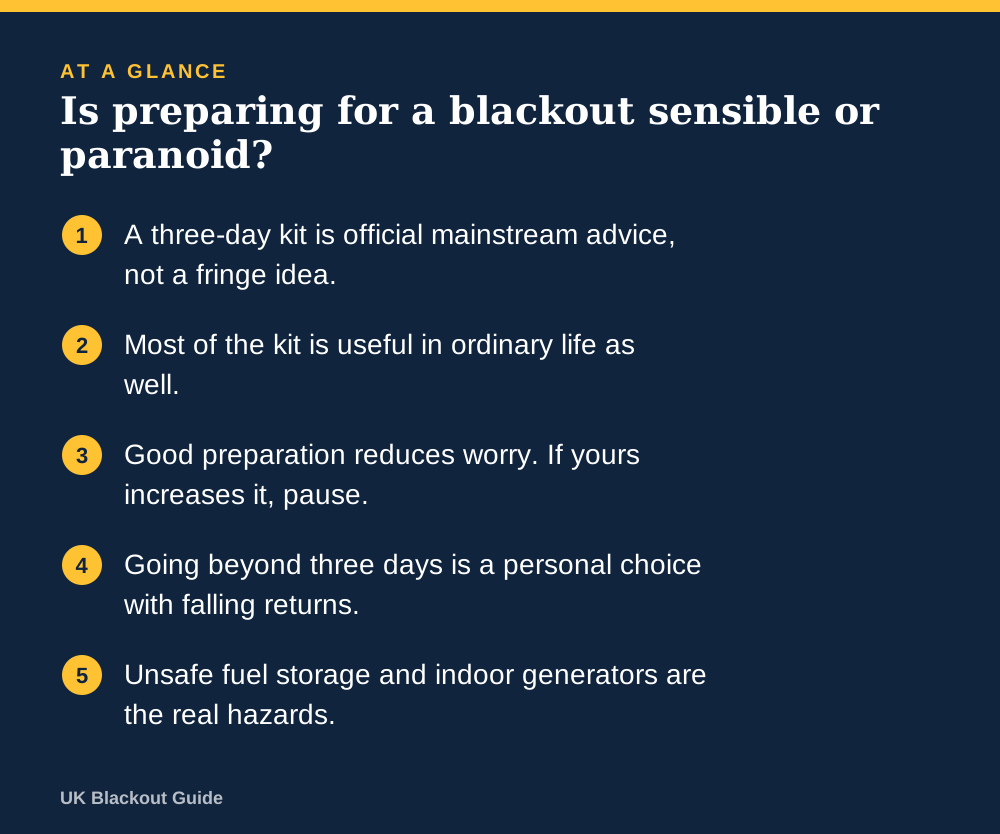
- A three-day kit is official mainstream advice, not a fringe idea.
- Most of the kit is useful in ordinary life as well.
- Good preparation reduces worry. If yours increases it, pause.
- Going beyond three days is a personal choice with falling returns.
- Unsafe fuel storage and indoor generators are the real hazards.
Three days of supplies is the mainstream position
If preparing feels like an odd thing to do, it may help to know it is official advice. The Be Ready campaign, launched by the UK government on 22 October 2026, asks every household to be able to manage for three days. The list is modest: water, food that needs no cooking, a torch, a radio, a power bank, medication, blankets and some cash.
The campaign presents this as general readiness for any disruption. It is not a forecast, and no national blackout is planned or predicted, which is the starting point for why the government is telling people to prepare.
Ordinary power cuts are reason enough. Storm Arwen in 2021 cut power to about 1 million customers, and some rural homes were off for more than a week. A torch and a few tins are useful in any cut, long or short.
A simple test: does it earn its keep in normal life
Sensible preparation is mostly made of things you would use anyway. A power bank goes on holiday. A torch finds the fuse box. Tinned food gets eaten. A first aid kit deals with cut fingers. If you never need them in a power cut, you have lost nothing.
That is a useful test for any purchase. If an item only makes sense in an extreme scenario, costs a lot and needs maintenance, think hard before buying it. Our guide to what not to buy for power cuts lists common examples.
Signs that it has stopped helping
Preparation is supposed to make you calmer. It has gone too far if you notice any of the following.
- You are spending money you do not have, or hiding purchases.
- You check the news or your supplies compulsively and still feel unsafe.
- It is causing arguments at home or frightening children.
- You are storing things that create real danger, such as large amounts of petrol or a generator you plan to run in the garage.
The last point matters. HSE rules allow up to 30 litres of petrol at home in suitable containers, and generators must never run indoors because of carbon monoxide. Poorly judged preparation can be more dangerous than the event it is meant for.
If worry is the main issue, our guide to coping with anxiety about blackouts may help, and your GP can too.
How far past three days is reasonable
A week or two of food and water is a personal choice. The government has not asked for it and has not suggested a cut of that length is expected. The method in preparing gradually without panic buying gets you there at little cost.
Beyond that, each extra week costs more. NESO's restoration standard is all of Great Britain's demand back within five days. Plans for a month or three months are a hobby-level stretch, harmless if they are affordable and safe, and unnecessary for most people. If you want to see what the far end involves, read preparing for 90 days: stock, rotation and routine.
A fair summary is that not preparing at all is the less sensible position, and the best power cut essentials are a practical first step.
Common questions
Is a three-day kit enough?
It is what the government asks for through the Be Ready campaign. Anything longer is a personal choice beyond official guidance.
Will people think I am strange for having an emergency kit?
Less than you might expect. A torch, a radio, some water and tins is what the official campaign asks for, and it is no different in spirit from keeping a first aid kit.
Is it selfish to prepare?
No, as long as you build supplies gradually. Prepared households need less help in an emergency and can support neighbours, which eases pressure on services.
Reviewed against these sources on 18 November 2026. If official advice has changed since, follow the official advice.
General information only. This page is not professional, safety, medical, legal or financial advice, and it is not official guidance. No national blackout has been forecast or announced, and nothing here suggests one is expected. We are independent and have no connection to the government or any energy company. Always check the official sources linked on this page. Full disclaimer
Keep reading
 Guide
Preparing without panic buying
How to build household supplies for a power cut gradually, without bulk buying: a six-week shopping plan based on the UK government's Be Ready advice.
Read: Preparing without panic buying Guide
Three days without power: the plan the government asks for
A day-by-day plan for three days without mains power, built on the UK government's Be Ready advice: water, food, light, radio, warmth and phone charge.
Read: Three days without power: the plan the Question
How long could a national blackout last?
How long a national blackout in Great Britain could last, based on NESO's restoration standard, the National Risk Register and what happened in past events.
Read: How long could a national blackout last? Guide
How to manage 30 days without mains power
Optional planning for 30 days without mains power, far beyond the three days UK guidance asks for: what water, food, energy and health would need.
Read: How to manage 30 days without mains power