On this page
- A simple test before any purchase
- Power banks with small solar panels on the back
- Capacity claims that are too good to be true
- A power station bought to run heating or the kettle
- Kits sold on piece count and survival gadgets
- Anything that burns fuel and is pitched for indoor use
- Candles in bulk, and years of ration packs
- Buying in a rush is the most expensive mistake
- Checklist
- Common questions
Avoid products that promise more than physics allows or solve problems you will not have. The usual offenders are small solar power banks sold as self-sufficient, power banks with implausible capacity claims, power stations bought to run heaters, kits padded with survival gadgets, and any fuel-burning heater or stove intended for indoor use without proper ventilation.
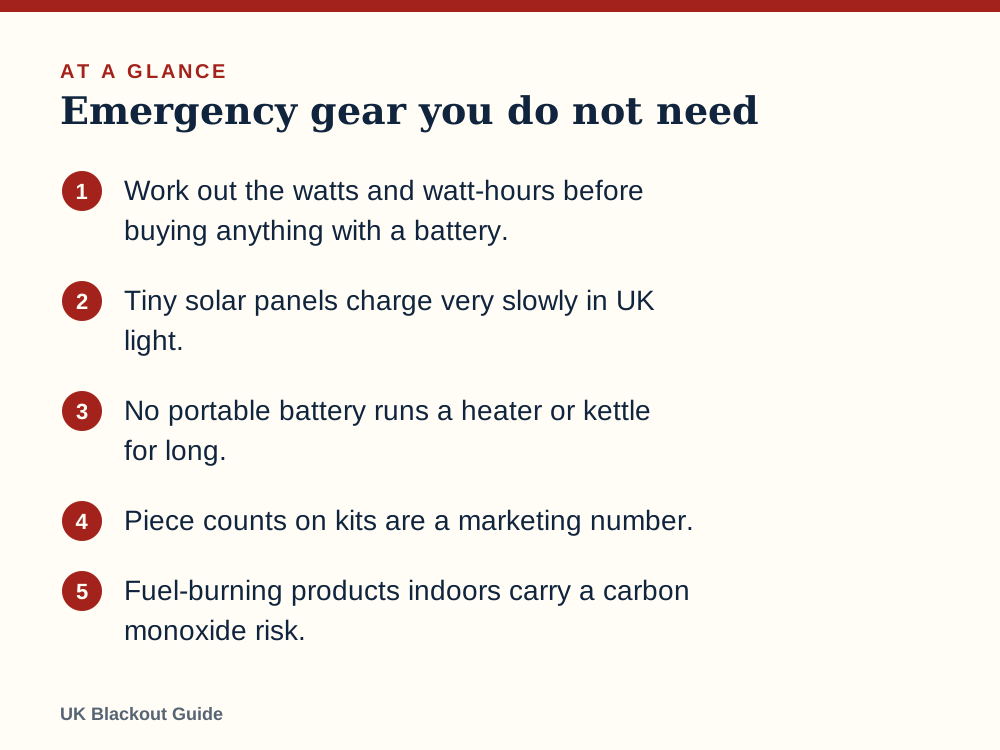
- Work out the watts and watt-hours before buying anything with a battery.
- Tiny solar panels charge very slowly in UK light.
- No portable battery runs a heater or kettle for long.
- Piece counts on kits are a marketing number.
- Fuel-burning products indoors carry a carbon monoxide risk.
A simple test before any purchase
Coverage of household preparedness rose after the Be Ready campaign launched on 22 October 2026, and there is a lot of emergency gear on sale. Some of what is on offer is good. A fair amount is overpriced, underpowered or aimed at wilderness survival instead of three days at home in Leeds. For the demand side of that, see why shops have been selling out of torches and radios.
Ask two questions of any product. Which item on the official list does this cover? And do the numbers on the box stand up to basic arithmetic? Most poor buys fail one of those. The official three-day kit list is short, and almost everything on it is ordinary.
Power banks with small solar panels on the back
These look like the perfect emergency product: a battery that recharges itself. The panel is the problem. A 100 W folding panel, roughly the size of a coffee table top, typically yields 300 to 400 Wh on a clear summer day in the UK and often only 30 to 80 Wh on a dull winter day. The panel on a power bank is a tiny fraction of that size, so its output is tiny too.
In practice, days of good sun may be needed for a single phone charge, and winter light adds very little. The built-in panel is best treated as a trickle. If you want one anyway, judge it as an ordinary power bank and ignore the solar claim. We go through the detail in whether solar power banks really work.
For the same money, a plain branded power bank charged from the wall before a storm does far more. See the power banks we recommend for power cuts.
Capacity claims that are too good to be true
Be wary of pocket-sized power banks from unknown sellers claiming 50,000 or 100,000 mAh at a bargain price. Genuine cells of that capacity are large and heavy. A unit that fits in a shirt pocket and claims it is not telling the truth.
Beyond wasted money, poorly made lithium batteries are a fire risk. Buy from recognised brands with UK safety markings, and be realistic about what the number means: usable phone charges are roughly the bank's mAh multiplied by 0.65, divided by your phone's battery size. A real 20,000 mAh bank gives three to four charges of a typical phone.
A power station bought to run heating or the kettle
Portable power stations are useful for phones, routers, lamps, laptops and some medical devices. They are a poor answer to heat. A fan heater draws about 2,000 W and a kettle 2,000 to 3,000 W.
Runtime in hours is roughly watt-hours multiplied by 0.85, divided by the device's watts. A 1,000 Wh station, which is a large and costly unit, would run a 2,000 W heater for about 25 minutes, if its inverter can supply that much at all. Many cannot. The sums are laid out in whether a power station can run a heater.
If you do want a power station, size it to low-wattage needs first using our power station sizing guide. For warmth, blankets, layers and a sleeping bag cost a fraction as much and never run flat.
Kits sold on piece count and survival gadgets
A 250-piece emergency kit sounds thorough. Often most of the pieces are plasters, safety pins and cable ties, wrapped around a weak torch and a whistle. Wire saws, fishing kits, tactical pens and credit-card multi-tools are aimed at a film version of survival, not at a household waiting for the lights to come back on.
Judge any kit by its torch, its radio and its first aid supplies, then check what you would still need to add. Our shortlist of ready-made kits that are worth considering applies that test.
The same caution applies to multi-function gadgets, such as a radio that is also a torch, power bank, siren and reading lamp. A good wind-up radio is worth having, as we explain in whether wind-up radios are any good. Just do not count on its small internal battery to keep a modern phone charged for three days.
Anything that burns fuel and is pitched for indoor use
Never use generators, barbecues, camping stoves or patio heaters indoors, in garages or in tents. They produce carbon monoxide, which has no smell. Symptoms include headache, dizziness, nausea, breathlessness and collapse.
Be sceptical of listings that describe outdoor heaters or stoves as fine for indoor emergencies. Some portable gas heaters are designed for indoor use, but only with the ventilation the manufacturer specifies and an audible carbon monoxide alarm certified to EN 50291. Read whether portable gas heaters are safe indoors before buying one.
Generators deserve particular thought. They need fuel, outdoor space well away from doors and windows, and they must never be plugged into a house socket. For most households facing a few hours without power, a generator is a large expense that brings new risks. Our generator safety guide explains why.
Candles in bulk, and years of ration packs
Bulk boxes of emergency candles are cheap and feel traditional. Official advice is that torches are safer than candles, and LED lanterns are now inexpensive and run for many hours. The comparison is in torches versus candles.
Pallets of 25-year freeze-dried food are the other common overspend. The official ask is three days of food that needs no cooking. Many freeze-dried meals need hot water, which is the one thing you may not have. Tins from the supermarket cover three days for a fraction of the cost and get eaten in normal life.
Buying in a rush is the most expensive mistake
Rushed buying rarely gets good value. Nothing in the official advice asks you to buy everything this week. Be Ready says to build a kit gradually, and no national blackout is planned or predicted.
Making a list, checking what you own and buying a little at a time gets you a better kit for less. It also leaves stock on the shelves for others, which is the point of preparing without panic buying.
Checklist
Emergency gear you do not need
- Match every purchase to an item on the official list
- Check watts and watt-hours before buying a power station
- Ignore solar panels built into power banks
- Distrust huge capacity claims at low prices
- Read a kit's contents, not its piece count
- Never buy fuel-burning gear intended for use indoors without ventilation
- Choose LED lights over boxes of candles
- Buy tins you will eat before long-life ration packs
Common questions
Are all solar chargers a waste of money?
No. A separate folding panel of a decent size can be useful in summer. It is the very small panels built into power banks that deliver too little to rely on.
Is a generator a bad idea for everyone?
No. It can suit rural homes with frequent long cuts and safe outdoor space. It is a poor first purchase for a typical household preparing for three days.
How can I tell if a power bank's capacity is real?
Compare its size and weight with well-known brands of the same stated capacity. If it is much smaller, lighter and cheaper, the claim is very unlikely to be accurate.
Is freeze-dried food ever worth buying?
It has a place for long storage if you also have a safe way to heat water. For the three days in official advice, ordinary tinned and dry food is simpler and cheaper.
Reviewed against these sources on 18 November 2026. If official advice has changed since, follow the official advice.
General information only. This page is not professional, safety, medical, legal or financial advice, and it is not official guidance. No national blackout has been forecast or announced, and nothing here suggests one is expected. We are independent and have no connection to the government or any energy company. Always check the official sources linked on this page. Full disclaimer
Keep reading
 Question
Are ready-made emergency kits worth it?
Are ready-made emergency kits worth buying in the UK? When a pre-packed kit makes sense, when it does not, and three checks to make before you pay.
Read: Are ready-made emergency kits worth it? Buying guide
Best batteries to stock for emergencies
Which batteries to stock for emergencies and power cuts: seven bulk AA and AAA alkaline packs from Amazon UK compared on shelf life, size and price.
Read: Best batteries to stock for emergencies Buying guide
Best emergency kits for UK homes
No ready-made emergency kit on Amazon UK matches the official Be Ready list. These seven listings cover the parts a UK home can buy ready-made.
Read: Best emergency kits for UK homes Buying guide
Best emergency preparedness gifts
Ten emergency preparedness gifts that work in a power cut: radios, power banks, head torches, hand warmers and flasks picked from Amazon UK listings.
Read: Best emergency preparedness gifts