On this page
An emergency kit should cover five needs for three days: water (3 litres per person per day), food that needs no cooking, light and information (torch, FM radio, power bank), health (first aid, medication, sanitiser, wet wipes) and warmth. Add cash, printed documents, a written contact list, and baby or pet supplies if you need them.
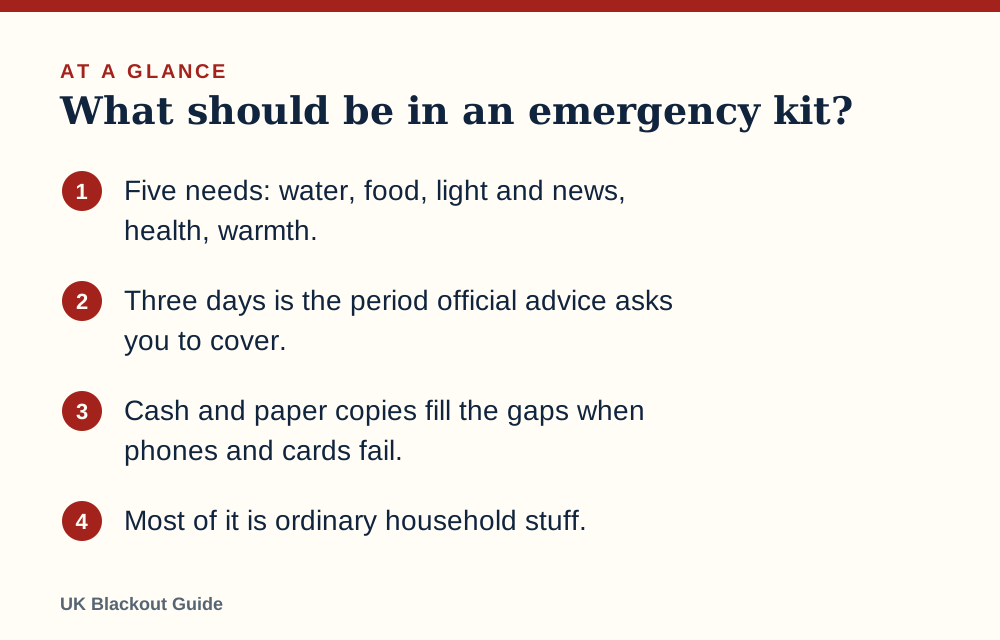
- Five needs: water, food, light and news, health, warmth.
- Three days is the period official advice asks you to cover.
- Cash and paper copies fill the gaps when phones and cards fail.
- Most of it is ordinary household stuff.
The official list, grouped by what each item is for
The UK government's Be Ready campaign publishes the list most households should follow, and what the government says to keep at home is short. It is easier to remember as five needs than as fifteen items.
| Need | What to have |
|---|---|
| Water | Bottled water, 3 litres per person per day for 3 days, more for cooking and washing |
| Food | Non-perishable food that needs no cooking or fridge, and a tin opener |
| Light and news | Battery or wind-up torch with spare batteries, battery or wind-up FM radio, charged power bank |
| Health | First aid kit, essential medication, hand sanitiser, wet wipes |
| Warmth | Blankets, sleeping bags, warm clothing |
Then three things that are easy to overlook: cash in notes and coins, printed copies of important documents, and a written list of contacts and medication. Households with a baby should add ready-to-feed formula and nappies, and pet owners should add pet food.
Why these items and not others
Each item answers something that stops working in a power cut. Mains water can be disrupted. Fridges, freezers and electric cookers go off. Lights go out, broadband drops, and mobile networks may only work for a while on backup power. Most heating stops, including gas boilers. Card payments can fail.
The list is also notable for what it leaves out. There are no generators, no power stations and no specialist survival gear. Be Ready says torches are safer than candles, so candles are not on it either.
What to get first if you have nothing
Start with water (the sum for how much water to store is 3 litres per person per day) and a torch, because being thirsty or in the dark are the problems that arrive soonest. Most people can then cover food from their own cupboards with a little planning.
After that, add a radio and a power bank.
If you would sooner buy a starting point than assemble one, a ready-made emergency kit gives you the bag, first aid supplies and basic light in one go. You will still need to add water, food, medication, cash and documents.
Adapting it to your home
The list is a baseline. An emergency kit for a family with small children will stress different parts of it from one for someone living alone in their eighties or a couple in a tenth-floor flat.
Official advice is to build the kit gradually and check it every six months. There is no need to buy it all at once, and our full emergency kit list with quantities can be worked through a few items at a time.
Checklist
What should be in an emergency kit?
- Bottled water for 3 days
- No-cook food and a tin opener
- Torch, spare batteries, FM radio and power bank
- First aid kit, medication, sanitiser and wet wipes
- Blankets and warm clothing
- Cash, printed documents and a written contact list
- Baby supplies and pet food if needed
Common questions
Should candles be in an emergency kit?
They are not on the official list. Be Ready recommends a battery or wind-up torch and says torches are safer than candles.
Do I need a generator or power station?
No. Neither is on the official list. A charged power bank for your phone is the only power item it asks for.
How long should the kit last?
Three days. That is the period the Be Ready campaign asks households to be able to manage for.
Reviewed against these sources on 18 November 2026. If official advice has changed since, follow the official advice.
General information only. This page is not professional, safety, medical, legal or financial advice, and it is not official guidance. No national blackout has been forecast or announced, and nothing here suggests one is expected. We are independent and have no connection to the government or any energy company. Always check the official sources linked on this page. Full disclaimer
Keep reading
 Guide
72-hour emergency kit UK: the Be Ready list, item by item
72 hour kit UK: the government's Be Ready three-day list explained item by item, with quantities per person, what each item is for and how to store it.
Read: 72-hour emergency kit UK: the Be Ready list, Buying guide
Best emergency kits for UK homes
No ready-made emergency kit on Amazon UK matches the official Be Ready list. These seven listings cover the parts a UK home can buy ready-made.
Read: Best emergency kits for UK homes Guide
UK emergency kit list: the official items and what we would add
The full UK emergency kit list for managing three days at home, based on the government's Be Ready advice, with quantities for water, food, light and power.
Read: UK emergency kit list: the official items and Guide
Ready-made or DIY emergency kit?
Ready-made emergency kit or build your own? A side-by-side comparison of cost, quality, effort and what every pre-packed kit still leaves you to add.
Read: Ready-made or DIY emergency kit?