On this page
A 72 hour kit in the UK is the three-day kit the government's Be Ready campaign describes: 9 litres of drinking water per person, three days of no-cook food, a tin opener, a torch, an FM radio, a power bank, first aid, medication, hygiene items, warm bedding, cash and key papers. It is general preparedness. No blackout is forecast.
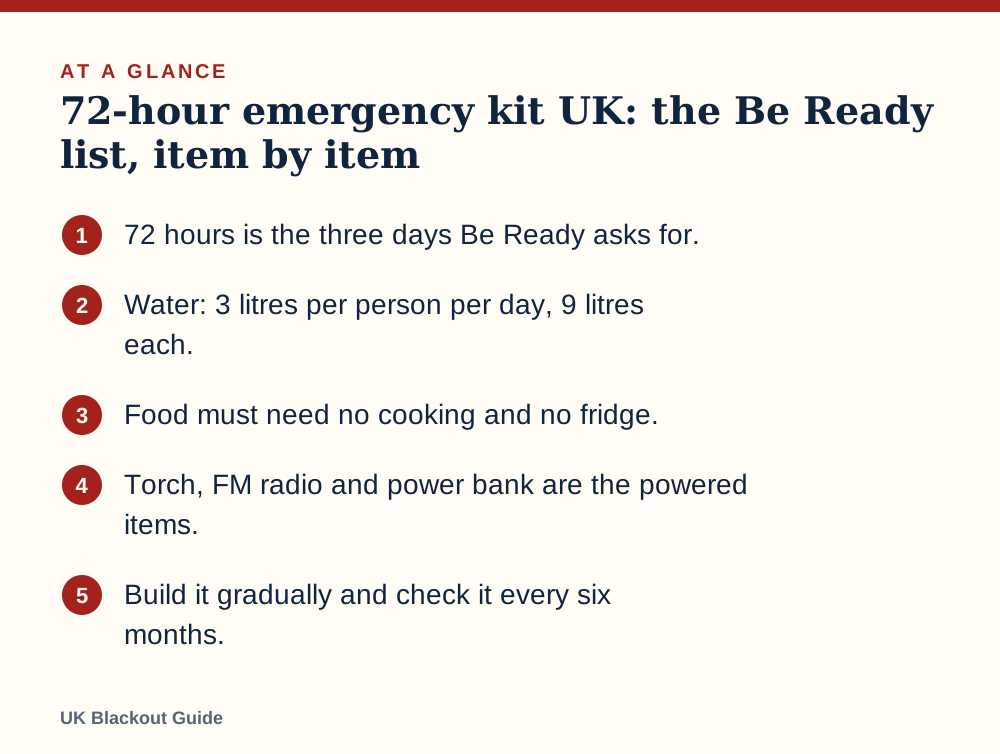
- 72 hours is the three days Be Ready asks for.
- Water: 3 litres per person per day, 9 litres each.
- Food must need no cooking and no fridge.
- Torch, FM radio and power bank are the powered items.
- Build it gradually and check it every six months.
Where the 72-hour figure comes from
A 72 hour kit in the UK means the three-day household kit set out by the government's Be Ready campaign at beready.campaign.gov.uk. The campaign, launched on 22 October 2026, asks households to be able to manage for three days.
Be Ready presents this as general preparedness for emergencies of several kinds, not a forecast. No UK blackout has been announced, planned or predicted, and the government has not asked households to prepare for longer than three days. Below is each item on the list, what it is for and how much you need.
Water: 9 litres per person
When you work out how much water to store, Be Ready says 3 litres per person per day for drinking, and more for cooking and washing. Over 72 hours that is 9 litres each: 18 litres for a couple, 36 for a family of four. Mains water can be disrupted during and after power cuts, because pumping and treatment need electricity.
Sealed shop-bought water is simplest. Keep it somewhere cool and dark and use it by the date on the bottle.
Food and a tin opener
The list asks for non-perishable food for three days that needs no cooking or fridge. Tinned fish and beans, crackers, nut butter, cereal bars, dried fruit and long-life milk all qualify, and they are the basis of most no-cook meal ideas. Choose things your household likes, so you can eat them and replace them before they go out of date.
Add a manual tin opener, even if most of your tins have ring pulls. Include ready-to-feed formula and nappies for a baby, and food for pets.
Food in your fridge and freezer is separate from the kit. The Food Standards Agency says an unopened fridge stays cold for around 4 hours and a full freezer stays frozen for about 48 hours. If in doubt, throw it out.
Torch and spare batteries
Be Ready lists a battery or wind-up torch with spare batteries, and states that torches are safer than candles. One torch per person stops arguments on the stairs.
FM radio and power bank
A battery or wind-up FM radio is on the list because broadband needs mains power and mobile networks may work only temporarily on backup power. Be Ready advises trying both FM and digital, which is worth remembering when you compare emergency radios. On 7 November 2026 the BBC reported that it plans to keep broadcasting on FM in a long outage.
A charged power bank keeps a phone alive for calls and texts. Usable charges are roughly the bank's mAh times 0.65, divided by your phone's battery mAh. A 20,000 mAh bank, a common size among the power banks suited to power cuts, gives a typical phone 3 to 4 charges, which covers three days of light use. Top it up every few months and keep a cable with it.
If you choose wind-up over batteries, it helps to know how well wind-up radios work and how much cranking they need.
First aid, medication and hygiene
The list includes a first aid kit, essential medication, hand sanitiser and wet wipes. For medication, speak to your pharmacist or GP about what reserve is sensible for you and follow their advice. Keep a written list of medicines and doses with the kit.
Sanitiser and wipes are there because water may be short. For the kit itself, the basics in what a first aid kit should contain are enough.
Warmth, cash and paperwork
Be Ready lists blankets, sleeping bags and warm clothing. In a cut, the official advice is to keep warm with layers and to close doors and curtains. Never heat a room with a barbecue, camping stove or patio heater, because of carbon monoxide.
Cash kept for an emergency, in notes and coins, covers you if card payments or cash machines stop. Printed copies of documents (ID, insurance, prescriptions) and a written list of contacts complete the set. Add 105 to that list, or 03457 643643 in Northern Ireland.
Buying a kit or building one
You can assemble all of this from a supermarket and a hardware shop. Some people start with a boxed kit for the torch, radio and first aid items, then add water, food and medication, which is the middle course between ready-made and home-built kits.
Be Ready says to build gradually and to give the kit a check every six months.
Checklist
72-hour emergency kit UK: the Be Ready list, item by item
- 9 litres of drinking water per person
- Three days of no-cook, no-fridge food
- Manual tin opener
- Torch and spare batteries
- Battery or wind-up FM radio
- Charged power bank
- First aid kit and medication
- Hand sanitiser and wet wipes
- Blankets and warm clothing
- Cash, document copies and contact list
Common questions
Is a 72-hour kit the same as a grab bag?
Not quite. A 72-hour kit is for staying at home for three days. A grab bag is a smaller bag for leaving quickly.
Why 72 hours and not a week?
Three days is what the government's Be Ready campaign asks for. It has not asked households to prepare for longer.
Where should I keep the kit?
Somewhere cool, dry and easy to reach in the dark, with everything in one or two boxes. Tell everyone in the house where it is.
Does the kit need to be bought new?
No. Most of it is ordinary food, bedding and items you may already own. Check they work and gather them together.
Reviewed against these sources on 18 November 2026. If official advice has changed since, follow the official advice.
General information only. This page is not professional, safety, medical, legal or financial advice, and it is not official guidance. No national blackout has been forecast or announced, and nothing here suggests one is expected. We are independent and have no connection to the government or any energy company. Always check the official sources linked on this page. Full disclaimer
Keep reading
 Guide
UK emergency kit list: the official items and what we would add
The full UK emergency kit list for managing three days at home, based on the government's Be Ready advice, with quantities for water, food, light and power.
Read: UK emergency kit list: the official items and Buying guide
Best emergency preparedness gifts
Ten emergency preparedness gifts that work in a power cut: radios, power banks, head torches, hand warmers and flasks picked from Amazon UK listings.
Read: Best emergency preparedness gifts Question
What does the government say to keep at home for a power cut?
What to buy for the blackout, according to the government: the Be Ready list of water, food, a torch, an FM radio, a power bank, medication and cash.
Read: What does the government say to keep at home Explainer
The government's Be Ready campaign: what it asks households to do
The government's Be Ready campaign, launched 22 October 2026, asks every household to be able to manage for three days. The full kit list and what it means.
Read: The government's Be Ready campaign: what it