On this page
Building your own kit usually gives better quality for the money, because you choose each item and reuse what you own. A ready-made kit is quicker and gets a reluctant household started. Neither is complete out of the box: no pre-packed kit includes your medication, enough water for your household, cash or your documents.
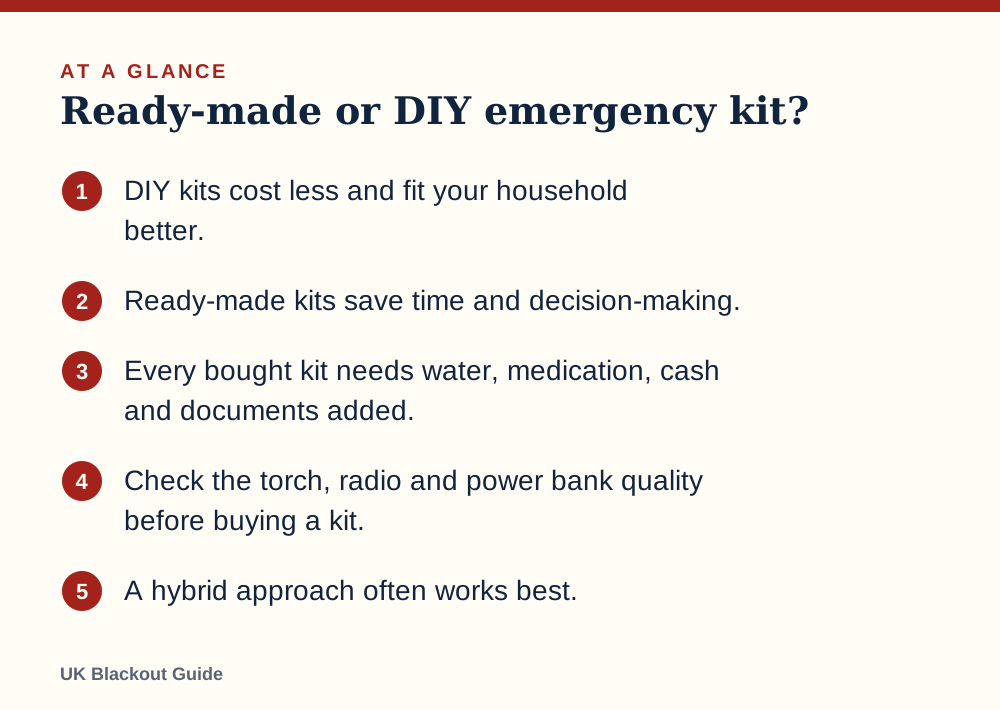
- DIY kits cost less and fit your household better.
- Ready-made kits save time and decision-making.
- Every bought kit needs water, medication, cash and documents added.
- Check the torch, radio and power bank quality before buying a kit.
- A hybrid approach often works best.
How the two approaches compare
| Ready-made kit | Build your own | |
|---|---|---|
| Time | One order | Several shopping trips |
| Cost | Higher for the same contents | Lower, and spread out |
| Quality of key items | Varies a lot, often basic | Your choice |
| Fit to your household | Generic, sized per person | Exact |
| Water for 3 days | Rarely the full amount | You buy the right quantity |
| Medication, cash, documents | Never included | You add them |
| Storage | Comes in one bag or box | You supply the container |
The table makes DIY look like the obvious winner, and on value it usually is, which is most of the answer to whether pre-packed kits are worth the money. The case for a bought kit rests on one thing: a kit that exists beats a list you never get round to.
What you are paying for in a ready-made kit
A ready-made emergency kit bundles a bag, a torch, often a wind-up radio, a first aid kit, foil blankets, and sometimes ration bars and water pouches. Part of the price is the items, and part is the assembling, packing and marketing.
That convenience has real worth for some buyers. If you are putting a kit together for an elderly parent who lives two hundred miles away, or you know you will not do the legwork, paying for someone else to do it is reasonable.
The weak points to check in any bought kit
Kits are often sold on the number of pieces. A 200-piece kit can be 150 plasters, wipes and safety pins. Look at the handful of items that do real work.
- The torch. Does it take standard batteries, and are they included?
- The radio. It should receive FM. A tiny crank radio with a weak speaker is better than nothing, but compare it with a stand-alone wind-up radio.
- The power bank, if there is one. Small built-in batteries in multi-function radios will not recharge a modern phone fully.
- Water. Be Ready advises 3 litres per person per day. A few small pouches fall a long way short, so plan to store the right amount of water separately.
- Food. Ration bars keep for years but few people enjoy them. Check dates on arrival.
If the listing does not say what the torch runs on or how big the battery is, assume the answer is disappointing.
What building your own involves
A DIY kit is the official list bought item by item. Work down the three-day emergency kit list, tick off what you own, and buy the rest over a few weeks. Much of it comes from a supermarket.
The advantage is that each choice is deliberate. You can buy a torch that shares batteries with your radio, a first aid kit that suits your family, and food you will happily eat when it comes up for rotation.
The drawback is effort and follow-through. Half-built kits are common. If you go this route, set a date to finish and put the small items in one labelled box as you buy them. A box that fills up week by week is its own reminder of what is still missing.
The hybrid route most households end up with
You do not have to pick a side. A sensible middle path is to buy a modest ready-made kit for the bag, first aid supplies and odds and ends, then upgrade the two or three items that matter and add the personal ones.
In practice that means swapping in a better torch, adding a proper power bank, and filling the gaps no manufacturer can fill for you: prescription medicines, a written contact list, printed documents, cash in notes and coins, baby supplies and pet food. Budget for those upgrades when you compare prices, because they change what an emergency kit costs either way.
Which one suits you
Build your own if you are on a budget, already own half the list, or have particular needs such as a baby, a medical condition or a pet. Buy ready-made if time is the constraint, if the kit is a gift, or if a bag by the door is what will finally get it done.
Whichever you choose, be wary of kits padded with survival gadgets you will never use, the classic emergency products that are poor value.
Checklist
Ready-made or DIY emergency kit?
- Compare the kit contents against the official Be Ready list
- Check what batteries the torch and radio use
- Confirm the radio receives FM
- Add 3 litres of water per person per day
- Add medication and a written list of doses
- Add cash, printed documents and a contact list
- Add baby supplies or pet food if needed
- Note food and battery dates for your six-month check
Common questions
Are ready-made kits approved by the government?
No. Be Ready publishes a list of items but does not approve or endorse commercial kits. Treat any claim of official approval with suspicion.
Do bought kits expire?
Parts of them do. Food, water pouches, batteries and some first aid items carry dates, so check them on arrival and every six months.
Is a kit sized for one person enough for a couple?
Not for water, food or bedding, which scale with the number of people. Shared items such as a radio and first aid kit can serve the whole household.
Can I build a kit entirely from a supermarket?
Very nearly. Water, tinned food, a tin opener, batteries, wipes, sanitiser, first aid basics and often a torch are all on supermarket shelves. A radio and power bank may need a separate purchase.
Reviewed against these sources on 18 November 2026. If official advice has changed since, follow the official advice.
General information only. This page is not professional, safety, medical, legal or financial advice, and it is not official guidance. No national blackout has been forecast or announced, and nothing here suggests one is expected. We are independent and have no connection to the government or any energy company. Always check the official sources linked on this page. Full disclaimer
Keep reading
 Question
Are ready-made emergency kits worth it?
Are ready-made emergency kits worth buying in the UK? When a pre-packed kit makes sense, when it does not, and three checks to make before you pay.
Read: Are ready-made emergency kits worth it? Buying guide
Best emergency kits for UK homes
No ready-made emergency kit on Amazon UK matches the official Be Ready list. These seven listings cover the parts a UK home can buy ready-made.
Read: Best emergency kits for UK homes Question
How much does a three-day emergency kit cost?
Rough costs for a UK three-day emergency kit, where the money goes, why most households spend less than they expect, and what pushes the bill up.
Read: How much does a three-day emergency kit cost? Question
What should be in an emergency kit?
The short answer to what belongs in a UK emergency kit: the items on the government's Be Ready list, grouped into five needs, with what to get first.
Read: What should be in an emergency kit?