On this page
Keep the small, urgent items (torch, radio, power bank, first aid kit, cash and documents) together in one box somewhere you can reach in the dark without stairs or a ladder, such as a hall cupboard or under the stairs. Water, food and bedding can stay where they normally live, as long as everyone knows where.
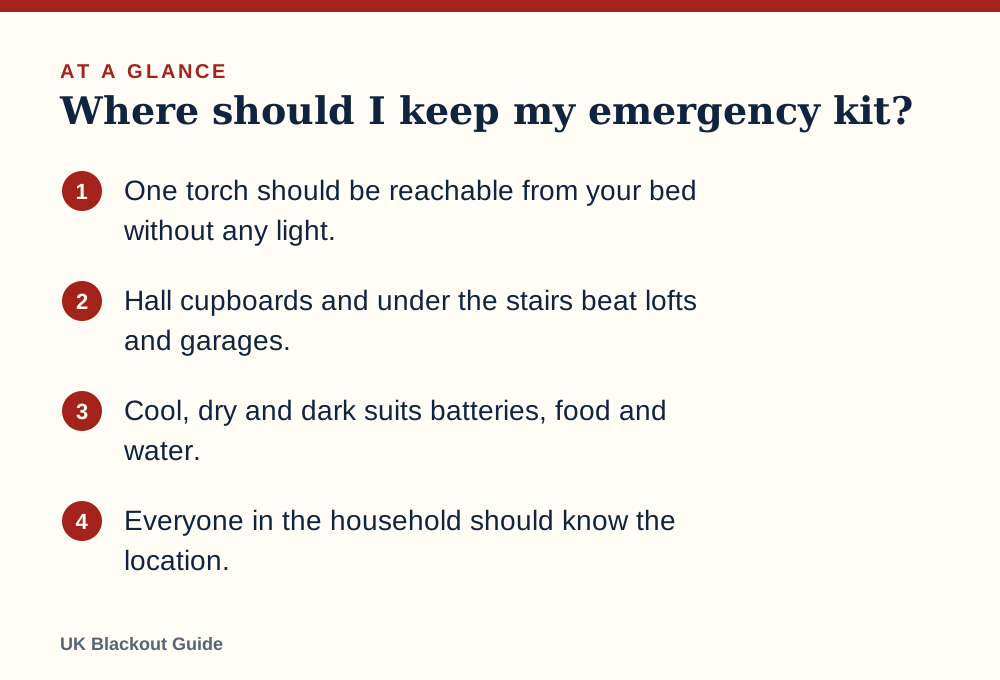
- One torch should be reachable from your bed without any light.
- Hall cupboards and under the stairs beat lofts and garages.
- Cool, dry and dark suits batteries, food and water.
- Everyone in the household should know the location.
The test: can you find it with the lights off
A kit is only useful if you can get to it when the power has just failed, possibly at night. Try it. Stand in your bedroom or living room, imagine complete darkness, and walk through how you would reach the box.
If the route involves a loft hatch, a garage across a dark garden or moving three suitcases, pick somewhere else. Good locations are a hall cupboard, the cupboard under the stairs, a low kitchen cupboard, or the bottom of a wardrobe.
Keep one torch outside the kit, by your bed or by the fuse box. Its job is to get you to the box. A plug-in automatic power cut light that switches on when the mains fails does this without you having to do anything.
Places that seem sensible but are not
The loft. Hard to reach in the dark, and it gets hot in summer and cold in winter, which shortens the life of batteries, food and medicines.
The garage or shed. Damp, temperature swings and the walk outside all count against it. It is the right place for spare petrol, which should never be kept in the living space, but not for food or electronics.
Next to the boiler or a radiator. Warmth speeds up battery drain and spoils food sooner.
A high shelf. Awkward for anyone with limited mobility, and impossible for children who may need to fetch a torch.
Aim for cool, dry and out of direct sunlight. That suits bottled water in particular, which should also be kept away from strong-smelling products such as paint and cleaning chemicals.
One box, or several places
Most homes do best with a split. Put the small things in a single lidded box you can carry to whichever room you are using. Leave the bulky things where there is space.
- The box: torches, spare batteries, radio, power bank and cable, first aid kit, sanitiser and wipes, tin opener, cash, document copies, contact list.
- Kitchen cupboard: three days of no-cook food, on one shelf so it is easy to see and rotate.
- Under a bed or in a cool cupboard: bottled water.
- Airing cupboard or wardrobe: blankets and sleeping bags.
- Usual place: daily medication, with a written list of it in the box.
Write on the lid where the other parts are, so the box leads you to everything on the three-day emergency kit list.
If you might have to leave
The home kit is for staying in. If you also keep a grab bag for leaving in a hurry, store that by the door you would use, separate from the main box.
Cash and documents deserve a little thought. Keeping them in the kit box is convenient, but a small lockable box or a fireproof document bag inside it is a sensible precaution.
Tell everyone, then check it
Show every member of the household where the box is and how the torch and radio work. Tell a relative or neighbour who might come to help. A location only one person knows is a weak point.
Wherever it lives, look inside twice a year, following a six-month kit check routine that takes about twenty minutes.
Common questions
Can I keep my emergency kit in the car?
A car kit is useful, but it should be a separate one. Heat and cold in a parked car are hard on food, water and batteries, and the car may not be at home when the power goes.
Is under the bed a good place for water?
Yes, if it is cool and away from heaters. Bottles laid flat under a bed are out of sunlight and use space that is otherwise empty.
Should the kit be locked away?
Not the whole kit, because you need quick access. Keep medicines out of children's reach, and consider a small lockable box inside the kit for cash.
Reviewed against these sources on 18 November 2026. If official advice has changed since, follow the official advice.
General information only. This page is not professional, safety, medical, legal or financial advice, and it is not official guidance. No national blackout has been forecast or announced, and nothing here suggests one is expected. We are independent and have no connection to the government or any energy company. Always check the official sources linked on this page. Full disclaimer
Keep reading
 Guide
72-hour emergency kit UK: the Be Ready list, item by item
72 hour kit UK: the government's Be Ready three-day list explained item by item, with quantities per person, what each item is for and how to store it.
Read: 72-hour emergency kit UK: the Be Ready list, Buying guide
Best batteries to stock for emergencies
Which batteries to stock for emergencies and power cuts: seven bulk AA and AAA alkaline packs from Amazon UK compared on shelf life, size and price.
Read: Best batteries to stock for emergencies Buying guide
Best emergency kits for UK homes
No ready-made emergency kit on Amazon UK matches the official Be Ready list. These seven listings cover the parts a UK home can buy ready-made.
Read: Best emergency kits for UK homes Buying guide
Best emergency preparedness gifts
Ten emergency preparedness gifts that work in a power cut: radios, power banks, head torches, hand warmers and flasks picked from Amazon UK listings.
Read: Best emergency preparedness gifts