On this page
A grab bag is a small bag of essentials, kept packed and near the door, that you can pick up and leave with at short notice if your home becomes unsafe. It holds documents, medication, cash, a phone charger, a torch, water, snacks and warm layers: enough for a night or two elsewhere.
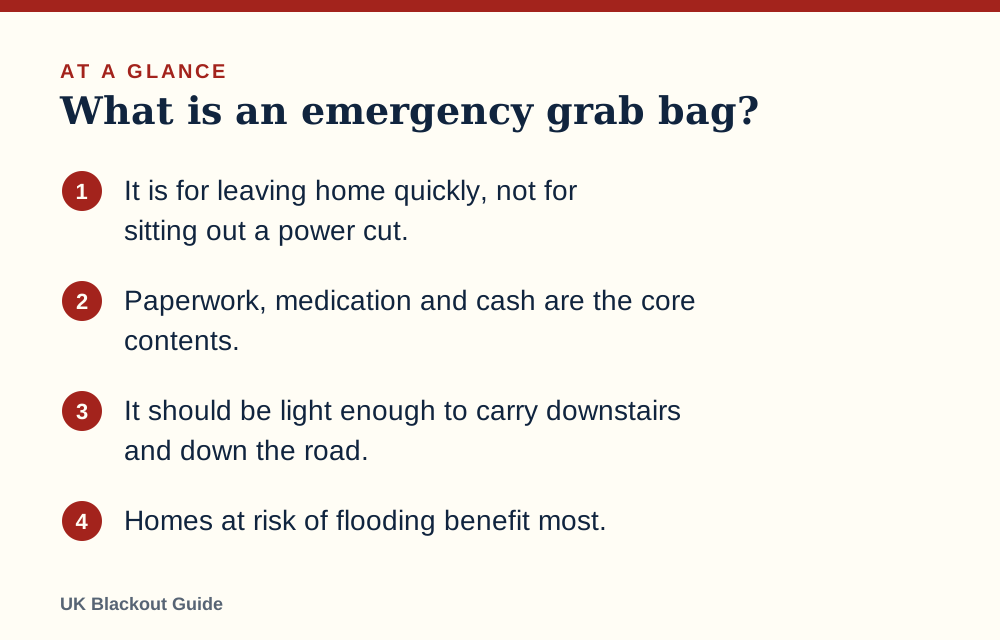
- It is for leaving home quickly, not for sitting out a power cut.
- Paperwork, medication and cash are the core contents.
- It should be light enough to carry downstairs and down the road.
- Homes at risk of flooding benefit most.
A bag for going, as opposed to a kit for staying
The idea is simple. If you had two minutes to get out, because of a flood warning, a fire in the building or a gas leak in the street, what would you want in your hand? A grab bag is that answer, packed in advance.
It is a different thing from the three-day emergency kit the government's Be Ready campaign asks households to keep. That kit includes 3 litres of water per person per day and three days of food, and is meant to stay at home with you. A grab bag carries hours of supplies, not days, because the assumption is that you are heading somewhere with food, water and shelter, such as a relative's home or a rest centre.
Whether you need one for a power cut
For a power cut alone, usually not. Your home is still sound, your bedding is there and your supplies are there. Staying put is nearly always safer and more comfortable than travelling when traffic lights, trains and fuel pumps may be affected.
The cases where leaving makes sense are narrower: the house is dangerously cold and someone vulnerable lives there, essential medical equipment has stopped, or there is a separate hazard such as flooding. Our guide to whether to stay at home or leave works through that decision.
So a grab bag is a sensible extra, particularly if you live somewhere with a flood risk, in a block of flats, or with someone who may need to move to a relative's house if the heating is off for long.
What goes in it
Keep it short. The useful contents are mostly dull.
- Medication for a few days and a written list of what each person takes
- Copies of ID, insurance details and key phone numbers (see which documents are worth copying)
- Cash in small notes and coins
- A charged power bank and cable
- A torch or head torch with spare batteries
- A bottle of water and some snack bars
- A hat, gloves, spare socks and a foil blanket
- A small first aid kit, wipes and sanitiser
- Spare glasses and spare keys
Follow your clinician's advice on any medication that needs special storage. For quantities, packing order and a last-minute list of things that cannot live in the bag, see our full guide to packing a grab bag.
The bag itself
Any comfortable rucksack will do, and you may well own a suitable one. A rucksack is better than a holdall because it leaves your hands free. Around 20 to 30 litres is enough for one adult, and it should be light enough that its owner can carry it down the stairs and walk for twenty minutes.
If you are buying one, our pick of grab bags and rucksacks sticks to plain designs that are comfortable to carry.
Store it by the door you would leave through, and check the contents every six months when you check your home kit.
In a fire, or if you smell gas or a carbon monoxide alarm sounds, leave immediately and do not go back for a bag.
Common questions
Is a grab bag the same as a go bag?
Yes. Grab bag, go bag and emergency bag all describe a small pre-packed bag for leaving home quickly.
How heavy should a grab bag be?
There is no official figure. A practical test is that the person it belongs to can carry it downstairs and walk for twenty minutes without difficulty.
Does every person in the house need one?
Not necessarily. One bag per adult works well, with children's things shared between them. A small household can manage with one.
Reviewed against these sources on 18 November 2026. If official advice has changed since, follow the official advice.
General information only. This page is not professional, safety, medical, legal or financial advice, and it is not official guidance. No national blackout has been forecast or announced, and nothing here suggests one is expected. We are independent and have no connection to the government or any energy company. Always check the official sources linked on this page. Full disclaimer
Keep reading
 Buying guide
Best grab bags for emergencies
Grab bags for emergencies are rucksacks kept packed by the door. Seven backpacks from Amazon UK compared on stated size, weather protection and price.
Read: Best grab bags for emergencies Guide
Grab bags: what to pack if you have to leave
What to pack in a UK grab bag, how heavy it should be, where to keep it and how it differs from the three-day emergency kit you keep at home.
Read: Grab bags: what to pack if you have to leave Guide
72-hour emergency kit UK: the Be Ready list, item by item
72 hour kit UK: the government's Be Ready three-day list explained item by item, with quantities per person, what each item is for and how to store it.
Read: 72-hour emergency kit UK: the Be Ready list, Buying guide
Best batteries to stock for emergencies
Which batteries to stock for emergencies and power cuts: seven bulk AA and AAA alkaline packs from Amazon UK compared on shelf life, size and price.
Read: Best batteries to stock for emergencies