On this page
Stay at home unless you have a specific reason to go. Home has your supplies, your bed and your neighbours. Leave if someone's health depends on power or warmth you cannot provide, if the house is unsafe, or if the cut is local and you have a confirmed place to stay with power nearby.
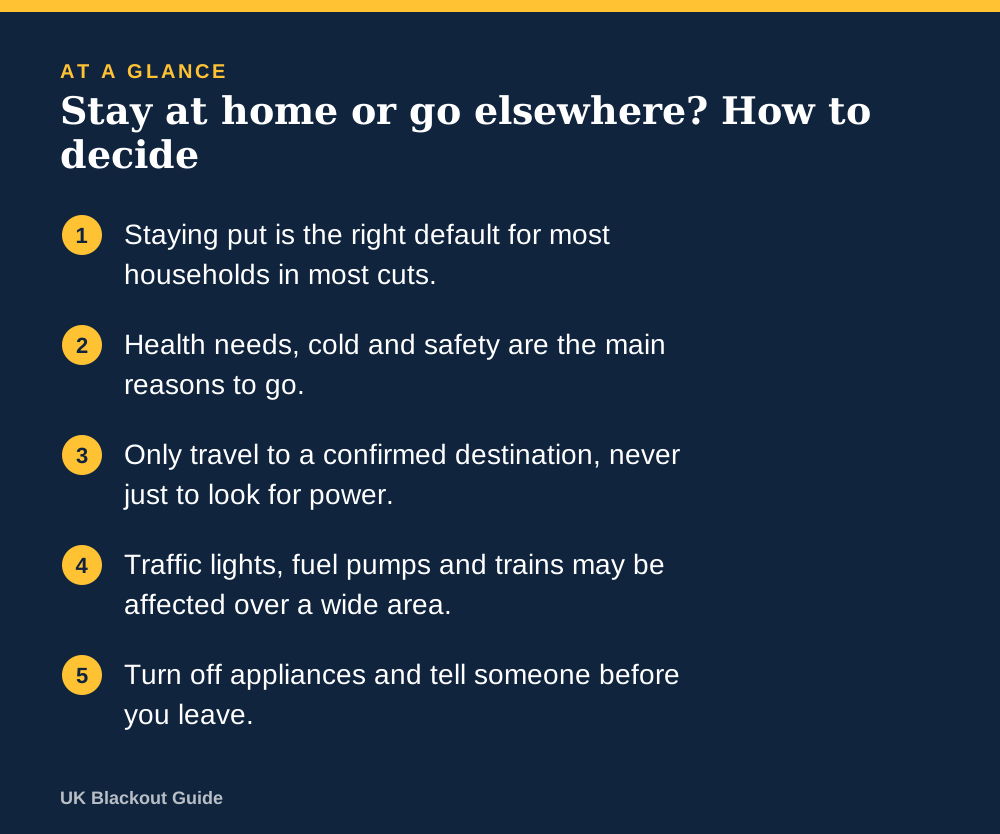
- Staying put is the right default for most households in most cuts.
- Health needs, cold and safety are the main reasons to go.
- Only travel to a confirmed destination, never just to look for power.
- Traffic lights, fuel pumps and trains may be affected over a wide area.
- Turn off appliances and tell someone before you leave.
Home is the default, and for good reasons
In nearly every UK power cut, the best place to be is your own home. Your food, water, medication, bedding and kit are there. You know the building in the dark. Your neighbours know you, and the network operator knows the address if you are on the Priority Services Register.
Official advice for power cuts is written around staying in: keep warm with layers and blankets, close doors and curtains, check on neighbours, listen to the radio. Travel adds risk, particularly at night or in the storm that caused the cut in the first place. So the question to ask is whether you have a reason to leave, not whether you have a reason to stay. The government has not suggested a long outage is expected, and this page describes the decision in general terms.
Five tests that can tip the decision
- Medical dependence. Someone relies on powered equipment, refrigerated medicine or care visits, and your backup will run out before power is likely to return. Plan this in advance with your clinician.
- Cold. You cannot keep one room and its occupants warm, and the household includes a baby, an older person or someone unwell. The NHS advises 18°C for rooms in use, a useful marker of how cold is too cold for a house.
- The building. Flooding, storm damage, a smell of gas or a carbon monoxide alarm make the decision for you. For gas, leave and call 0800 111 999.
- Water and sanitation. No water and no means of managing toilets, which arrives sooner in high flats where pumps supply the upper floors.
- Duration and extent. The cut is local, your network operator estimates days, and family or friends a short drive away have power.
One clear yes is enough to start planning a move. Several weak maybes are usually a reason to stay and improve things where you are.
Find out how big the cut is before you move
Whether leaving helps depends on how far the outage reaches. Call 105 or check your network operator's website from a phone to learn the cause and the estimated restoration time. A battery or wind-up radio, the mainstay of getting news in a blackout, will tell you whether the problem is your street, your town or something wider.
A local fault means power, shops and heating exist a few miles away, and moving is straightforward. A wide-area outage is different. There may be nowhere nearby that is better off, and roads and transport may be disrupted. In that case, staying is almost always right unless one of the first three tests applies.
Where to go, in order of preference
Family or friends with power, a spare room and an invitation come first. Agree this in advance as part of a household emergency plan, with their address and number written on paper, since you may not be able to look it up.
Second is a hotel or similar, if the cut is local and you can pay. Card machines need power and a network connection, so carry cash.
Third is an official rest centre. Councils and network operators may open these in long cuts, with warmth, hot food and charging. Listen for announcements on local radio. Do not set off without a confirmed destination, and do not drive around looking for somewhere with lights on.
Travelling when the power is out
When driving in a power cut, assume traffic lights are off and treat dead junctions with great care. Street lighting may be out, so walk with a torch and something reflective.
Trains in a power cut may be delayed or cancelled, as happened across Britain on 9 August 2019, and fuel pumps need electricity.
This is the reason for keeping the car at least half full and one of the best grab bags you can manage ready by the door.
A good head torch is the most useful single item for leaving in the dark.
Leaving the house safe behind you
Before you go, switch off and unplug cookers, heaters, irons and electronics, so nothing comes on unattended when power returns, and be sure you know how to turn off your gas, water and electricity at the mains. Leave one light switched on if you want a neighbour to see when supply is back.
Empty the fridge of anything that will spoil. In freezing weather, protect the plumbing by keeping pipes from freezing.
Lock up as normal, take keys, and tell a neighbour or relative where you are going and how to reach you. If you are on the Priority Services Register, let your network operator know you have moved so they do not send help to an empty house. Take pets with you, with food and a lead or carrier.
If you stay, decide when you would review it
A decision to stay is not final. Set review points: each morning, each time the restoration estimate changes, and whenever someone's health changes. Agree in advance what would make you go, such as a room temperature you cannot raise, a medicine supply down to two days or a backup battery down to its last night.
Deciding these thresholds while calm means you will not be arguing about them at 3am on the fourth night.
Common questions
Should I leave home as soon as a big power cut starts?
No. Find out the cause and the estimated restoration time first. Travelling in the dark or in a storm carries its own risks.
What if I have nowhere to go?
Stay, keep to one warm room and tell your network operator on 105 if anyone is vulnerable. Listen to local radio for rest centres opened by councils or network operators.
Can I be told to leave my home in a power cut?
Evacuation is rare and would be for a specific danger such as flooding or a gas leak. If emergency services ask you to leave, follow their instructions.
Should I take my emergency kit with me?
Take the grab bag, medication, documents and cash. Leave bulky stores at home, where you will need them when you return.
Reviewed against these sources on 18 November 2026. If official advice has changed since, follow the official advice.
General information only. This page is not professional, safety, medical, legal or financial advice, and it is not official guidance. No national blackout has been forecast or announced, and nothing here suggests one is expected. We are independent and have no connection to the government or any energy company. Always check the official sources linked on this page. Full disclaimer
Keep reading
 Question
Can portable solar keep a household going in a long power cut?
What portable solar panels can and cannot power in a UK home during a long outage, with realistic summer and winter output and example daily loads.
Read: Can portable solar keep a household going in Question
How do I wash clothes without power?
How to wash and dry clothes by hand in a long power cut using two buckets, a little detergent and as little water as possible, and what to wash first.
Read: How do I wash clothes without power? Question
How long could a national blackout last?
How long a national blackout in Great Britain could last, based on NESO's restoration standard, the National Risk Register and what happened in past events.
Read: How long could a national blackout last? Guide
How to manage 30 days without mains power
Optional planning for 30 days without mains power, far beyond the three days UK guidance asks for: what water, food, energy and health would need.
Read: How to manage 30 days without mains power