On this page
You can drive in a power cut, but expect dead traffic lights, dark streets and closed petrol stations. Treat any junction with failed lights as unmarked and proceed with great care. Avoid journeys you do not need, keep fuel in the tank, and never run the engine in a garage to charge phones or keep warm.
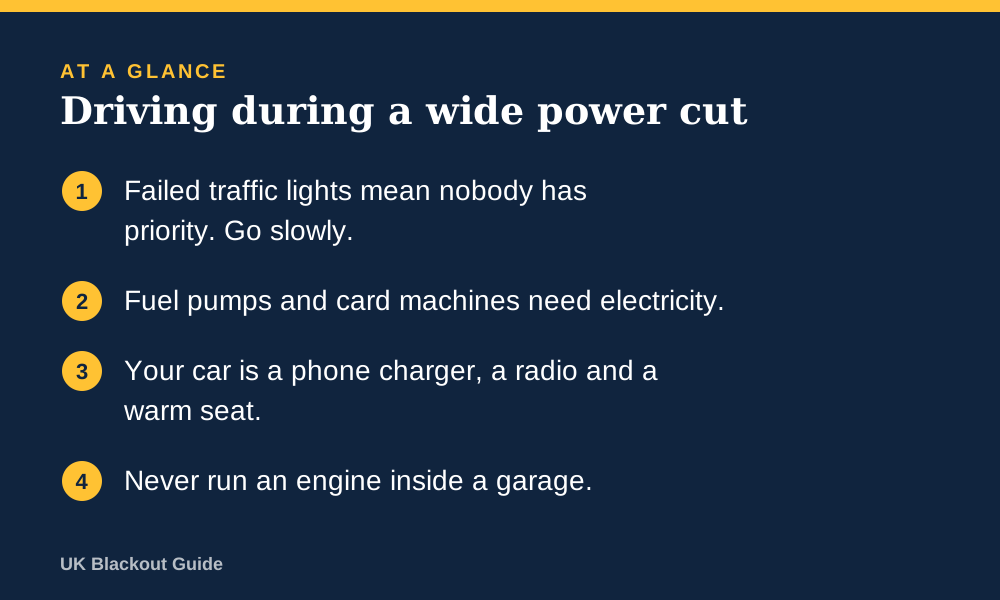
- Failed traffic lights mean nobody has priority. Go slowly.
- Fuel pumps and card machines need electricity.
- Your car is a phone charger, a radio and a warm seat.
- Never run an engine inside a garage.
Decide whether you need to drive at all
In a local cut covering a few streets, driving is normal a mile down the road. In a wide one, the roads themselves change: signals are out, street lights are off, and other drivers are distracted and unsure. If the journey can wait a few hours, let it.
Good reasons to go include reaching someone vulnerable, getting to somewhere with heat or power, or collecting children. Going out to look for an open shop or a working cash machine in the affected area is usually a waste of fuel.
Junctions when the traffic lights are out
The Highway Code is clear. If traffic lights are not working, treat the junction as an unmarked one and proceed with great care. Nobody has priority, including the driver on the bigger road.
In practice:
- Slow right down on the approach and be ready to stop.
- Make eye contact with other drivers where you can. Take turns.
- Do not assume the other driver has noticed the lights are out.
- Watch for pedestrians. Signal-controlled crossings will be dead too, and people will cross where they can.
- If a police officer is directing traffic, follow their signals.
Large multi-lane junctions and signal-controlled roundabouts are the hardest. If you know an alternative route with simpler junctions, use it.
Dark roads, crossings and car parks
With street lights off, towns are as dark as country lanes, but with far more people on foot. Use dipped headlights, drop your speed, and look out for pedestrians and cyclists in dark clothing. Shop windows and signs that normally help you read the road will be black.
Automatic barriers at car parks may be stuck down, and ticket machines will not take payment. If you are parked in a multi-storey when a cut starts, look for an attendant or a help point before queuing at the exit.
At home, an electric garage door or gate will not open from the remote. Most have a manual release cord or key. Learn where yours is before you need the car in a hurry, using our answer on electric garage doors in a power cut.
Rail services can be hit as well, as they were on 9 August 2019, so do not count on switching to the train.
Fuel, charging and paying
Petrol pumps are electric, which settles whether petrol stations work in a power cut. A forecourt without power cannot sell fuel, even though the tanks are full, and a station that does have power will draw queues from a wide area. Tills and card readers depend on electricity and data links too, so carry some cash in case card payments do not work in a power cut.
The simple habit that covers this is not letting the tank run low. If you routinely fill up at around half, a power cut never catches you on fumes.
Electric cars have the same issue in a different form. Home chargers and public charge points both need the grid. A car with a reasonable charge is fine for local trips, but charging an electric car in a power cut is not possible inside the affected area.
Storing petrol at home has legal limits. The Health and Safety Executive allows up to 30 litres without notifying anyone, in suitable containers (plastic up to 10 litres, metal up to 20 litres), kept in a garage or shed and never in the living space.
Your car as a charger, radio and warm room
A parked car is one of the most useful things you own in a power cut. It has a large battery, a radio that needs no mains and a heater, and using your car as backup power draws on all three.
Charging. Charging a phone from your car works from the USB port or 12 V socket whether or not you are driving. Built-in USB ports are often slow, so a plug-in adapter is worth having.
Larger items need a car inverter, which turns the 12 V supply into mains voltage.
News. A car radio works in a blackout and picks up local FM stations, which is where practical information is broadcast in a wide outage.
Warmth. Sitting in the car with the engine running and the heater on is a reasonable way to warm up for half an hour, provided the car is outside.
Never run the engine in a garage, even with the door open, and make sure the exhaust is not blocked by snow or pointing at an open window. Exhaust fumes contain carbon monoxide, which has no smell and can kill.
Do not flatten the battery
Charging a phone takes very little from a healthy car battery. Leaving the ignition on for hours with the radio, lights and blower running is another matter, and a car that will not start is the last thing you need.
Run the engine for a while if you are using the car as a base, and do not rely on an old battery in cold weather. A compact jump starter removes the worry, since you can restart the car yourself without another vehicle.
Many also work as a power bank and torch.
What to keep in the car
If you do have to travel in a wide outage, assume you might be delayed with no shops open. A blanket, water, a snack, a torch, a paper road atlas and a phone cable cover most situations. Sat nav on a phone depends on mobile data unless you have downloaded maps in advance, and mobile networks may only work temporarily.
Our car emergency kit list has the full set, and it doubles as a breakdown kit for the rest of the year.
Common questions
Who has right of way when traffic lights fail?
Nobody. The Highway Code says to treat the junction as unmarked and proceed with great care.
Will motorway signs and tunnels still work?
Major roads have their own arrangements and may be affected differently. Follow any signs and instructions from traffic officers or police.
How much fuel should I keep in the car?
There is no official figure. Refilling at around half a tank is a simple habit that leaves a comfortable reserve.
Can I idle the car all night to keep warm?
It is better to use blankets and layers in the house and warm up in the car for short spells. Only ever run the engine outdoors with the exhaust clear.
Reviewed against these sources on 18 November 2026. If official advice has changed since, follow the official advice.
General information only. This page is not professional, safety, medical, legal or financial advice, and it is not official guidance. No national blackout has been forecast or announced, and nothing here suggests one is expected. We are independent and have no connection to the government or any energy company. Always check the official sources linked on this page. Full disclaimer
Keep reading
 Question
Can I charge my phone from my car in a power cut?
Charging a phone from a car uses a tiny share of the car battery. How many charges you can take with the engine off, and how to avoid a flat battery.
Read: Can I charge my phone from my car in a power Buying guide
Best power cut essentials: the blackout kit worth buying
The blackout kit worth buying for a UK power cut: a battery torch, a lantern, a power bank, a wind-up radio, an automatic light and a flask, with picks.
Read: Best power cut essentials: the blackout kit Buying guide
Best surge protectors for power cuts
Surge protectors for power cuts: extension leads that guard a TV, computer or router from the spike when the mains returns, chosen from Amazon UK listings.
Read: Best surge protectors for power cuts Question
Can a power cut damage appliances?
A power cut rarely harms appliances by itself. The risk comes from surges and flickering when supply returns, and from computers losing power mid-task.
Read: Can a power cut damage appliances?