On this page
Mostly no. Fuel pumps, tills and card machines all run on mains electricity, so a petrol station inside the affected area usually has to close. In a local cut you can drive to a station that still has power. The National Risk Register describes knock-on effects on fuel in a national outage, which it rates as low likelihood but very high impact.
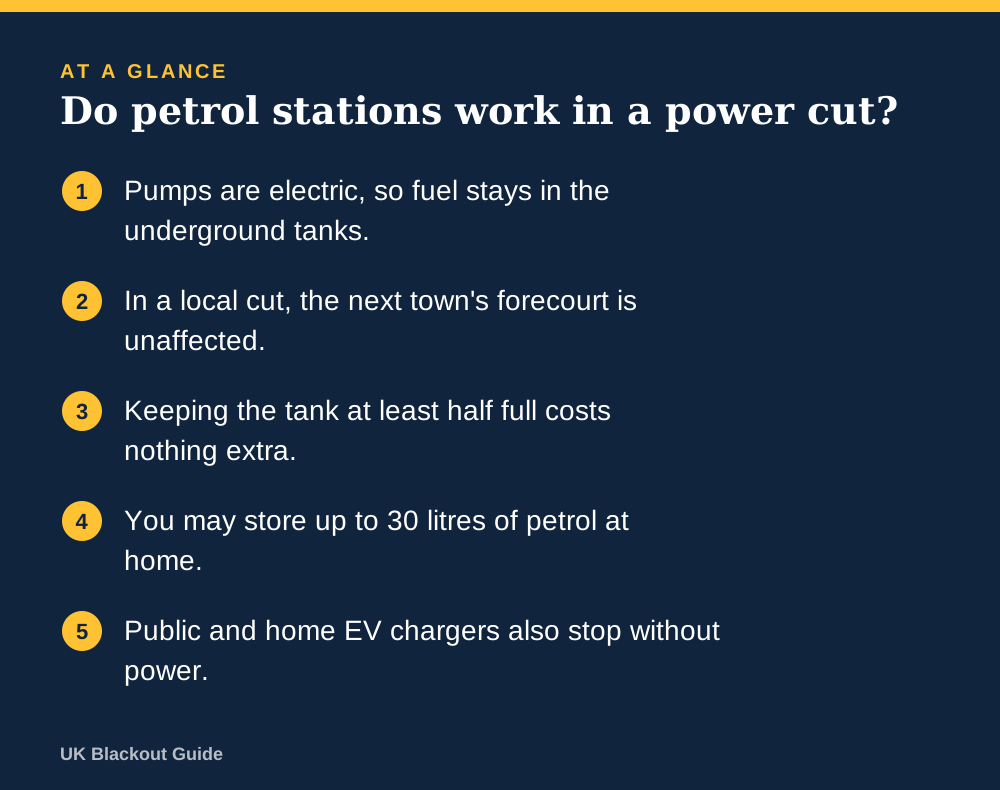
- Pumps are electric, so fuel stays in the underground tanks.
- In a local cut, the next town's forecourt is unaffected.
- Keeping the tank at least half full costs nothing extra.
- You may store up to 30 litres of petrol at home.
- Public and home EV chargers also stop without power.
Why a forecourt shuts when the power fails
Fuel sits in tanks under the forecourt and has to be pumped up to the nozzle. Those pumps are electric. So are the tills, the card readers, the pay-at-pump screens, the lighting and the systems that monitor the tanks.
Some sites have a generator, but you cannot tell which from the road, and you should not plan around finding one. If the lights at the station are off, assume it cannot serve you.
Local cut or wide outage
Most power cuts are local. A fault on one part of the network might take out a few streets or a small town for a few hours. A petrol station a few miles away will be trading normally, so there is no need to rush anywhere.
A national outage is a different case. The National Risk Register rates one as low likelihood but very high impact, and describes knock-on effects on fuel, alongside water, mobile, internet, payments and transport. No national blackout has been forecast or announced. Card payments can be down in any cut, which is one reason the official kit list includes cash and why keeping cash for an emergency is worth a little thought.
The habit that solves most of the problem
Fill up when the gauge reaches half, not when the fuel light comes on. It costs no more over a year, and it means a power cut never finds you with an empty tank and a long way to go.
Half a tank is also a resource in itself, whether or not you end up driving during a power cut. A car can warm you up, charge a phone and pick up radio news. Run the engine only outdoors, never in a garage, because exhaust fumes contain carbon monoxide.
A power cut is also a bad time for a flat car battery. The portable jump starters we list can start a car without a second vehicle, and many will charge a phone too.
Storing petrol at home, within the rules
According to the Health and Safety Executive, how much petrol you can store at home without notifying anyone is up to 30 litres. It must be in suitable containers, plastic ones up to 10 litres and metal ones up to 20 litres, and kept in a garage or shed, not in the living space.
Petrol vapour ignites easily. Never store it indoors, never decant it near a flame or a running engine, and never fill containers beyond their marked capacity.
Whether storing fuel at home is safe depends on keeping to those rules. For most households, a tank kept above half is the simpler and safer answer.
Electric cars are not exempt
Chargers need the grid. A home charger stops in a power cut, and so do public chargers in the affected area, so charging an electric car during a power cut is not something to count on. The same half-full habit applies: keep the battery topped up in stormy weather.
Common questions
Can a petrol station pump fuel by hand in a power cut?
Modern forecourts are not set up for it. Without power to the pumps and tills, most sites close until the supply returns.
Should I fill jerry cans when a storm is forecast?
Filling the car's tank is the better step. If you do keep spare petrol, stay within the 30 litre limit and use approved containers stored in a garage or shed.
Does diesel have the same 30 litre limit?
The 30 litre figure here is the HSE's rule for petrol. Check the HSE's guidance for other fuels before storing them.
Reviewed against these sources on 18 November 2026. If official advice has changed since, follow the official advice.
General information only. This page is not professional, safety, medical, legal or financial advice, and it is not official guidance. No national blackout has been forecast or announced, and nothing here suggests one is expected. We are independent and have no connection to the government or any energy company. Always check the official sources linked on this page. Full disclaimer
Keep reading
 Explainer
The 9 August 2019 power cut: what happened
On 9 August 2019 a lightning strike and the loss of two generators cut power to about 1 million customers, most for under an hour. What happened and why.
Read: The 9 August 2019 power cut: what happened News
Amazon Web Services outage, May 2026: what happened and why
The Amazon Web Services outage of 7 May 2026 began when a US data centre overheated. What AWS said, who was affected, and what it means for UK households.
Read: Amazon Web Services outage, May 2026: what News
Amazon Web Services outage, October 2025: what happened and why
The Amazon Web Services outage of 20 October 2025 disrupted Lloyds, HMRC, Snapchat and many more. AWS blamed a DNS fault in its DynamoDB database service.
Read: Amazon Web Services outage, October 2025: Explainer
How the BBC plans to keep broadcasting in a blackout
A BBC report on 7 November 2026 set out how it would keep broadcasting on FM radio through a long blackout. What it said and what radio you need to hear it.
Read: How the BBC plans to keep broadcasting in a