On this page
The Amazon Web Services outage began at 7.48am UK time on Monday 20 October 2025 and took about 14 and a half hours to clear fully. AWS said a hidden software fault left a key database service, DynamoDB, without a working internet address in its northern Virginia region. Lloyds, Bank of Scotland, HMRC, Vodafone, BT and Snapchat were among those disrupted.
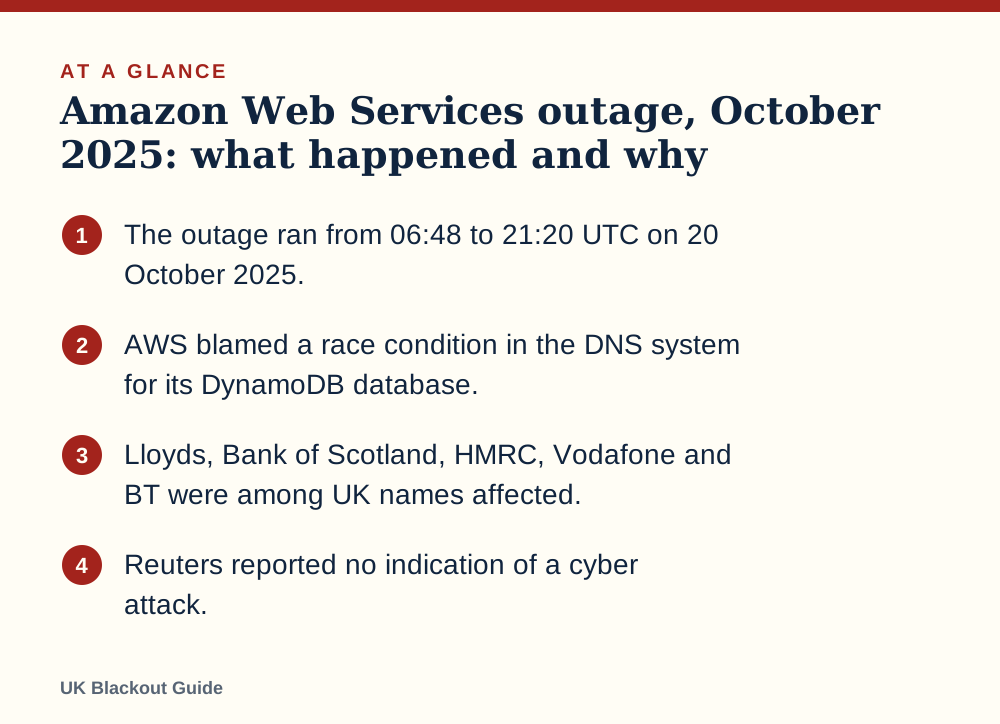
- The outage ran from 06:48 to 21:20 UTC on 20 October 2025.
- AWS blamed a race condition in the DNS system for its DynamoDB database.
- Lloyds, Bank of Scotland, HMRC, Vodafone and BT were among UK names affected.
- Reuters reported no indication of a cyber attack.
What happened at Amazon Web Services
Early on Monday 20 October 2025, a large part of the internet stopped working properly. Apps would not load, bank logins failed and smart speakers went quiet. The common link was Amazon Web Services (AWS), which hosts the computing behind thousands of companies.
The fault began in AWS's oldest and largest region, US-EAST-1 in northern Virginia. Reuters called it the largest internet disruption since the CrowdStrike outage of July 2024.
When it started and how long it lasted
AWS's own summary gives a start time of 11.48pm Pacific time on 19 October, which was 7.48am on 20 October in the UK. The first and most serious phase, when the DynamoDB database service could not be reached, lasted until 10.40am UK time.
Knock-on problems then affected other AWS services for the rest of the day. AWS's summary puts the end of the overall event at 2.20pm Pacific time, or 10.20pm in the UK, about 14 and a half hours after it began.
Who and what was affected
Reuters reported that in the UK, Lloyds Bank and Bank of Scotland, the mobile and broadband firms Vodafone and BT, and the HMRC website were all disrupted. Lloyds and Bank of Scotland customers were locked out again in the Lloyds and Halifax app outage of June 2026, which was later put down to a software defect in the bank's own app. Worldwide, the list included Snapchat, Reddit, Roblox, Duolingo, Signal, Coinbase, Venmo and Amazon's own shopping site, Prime Video and Alexa.
Ookla, which owns Downdetector, said more than 4 million users reported problems and at least 1,000 companies were affected, according to Reuters.
The cause, as stated by AWS
AWS said the trigger was a latent race condition, a rare timing bug, in the automated system that manages DNS records for DynamoDB. DNS is the address book of the internet. Two automated processes clashed, and the result was an empty address record for the service in that region. The automation could not repair it, so engineers had to step in by hand.
With no address, nothing could connect to DynamoDB, and many other AWS services depend on it. Even after the address was restored, systems that launch new servers and balance traffic took hours to recover. The same region failed for a different reason in the AWS outage of May 2026, when a data centre overheated and the crypto exchange Coinbase halted trading for several hours.
Reuters reported there was no indication of a cyber attack. AWS apologised and said it had switched off the faulty automation worldwide until the bug was fixed and extra safeguards were added. Less than a month later the Cloudflare outage of November 2025 took X and ChatGPT offline, and that too was an internal software fault and not an attack.
What customers were told
AWS posted updates on its status page through the day. By early afternoon US time some apps were gradually returning, Reuters reported, while AWS said several services were still seeing errors.
As with any large outage, it is a moment to be careful about messages claiming to be from your bank.
What this does and does not tell us about power cuts
This was a software fault in a cloud service. It was not a power cut and it did not cause one in the UK or anywhere else. No official body has said a cyber attack on the UK electricity grid is expected, and this event was not an attack.
It did show how many unrelated services, from a bank login to a tax return, can depend on one supplier in one place. A year later to the day, the Google Cloud outage of October 2026 made the same point in the UK, when a fault in one London zone disrupted Revolut, Lloyds and HSBC customers. The National Risk Register makes a related point about a national power outage, saying it would have knock-on effects on payments, mobile and internet services.
For a household, the sensible response is the same in both cases: do not rely on a single way to pay or to get information. A small amount of money in notes and coins is one backup, and our guide to cash in an emergency explains how to keep it.
Common questions
What caused the AWS outage in October 2025?
AWS said a rare timing bug in its DNS automation left the DynamoDB service in northern Virginia without a working address.
Which UK services were affected by the AWS outage?
Reuters reported disruption at Lloyds Bank, Bank of Scotland, Vodafone, BT and the HMRC website.
Has AWS had outages since?
Yes. A separate AWS outage on 7 May 2026 was caused by overheating at a data centre in the same region.
- Amazon Web Services: Summary of the Amazon DynamoDB Service Disruption in the Northern Virginia (US-EAST-1) Region
- Reuters and AFP via Dawn: Amazon's AWS struggles to recover after major outage disrupts apps, services worldwide
Reviewed against these sources on 18 November 2026. If official advice has changed since, follow the official advice.
General information only. This page is not professional, safety, medical, legal or financial advice, and it is not official guidance. No national blackout has been forecast or announced, and nothing here suggests one is expected. We are independent and have no connection to the government or any energy company. Always check the official sources linked on this page. Full disclaimer
Keep reading
 News
CrowdStrike outage, July 2024: what happened and why
The CrowdStrike outage of 19 July 2024 crashed about 8.5 million Windows computers worldwide, hitting GP surgeries and airlines. What happened and why.
Read: CrowdStrike outage, July 2024: what happened News
Lloyds and Halifax app outage, June 2026: what happened and why
The Lloyds, Halifax and Bank of Scotland app outage of 3 June 2026 locked customers out for more than three hours. What happened, the cause and what to do.
Read: Lloyds and Halifax app outage, June 2026: News
Amazon Web Services outage, May 2026: what happened and why
The Amazon Web Services outage of 7 May 2026 began when a US data centre overheated. What AWS said, who was affected, and what it means for UK households.
Read: Amazon Web Services outage, May 2026: what News
Cloudflare outage, November 2025: what happened and why
The Cloudflare outage of 18 November 2025 knocked X, ChatGPT and many other sites offline for hours. Cloudflare blamed an oversized internal file, not an attack.
Read: Cloudflare outage, November 2025: what