On this page
The CrowdStrike outage on Friday 19 July 2024 was caused by a faulty update to security software, not by a cyber attack. Microsoft estimated it crashed 8.5 million Windows devices, under 1% of the total. In the UK it disrupted the records system used by most GP practices. Many systems were back within hours, and CrowdStrike said about 99% of affected sensors were online by 29 July.
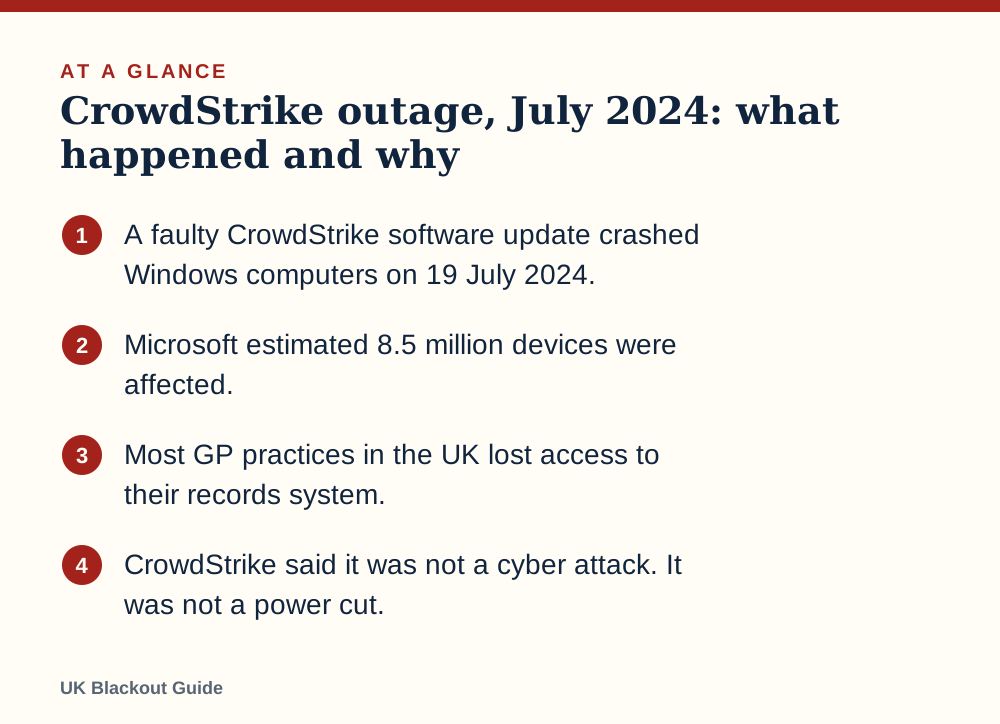
- A faulty CrowdStrike software update crashed Windows computers on 19 July 2024.
- Microsoft estimated 8.5 million devices were affected.
- Most GP practices in the UK lost access to their records system.
- CrowdStrike said it was not a cyber attack. It was not a power cut.
What happened in the CrowdStrike outage
On Friday 19 July 2024, Windows computers in offices, airports, hospitals and shops around the world crashed and would not restart properly. Each one showed the blue error screen that Windows displays when it cannot carry on.
The computers had one thing in common. They all ran Falcon, security software made by an American company called CrowdStrike. That morning CrowdStrike had sent out a routine update to the software's settings, and the update contained a fault that crashed Windows itself. It remains the reference case for a large IT outage: Reuters called the AWS outage of October 2025 the largest internet disruption since this one.
When it started and how long it lasted
CrowdStrike says the update went out on 19 July 2024 as part of its normal operations. The company withdrew it, but machines that had already received it stayed broken until someone repaired them.
That is why recovery was uneven. CrowdStrike says many customers were back online within hours. It reported that by the evening of 29 July 2024, ten days later, about 99% of the Windows machines running its software were online again compared with before the update.
Who and what was affected
Microsoft estimated that the update affected 8.5 million Windows devices, which it said was less than 1% of all Windows machines. The effect was far larger than that share suggests, because the software is used by organisations that run important services. Airports were disrupted again by the ransomware attack on Collins Aerospace check-in software in September 2025, which hit Heathrow, Brussels, Berlin and Dublin.
In the UK, The Register reported that the EMIS records system used by most general practices was disrupted, and that a pharmacy attached to a surgery could not process new electronic prescriptions. One NHS hospital declared a critical incident because the system running its radiotherapy was affected. Treatments were cancelled briefly that morning and resumed later the same day. The Register described the wider impact as running from airlines to GP services. It came less than seven weeks after the Synnovis ransomware attack of 3 June 2024, a deliberate attack that delayed more than 11,000 NHS appointments in south-east London.
The cause, as stated by CrowdStrike
CrowdStrike said the cause was a content configuration update for its Windows software, delivered through what it calls channel files. The Register reported that the faulty file made CrowdStrike's driver crash, taking Windows down with it. Because the driver loads when the computer starts, affected machines could crash again on every restart.
CrowdStrike said the incident was not malicious and was not a cyber attack, and apologised. It published a root cause analysis on 6 August 2024 and said the fault could no longer recur, with further changes to its processes to follow. Microsoft stressed that it was not a Microsoft incident, though it affected Microsoft's customers. Microsoft's own services did fail in the Microsoft 365 outage of November 2026, which the company blamed on a hidden software defect in its network gateway servers.
What customers were told
CrowdStrike stopped the update and published repair instructions. Microsoft said it put hundreds of engineers to work with customers and published its own repair guidance and tools.
For the public, the practical effect was waiting: for a GP appointment to be rebooked, a prescription to be issued or a flight to be rearranged. Events like this also bring a wave of fake support calls and emails.
What this does and does not tell us about power cuts
This was a faulty software update. It was not a cyber attack, it was not a power cut, and it did not cause a power cut in the UK. No official body has said a cyber attack on the UK electricity grid is expected. Our guide to cyber attacks and the power grid sets out what has and has not been said officially.
What July 2024 showed is that services people rely on can stop for a day or more with the electricity on. The steps that help are the same ones the Be Ready campaign suggests for any disruption, such as a written list of contacts and medication, and some cash in notes and coins, which our guide on how to keep cash for an emergency covers in more detail.
Common questions
Was the CrowdStrike outage a cyber attack?
No. CrowdStrike said it was caused by a faulty update to its own software and was not malicious.
How many computers were affected by the CrowdStrike outage?
Microsoft estimated 8.5 million Windows devices, which it said was less than 1% of all Windows machines.
Were Macs and phones affected?
The faulty update was for CrowdStrike's Windows software. CrowdStrike and Microsoft described the impact on Windows devices.
- CrowdStrike: Channel File 291 Incident: Root Cause Analysis is Available
- Microsoft: Helping our customers through the CrowdStrike outage
- The Register: Second NHS IT system confirmed to be affected by CrowdStrike issues
Reviewed against these sources on 18 November 2026. If official advice has changed since, follow the official advice.
General information only. This page is not professional, safety, medical, legal or financial advice, and it is not official guidance. No national blackout has been forecast or announced, and nothing here suggests one is expected. We are independent and have no connection to the government or any energy company. Always check the official sources linked on this page. Full disclaimer
Keep reading
 News
Amazon Web Services outage, October 2025: what happened and why
The Amazon Web Services outage of 20 October 2025 disrupted Lloyds, HMRC, Snapchat and many more. AWS blamed a DNS fault in its DynamoDB database service.
Read: Amazon Web Services outage, October 2025: News
Heathrow check-in cyber attack, September 2025: the Collins Aerospace ransomware incident
Ransomware hit Collins Aerospace check-in software on 19 September 2025, disrupting Heathrow and other European airports. What happened and what is known.
Read: Heathrow check-in cyber attack, September News
Synnovis cyber attack, 2024: how a ransomware attack disrupted London blood tests
Ransomware hit NHS pathology provider Synnovis on 3 June 2024, delaying over 11,000 appointments in south-east London. What happened and how long it lasted.
Read: Synnovis cyber attack, 2024: how a ransomware News
Microsoft 365 outage, November 2026: what happened and why
The Microsoft 365 outage of 12 and 13 November 2026 cut off Outlook email worldwide for almost a day. What failed, why, and what it means for UK households.
Read: Microsoft 365 outage, November 2026: what