On this page
On 29 December 2025 coordinated cyber attacks hit more than 30 wind and solar farms and a large combined heat and power plant in Poland. Poland's cyber response team says electricity production continued and heat supply was not interrupted. On 13 July 2026 the UK and EU attributed the attack to Russia's FSB. It did not affect UK supplies.
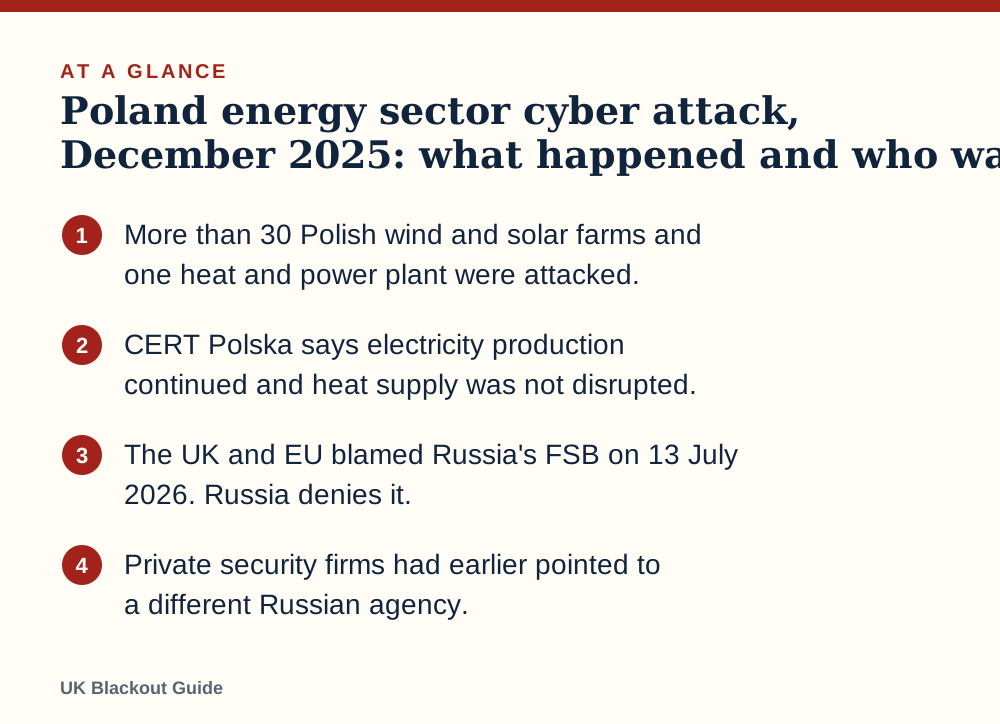
- More than 30 Polish wind and solar farms and one heat and power plant were attacked.
- CERT Polska says electricity production continued and heat supply was not disrupted.
- The UK and EU blamed Russia's FSB on 13 July 2026. Russia denies it.
- Private security firms had earlier pointed to a different Russian agency.
What happened
On 29 December 2025 a set of coordinated cyber attacks hit Poland's energy sector. CERT Polska, the country's national cyber incident response team, set out the details in a report published on 30 January 2026.
According to that report there were three kinds of target: more than 30 wind and solar farms, attacked at the substations that connect them to the grid; a large combined heat and power plant that supplies heat to almost half a million customers; and a private manufacturing company. CERT Polska called the attacks purely destructive and compared them to deliberate arson.
When it happened and how long it lasted
The attacks took place in the morning and afternoon of 29 December 2025. The intrusion behind them was older: CERT Polska says the heat and power plant had been infiltrated over a long period, with operational information stolen beforehand. Three days earlier, ransomware had hit Romania's Oltenia Energy Complex, knocking out office systems, and the reports we read do not connect the two.
The reports we read do not say how long repairs to the damaged control equipment took. What they do say is that supply to customers was not interrupted on the day.
What was affected and who it touched
At the wind and solar farms, the attackers damaged remote terminal units, the devices that let a network operator see and control a site from a distance. That cut communication between the farms and the distribution system operator and stopped remote control. Electricity production continued.
At the heat and power plant, the attackers tried to run "wiper" malware to destroy data on the internal network. CERT Polska says the plant's security software blocked it and that heat supply to end users was not disrupted.
Accounts of how close it came differ. The Record reports that a senior Polish minister said the attack came "very close" to causing a blackout. The UK government later said that about 500,000 people could have been affected in winter had it succeeded. The Record describes that as heating and the Associated Press as electricity.
What is known about the cause and who was responsible
Attribution has been disputed between two Russian agencies. Early analysis from the security companies ESET and Dragos linked the attack to Sandworm, a group they tie to Russian military intelligence (the GRU). CERT Polska disagreed, saying the infrastructure used overlapped heavily with a cluster known as Static Tundra, Berserk Bear or Dragonfly, which is linked to the FSB, Russia's security service.
On 13 July 2026 the UK and the EU formally attributed the activity to Centre 16 of the FSB, according to The Record. The Kremlin has denied carrying out offensive cyber operations, and President Putin called the European allegations baseless. The UK government has made no such attribution for the cyber incident at a small UK generator in July 2026, which it has confirmed without naming anyone as responsible.
What the organisation and officials did
Alongside the attribution, the UK and EU imposed their first coordinated cyber sanctions package, covering more than 30 individuals and entities. The UK called the attack "reckless". Foreign Secretary Yvette Cooper said the sanctions "strike at the core of the cybercriminal networks propping up the Russian state's aggression". The NCSC's Annual Review, published on 3 November 2026, also refers to the Polish attack.
A joint advisory published by the United States and co-signed by about a dozen allied agencies said Centre 16 operators had been scanning the internet for devices with default or weak credentials. In the UK, the energy sector cyber security strategy of May 2026 cites the Polish attack as one of the incidents behind its plans.
What this does and does not tell us about power cuts
This attack did not cause a power cut in the UK, and by CERT Polska's account it did not cut electricity or heat to customers in Poland either. It happened on another country's network.
UK officials have used the incident to explain why they are tightening rules for energy companies. That is different from predicting an attack here. No official body has said a cyber attack on the UK grid is expected. The National Risk Register rates a national power outage as low likelihood but very high impact, and our page on cyber attacks and the UK power grid explains the system in general terms.
For households the practical position is unchanged: the government's Be Ready campaign asks people to be able to manage for three days as general preparedness, and what the Be Ready campaign asks for is the place to start. A battery or wind-up radio is on the official list.
Common questions
Did the lights go out in Poland?
No. CERT Polska says electricity production at the wind and solar farms continued and heat supply from the plant was not disrupted.
Who was responsible for the Poland energy attack?
The UK and EU attributed it to Centre 16 of Russia's FSB on 13 July 2026. Some private security firms had linked it to a different Russian agency. Russia denies involvement.
Does this mean the UK grid is at risk of the same thing?
No official body has said a cyber attack on the UK grid is expected. UK officials have cited the incident as a reason to strengthen cyber rules for energy companies.
- CERT Polska: Energy Sector Incident Report, 29 December 2025
- The Record: Russia's FSB blamed for Poland grid attack as UK and EU impose first joint cyber sanctions
- Associated Press (via ClickOrlando): UK cyber chief says the UK will face AI cyberattacks on critical infrastructure by 2028
- GOV.UK: Energy sector cyber security strategy
Reviewed against these sources on 18 November 2026. If official advice has changed since, follow the official advice.
General information only. This page is not professional, safety, medical, legal or financial advice, and it is not official guidance. No national blackout has been forecast or announced, and nothing here suggests one is expected. We are independent and have no connection to the government or any energy company. Always check the official sources linked on this page. Full disclaimer
Keep reading
 News
Oltenia Energy Complex ransomware attack, December 2025: what happened in Romania
Romania's largest coal power producer was hit by ransomware on 26 December 2025. What was affected, who was named, and why the national grid kept running.
Read: Oltenia Energy Complex ransomware attack, News
UK small generator cyber incident, July 2026: what the government has confirmed
A small UK electricity generator was reportedly offline for four days in July 2026 after a cyber incident. What ministers confirmed, and what remains unknown.
Read: UK small generator cyber incident, July 2026: News
NCSC Annual Review 2026: what the cyber agency said about AI, ransomware and critical infrastructure
What the National Cyber Security Centre's Annual Review of 3 November 2026 said about AI, ransomware and critical infrastructure, and what it did not say.
Read: NCSC Annual Review 2026: what the cyber News
Energy Sector Cyber Security Strategy, May 2026: what the government has committed to
The UK's Energy Sector Cyber Security Strategy was published on 28 May 2026. What it commits energy companies and regulators to do by 2030, in plain English.
Read: Energy Sector Cyber Security Strategy, May