On this page
Be Ready is the UK government's household preparedness campaign, launched on 22 October 2026 and previously called Prepare. It asks every household to be able to manage for three days without outside help, and publishes a kit list covering water, food, light, a radio, a power bank, medication and cash. It is general advice, not a forecast of a blackout.
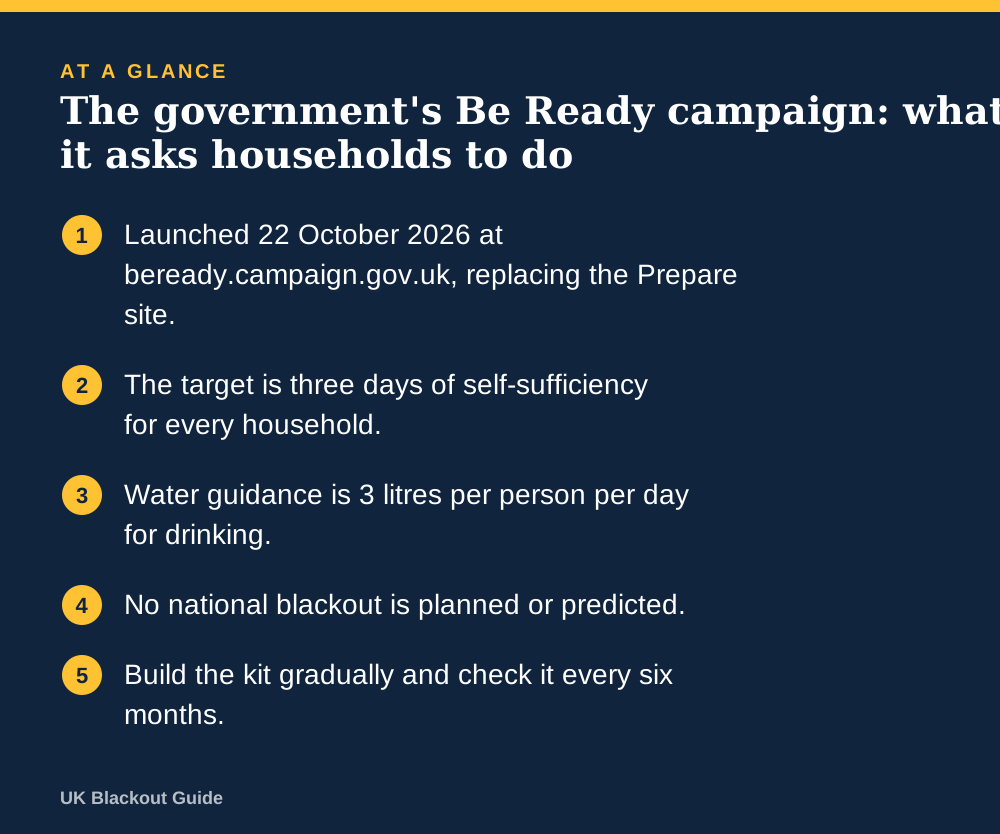
- Launched 22 October 2026 at beready.campaign.gov.uk, replacing the Prepare site.
- The target is three days of self-sufficiency for every household.
- Water guidance is 3 litres per person per day for drinking.
- No national blackout is planned or predicted.
- Build the kit gradually and check it every six months.
What launched on 22 October 2026
On 22 October 2026 the UK government launched Be Ready, a public campaign with a website at beready.campaign.gov.uk. It replaces the earlier Prepare site and carries the same basic message in a more direct form: every household should be able to manage for three days, the figure behind the three-day blackout claim in the headlines.
The campaign is presented as general preparedness. It covers power cuts, flooding, severe weather and other disruption, and it does not say that any of them is about to happen. No national blackout is planned or predicted. If the timing has left you uneasy, our piece on why the government is asking people to prepare deals with that question on its own.
This site is independent and has no connection to the government. What follows is a plain summary of the published advice.
The three-day kit list in full
The official list of what the government says to keep at home is short and mostly made of things you can buy in a supermarket.
- Water: bottled water for three days, at 3 litres per person per day for drinking, plus more for cooking and washing
- Food: three days of non-perishable food that needs no cooking and no fridge, and a tin opener
- Light: a battery or wind-up torch with spare batteries. The campaign notes that torches are safer than candles
- Information: a battery or wind-up FM radio
- Power: a charged power bank
- Health: a first aid kit, essential medication, hand sanitiser and wet wipes
- Warmth: blankets, sleeping bags and warm clothing
- Money and paperwork: cash in notes and coins, printed copies of documents, and a written list of contacts and medication
- Babies and pets: baby supplies, with ready-to-feed formula preferred, nappies, and pet food
For a household of four, the water line alone means 36 litres for drinking, which makes how much water to store the first practical question.
Three items people tend not to own already
Set against a full emergency kit list, most homes have tins, blankets and a torch somewhere. The gaps are usually the radio, the power bank and a single place where everything is kept together.
The radio is there because phones and broadband depend on networks that may fail. Be Ready advises trying both FM and digital stations.
A power bank keeps a phone going for calls, texts and a torch. As a rule of thumb, usable charges are the capacity in mAh multiplied by 0.65, divided by your phone's battery size. A 20,000 mAh bank gives about 3 to 4 charges of a typical phone.
If you would sooner buy the basics in one go, ready-made emergency kits exist. They vary a lot in quality, and none includes the water.
What the campaign says to do during a power cut
Be Ready also gives advice for the cut itself. Report it by calling 105, which is free in England, Scotland and Wales, or 03457 643643 in Northern Ireland.
Keep away from power lines. Turn off irons, ovens, electric fires and fryers so they do not come back on unattended, and unplug the TV and PC in case of a surge when the supply returns. Keep warm with layers and blankets, and close doors and curtains. Keep fridge and freezer doors shut. Check on neighbours.
On communications, the advice is that a corded landline may work, mobile networks may work temporarily in some areas on backup power, and a 999 or 112 call from a mobile can roam onto any available network. It also says that mains water can be disrupted during and after a power cut.
How to act on it without overspending
The campaign's own advice is to build the kit gradually and check it every six months. Add a few tins and a pack of water to the weekly shop. Buy the radio one month and the power bank the next.
Nothing on the list requires bulk buying, and clearing shelves makes things harder for everyone, which is the case for preparing without panic buying. A simple six-monthly routine keeps batteries, food and medication in date.
Common questions
Is Be Ready a warning that a blackout is coming?
No. It is presented as general preparedness for many kinds of disruption. No national blackout is planned or predicted.
Why three days?
Three days is the period the campaign asks households to be able to manage for. It is a baseline for general preparedness, not a forecast of how long any event would last.
Is Be Ready the same as the old Prepare website?
It is the successor. The Prepare campaign was renamed and relaunched as Be Ready on 22 October 2026.
Reviewed against these sources on 18 November 2026. If official advice has changed since, follow the official advice.
General information only. This page is not professional, safety, medical, legal or financial advice, and it is not official guidance. No national blackout has been forecast or announced, and nothing here suggests one is expected. We are independent and have no connection to the government or any energy company. Always check the official sources linked on this page. Full disclaimer
Keep reading
 Explainer
UK blackout 2026: what the government has actually said
UK blackout 2026: no blackout has been announced, planned or forecast. What Be Ready, NESO and the National Risk Register have said, and what they have not.
Read: UK blackout 2026: what the government has Question
Do mobile phones work in a power cut?
Your mobile keeps working while its battery lasts, but masts rely on backup power that may only hold temporarily. What to expect and how to stay in touch.
Read: Do mobile phones work in a power cut? Guide
Why is everyone suddenly talking about blackouts?
Blackouts are in the news because of the Be Ready campaign, a BBC report on emergency broadcasting and a grid restoration deadline. No blackout is predicted.
Read: Why is everyone suddenly talking about Guide
72-hour emergency kit UK: the Be Ready list, item by item
72 hour kit UK: the government's Be Ready three-day list explained item by item, with quantities per person, what each item is for and how to store it.
Read: 72-hour emergency kit UK: the Be Ready list,