On this page
There is no UK blackout planned, announced or forecast for 2026, and no date has been given by anyone in authority. What the government has said, through the Be Ready campaign launched on 22 October 2026, is that every household should be able to manage for three days. It presents that as general preparedness, not a forecast.
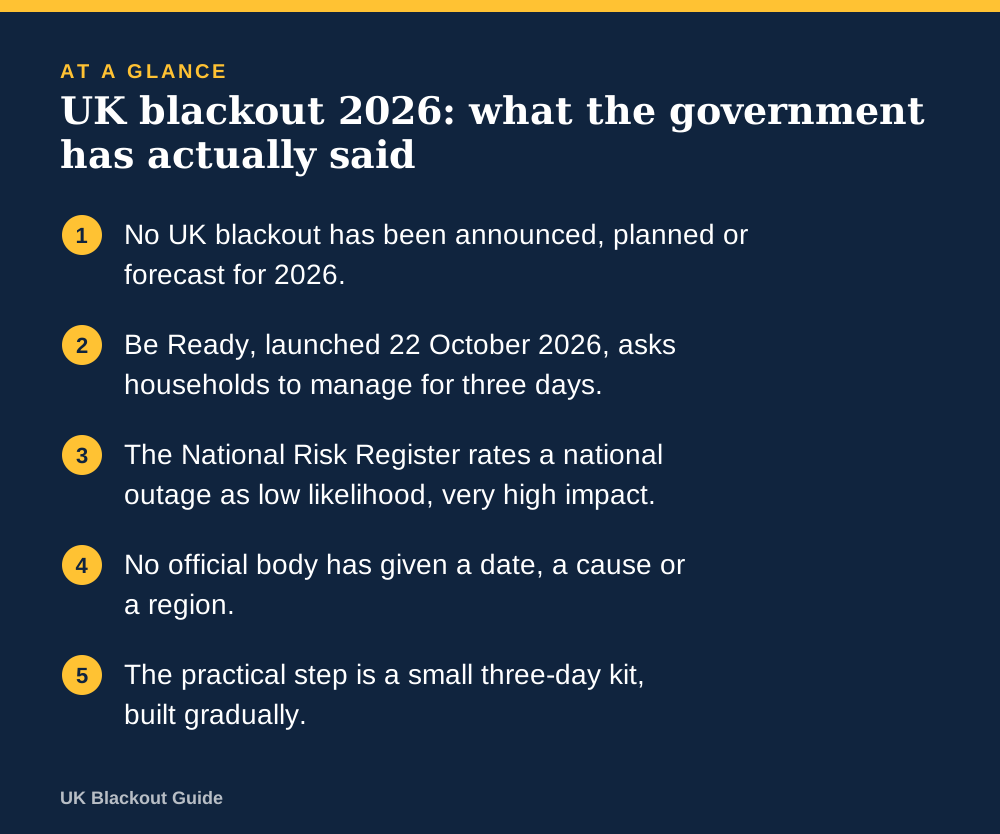
- No UK blackout has been announced, planned or forecast for 2026.
- Be Ready, launched 22 October 2026, asks households to manage for three days.
- The National Risk Register rates a national outage as low likelihood, very high impact.
- No official body has given a date, a cause or a region.
- The practical step is a small three-day kit, built gradually.
No UK blackout has been announced for 2026
No UK blackout is planned, announced or forecast for 2026. The government has not named a date for a UK blackout, and neither has NESO (the National Energy System Operator, which runs Great Britain's electricity system) or any network operator.
The searches for "UK blackout 2026" follow two real events. The government launched its Be Ready campaign on 22 October 2026, and on 7 November 2026 the BBC reported on how it would keep broadcasting during a long outage. Both are about planning. Neither says an outage is coming.
What the Be Ready campaign says
Be Ready is the UK government's household preparedness campaign, at beready.campaign.gov.uk. It was previously called "Prepare". It asks households to be able to manage for three days without help, and it covers emergencies in general: flooding, severe weather and power cuts among them.
The campaign presents this as general preparedness, not a forecast. It lists what to keep at home, the basis of our 72-hour emergency kit list: bottled water (3 litres per person per day for drinking), food that needs no cooking or fridge, a tin opener, a battery or wind-up torch with spare batteries, a battery or wind-up FM radio, a charged power bank, a first aid kit, essential medication, blankets and warm clothing, and cash in notes and coins. It advises building the kit gradually and checking it every six months.
What the National Risk Register and NESO say
The National Risk Register, published by the Cabinet Office, describes a national power outage as low likelihood but very high impact. It says the knock-on effects would reach water, mobile networks, internet, fuel, payments and transport, and that restoring the transmission system could take up to about 7 days. That is a description of a planning scenario. It is not a prediction.
NESO has a grid restoration deadline that falls in 2026, which may be one reason the year appears in searches. Under the Electricity System Restoration Standard, set by government in 2021, NESO must by 31 December 2026 have the capability to restore 60% of demand in each region within 24 hours and 100% of Great Britain's demand within five days. That date is a target for being able to recover faster. It is not a date for an outage.
Where the Black Sky headlines came from
"Black Sky" is a planning term for a prolonged, wide-area outage that disrupts other essential services. Coverage of it rose after the Be Ready launch and again after the BBC's report on 7 November 2026. The BBC described how it would keep broadcasting on FM radio from an emergency studio, with generator-backed transmitters and supplies for at least three days.
That report describes a contingency plan, the BBC's emergency broadcasting plan. Broadcasters, hospitals and utilities keep plans like this as routine. The government also ran a national power outage exercise, Exercise Mighty Oak, in 2023.
What official bodies have not said
It helps to be exact about what is missing from the official record. As of 18 November 2026, when we last checked:
- No official body has given a date, month or season for a blackout.
- No official body has said a national blackout is expected or likely.
- No official body has named a cause it expects to bring one about.
- The government has not asked households to prepare for longer than three days.
- The government has not told people to buy generators or to stockpile.
Posts and videos that give a date or a cause are adding something the official sources do not contain, which is the test to apply when asking whether the blackout warning is real.
The practical next step for your household
The official ask is modest: three days of water, food, light, a radio and a way to charge a phone. Most homes already hold part of it. Check what you have against the list, then fill gaps over a few weeks of ordinary shopping.
If you would rather start from one box and add to it, a ready-made kit covers the basics, though you still need to add water, food and medication yourself.
A battery or wind-up emergency radio matters because phone networks and broadband may not last. Be Ready lists a battery or wind-up FM radio.
A charged power bank is on the official list too. A 20,000 mAh bank gives a typical phone about 3 to 4 charges.
For ordinary local power cuts, which are far more common than anything national, call 105 (free in England, Scotland and Wales) or 03457 643643 in Northern Ireland.
Common questions
Has the government said there will be a blackout in 2026?
No. The Be Ready campaign asks households to be able to manage for three days as general preparedness, and it is not presented as a forecast of a blackout.
What happens on 31 December 2026?
That is the deadline for NESO to have the capability to restore 60% of regional demand within 24 hours and all of Great Britain's demand within five days. It is a recovery target, not an outage date.
Is Be Ready only about power cuts?
No. It is a general household preparedness campaign that covers several kinds of emergency, including flooding and severe weather.
- Be Ready campaign, UK government
- National Energy System Operator (NESO)
- National Risk Register, Cabinet Office
- Power Cut 105
Reviewed against these sources on 18 November 2026. If official advice has changed since, follow the official advice.
General information only. This page is not professional, safety, medical, legal or financial advice, and it is not official guidance. No national blackout has been forecast or announced, and nothing here suggests one is expected. We are independent and have no connection to the government or any energy company. Always check the official sources linked on this page. Full disclaimer
Keep reading
 Explainer
The government's Be Ready campaign: what it asks households to do
The government's Be Ready campaign, launched 22 October 2026, asks every household to be able to manage for three days. The full kit list and what it means.
Read: The government's Be Ready campaign: what it Question
Do mobile phones work in a power cut?
Your mobile keeps working while its battery lasts, but masts rely on backup power that may only hold temporarily. What to expect and how to stay in touch.
Read: Do mobile phones work in a power cut? Guide
Why is everyone suddenly talking about blackouts?
Blackouts are in the news because of the Be Ready campaign, a BBC report on emergency broadcasting and a grid restoration deadline. No blackout is predicted.
Read: Why is everyone suddenly talking about Guide
72-hour emergency kit UK: the Be Ready list, item by item
72 hour kit UK: the government's Be Ready three-day list explained item by item, with quantities per person, what each item is for and how to store it.
Read: 72-hour emergency kit UK: the Be Ready list,