On this page
The difference is scale. A power cut is any loss of electricity supply, and in the UK it usually affects a street or a town for a few hours. A blackout is a power cut across a wide area, such as a region or a country. In a blackout, other services such as mobile networks, payments and transport are disrupted too.
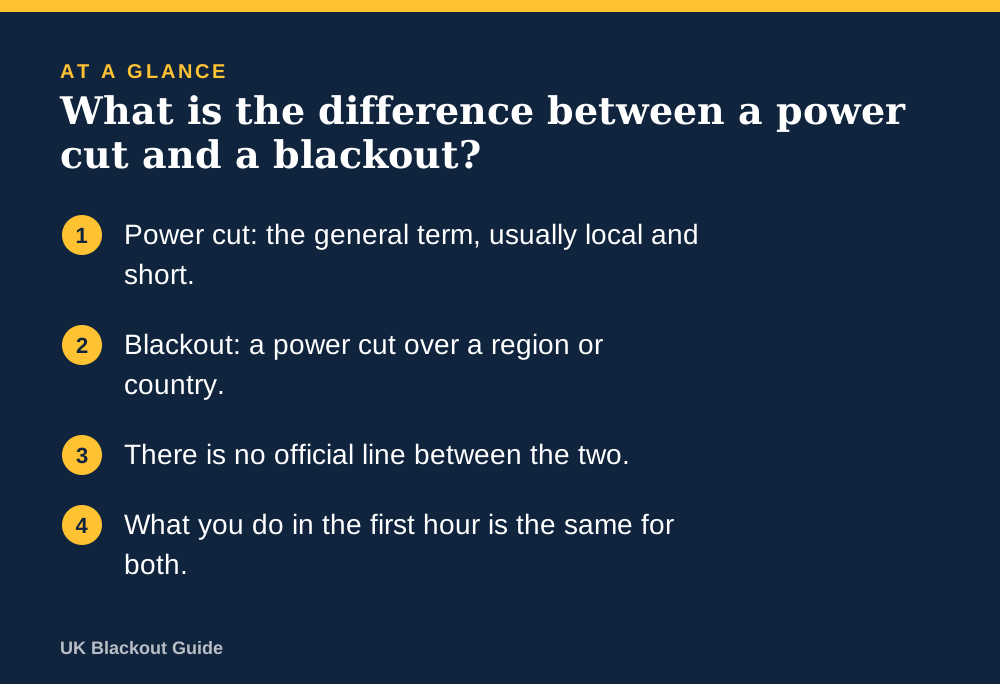
- Power cut: the general term, usually local and short.
- Blackout: a power cut over a region or country.
- There is no official line between the two.
- What you do in the first hour is the same for both.
Same event, different size
Every blackout is a power cut, but most power cuts are not blackouts. British network companies and Ofgem talk about power cuts, interruptions and outages. Blackout is the word newspapers and the public reach for when the affected area is very large, and it is more common in American usage for cuts of any size.
There is no official threshold. Nobody declares that a power cut has become a blackout at a certain number of homes. As a working rule, if you could drive twenty minutes and find the lights on, it is a power cut.
A third term, brownout, means the voltage has dropped but the supply has not stopped. All three are compared in power cuts, brownouts and blackouts explained.
How they differ in practice
Cause. Power cuts mostly come from local faults: storm damage, a cable struck during roadworks, failed equipment. A wide-area blackout involves the main system itself, not a single local fault.
What else fails. In a local cut, only things plugged in at your home stop. In a wide-area blackout, mobile masts may work only temporarily on backup power, card payments and cash machines go down, trains stop and mains water can be disrupted.
Where help comes from. In a power cut, engineers, shops and relatives in the next town are unaffected. In a blackout, they are in the same position as you.
How long. Most power cuts last hours. For a national shutdown, the standard NESO must be able to meet by 31 December 2026 is 60% of demand in each region restored within 24 hours and all of it within five days.
The detail of which services go and when is in what stops working in a blackout, in order.
Two UK examples and one from abroad
On 9 August 2019, about 1 million customers across Great Britain were disconnected after a lightning strike and the loss of two generators. Most were back within an hour. It was widespread but brief, and usually described as a major power cut.
In Lancaster in December 2015, flooding at a substation cut power to about 61,000 properties. It was local, yet mobile, internet, cash machines and card payments all failed in the city, so it felt like a blackout to those inside it.
The clearest true blackout of recent years was Spain and Portugal on 28 April 2025, when the whole Iberian peninsula lost power. Great Britain has not had one on that scale, and the National Risk Register rates a national outage here as low likelihood but very high impact. The history is in whether the UK has ever had a national blackout.
Why the first hour is the same
When the lights go out you cannot tell which kind you are in. Check your fuse box, look outside, call 105 and follow the standard steps for a power cut. If your mobile signal fades and a battery radio reports a wide outage, you know to start conserving phone battery, water and warmth.
The preparation overlaps as well. The handful of items that see you through an evening without power are the base of a three-day kit. They are ranked in our list of power cut essentials.
Common questions
Is a rota power cut a blackout?
No. Rota cuts are planned, announced and limited to about three hours at a time for each load block.
Which word do UK energy companies use?
Power cut. You report one by calling 105 in England, Scotland and Wales.
What is a Black Sky event?
A planning term for a prolonged, wide-area blackout that also disrupts other essential services.
Reviewed against these sources on 18 November 2026. If official advice has changed since, follow the official advice.
General information only. This page is not professional, safety, medical, legal or financial advice, and it is not official guidance. No national blackout has been forecast or announced, and nothing here suggests one is expected. We are independent and have no connection to the government or any energy company. Always check the official sources linked on this page. Full disclaimer
Keep reading
 Explainer
The 9 August 2019 power cut: what happened
On 9 August 2019 a lightning strike and the loss of two generators cut power to about 1 million customers, most for under an hour. What happened and why.
Read: The 9 August 2019 power cut: what happened News
Amazon Web Services outage, May 2026: what happened and why
The Amazon Web Services outage of 7 May 2026 began when a US data centre overheated. What AWS said, who was affected, and what it means for UK households.
Read: Amazon Web Services outage, May 2026: what News
Amazon Web Services outage, October 2025: what happened and why
The Amazon Web Services outage of 20 October 2025 disrupted Lloyds, HMRC, Snapchat and many more. AWS blamed a DNS fault in its DynamoDB database service.
Read: Amazon Web Services outage, October 2025: Explainer
How the BBC plans to keep broadcasting in a blackout
A BBC report on 7 November 2026 set out how it would keep broadcasting on FM radio through a long blackout. What it said and what radio you need to hear it.
Read: How the BBC plans to keep broadcasting in a