On this page
Mains lights, sockets, broadband, digital landlines, gas central heating and electric cooking stop at once. In a wide-area outage, mobile networks may run for a while on backup power, then fade. Card payments, cash machines, fuel pumps and trains are disrupted, and mains water can be affected. Battery radios, torches, cars and anything with its own battery keep working.
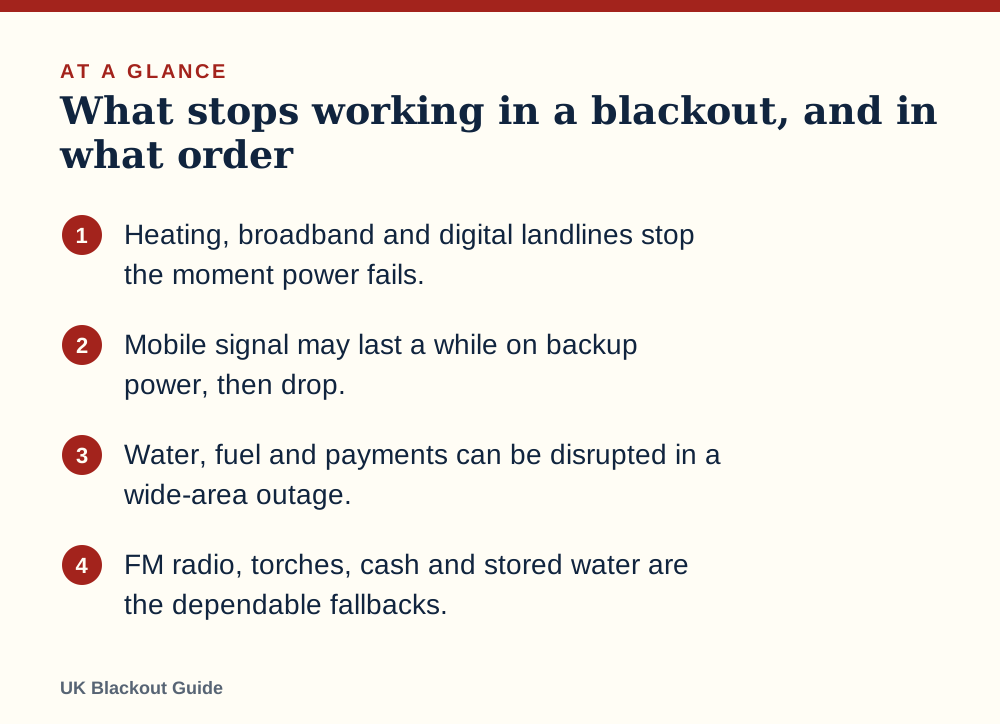
- Heating, broadband and digital landlines stop the moment power fails.
- Mobile signal may last a while on backup power, then drop.
- Water, fuel and payments can be disrupted in a wide-area outage.
- FM radio, torches, cash and stored water are the dependable fallbacks.
The first minute: everything plugged into the wall
The obvious things go first: lights, sockets, the television, the electric oven and hob, the kettle, the washing machine. Less obvious items go with them.
- Gas central heating. The boiler burns gas, but its controls and pump need electricity, so a gas boiler stops in a power cut.
- Broadband and wifi. The router needs mains power.
- Digital landlines. Phones that plug into the router stop with it. Providers may give people who depend on a landline a free battery backup unit lasting at least an hour.
- Cordless phones. The base station needs power even on an older line.
- Electric showers, stairlifts without batteries, electric garage doors and door entry systems.
In a local power cut, the list ends there. Everything below applies only when the outage covers a wide area. It describes how these services work in general terms. No national blackout has been forecast or announced, and the National Risk Register rates one as low likelihood but very high impact.
The first hours: networks running on backup
Outside your home, a lot of infrastructure switches to batteries or generators. How long each lasts varies from site to site, so treat this stage as borrowed time.
Mobile networks may work temporarily in some areas on backup power, which is the short answer to whether mobile phones work in a power cut. Expect calls and data to become patchy as masts drop out and everyone tries to use the ones that remain. Send texts instead of calling, and save your battery. Emergency calls from a mobile can roam onto any available network, so try 999 or 112 even with no bars from your own provider.
Shops and payments are hit early. Tills, card readers and cash machines need both power and a data link. In Lancaster in December 2015, when a flooded substation cut power to about 61,000 properties, mobile, internet, cash machines and card payments all failed locally. This is why notes and coins are on the official kit list, and why how much cash to keep and in what form deserves some thought.
Transport is disrupted, because trains and traffic lights both depend on mains power. Traffic lights go dark, so treat junctions with great care. Electric trains stop. On 9 August 2019, a cut that lasted under an hour for most customers caused major rail disruption for the rest of the day.
Later in the first day: fridges, phones and fuel
By the evening of the first 24 hours without power, the things with stored energy begin to run down.
| Item | Roughly how long it lasts |
|---|---|
| Fridge, door kept shut | Around 4 hours cold |
| Half-full freezer, door shut | About 24 hours frozen |
| Full freezer, door shut | About 48 hours frozen |
| Phone battery | A day or so with careful use |
| Warmth in the house | Hours, depending on insulation and weather |
The fridge and freezer figures come from the Food Standards Agency. If in doubt about any food, throw it out.
Petrol stations need electricity to pump fuel and take payment, so in a wide-area outage most cannot serve you. Keeping your tank above half is a cheap habit. Electric car chargers stop too.
Water: the service people forget
Official advice is that mains water can be disrupted during and after power cuts. Water is pumped and treated using electricity, which is why water does not always work in a power cut: although water companies have backup arrangements, pressure can fall or supply can stop, particularly in tall buildings that rely on their own booster pumps.
The Be Ready list asks for 3 litres of drinking water per person per day for three days, with more for cooking and washing. For a household of four, that is 36 litres for drinking alone. Shop-bought bottled water is the simplest way to hold it. Refillable water containers are cheaper per litre and let you fill up quickly if you get notice.
Days two and three: services outside the home
If an outage ran into a second and third day, the effects would shift from things in your home to services outside it, and what runs out first in a blackout becomes the question. The National Risk Register lists knock-on effects on water, mobile, internet, fuel, payments and transport.
Three days is the period the Be Ready campaign asks households to be able to manage for, and the government has not asked for longer. Separately, NESO must have the capability by 31 December 2026 to restore 60% of demand in each region within 24 hours and all of Great Britain's demand within five days.
What carries on working
The list of survivors is longer than people expect.
- FM radio. The BBC has described how it would keep broadcasting on FM with generator-backed transmitters. A battery or wind-up set, or your car radio, will receive it.
- A corded phone on a traditional line may still work.
- Gas hobs on many cookers can be lit with a match while the gas supply holds. Do not use a hob to heat the room.
- Cars, including the 12 volt socket for charging a phone.
- Wood burners and open fires that do not rely on an electric fan or pump.
- Anything with its own battery: torches, lanterns, power banks, laptops, battery smoke alarms.
Never bring a barbecue, camping stove, patio heater or generator indoors for heat or cooking. They produce carbon monoxide, which has no smell and can kill. Fit an audible carbon monoxide alarm.
Turning the timeline into a kit
Each failure above has a simple answer: a torch for light, a radio for news, a power bank for the phone, stored water, food that needs no cooking, blankets for warmth and cash for the shop that is still open. That is the Be Ready list, and you can work through it in our full emergency kit list.
If you would prefer a single purchase as a base, a ready-made emergency kit covers several of these at once.
Common questions
Will my gas hob work in a blackout?
Many gas hobs can be lit with a match when the electric ignition is dead. Some modern models have safety systems that need power, so check your manual.
Do smoke alarms stop working?
Battery alarms carry on. Mains-wired alarms normally have a backup battery, which is worth testing now.
Will the toilet still flush?
Yes, while mains water pressure holds. If water stops, you can flush by pouring a bucket of water into the pan.
Does 999 still work?
Try it. A mobile can roam onto any available network for emergency calls, and a corded landline may still work.
- Be Ready campaign, UK government
- Food Standards Agency
- National Risk Register, Cabinet Office
- National Energy System Operator (NESO)
Reviewed against these sources on 18 November 2026. If official advice has changed since, follow the official advice.
General information only. This page is not professional, safety, medical, legal or financial advice, and it is not official guidance. No national blackout has been forecast or announced, and nothing here suggests one is expected. We are independent and have no connection to the government or any energy company. Always check the official sources linked on this page. Full disclaimer
Keep reading
 Explainer
The government's Be Ready campaign: what it asks households to do
The government's Be Ready campaign, launched 22 October 2026, asks every household to be able to manage for three days. The full kit list and what it means.
Read: The government's Be Ready campaign: what it Question
Does tap water still work in a power cut?
Cold tap water usually keeps running in a short local power cut, but pumps and treatment works need electricity. See when water fails and how much to store.
Read: Does tap water still work in a power cut? Question
Is the UK going to have a blackout?
No national blackout is planned or predicted in the UK. The official risk rating is low likelihood. What the recent headlines mean and what is worth doing.
Read: Is the UK going to have a blackout? Explainer
What the National Risk Register says about a national power outage
The National Risk Register rates a national power outage as low likelihood but very high impact. What it says would be disrupted, and for how long.
Read: What the National Risk Register says about a