On this page
The Be Ready campaign, launched on 22 October 2026, asks households to be able to manage for three days in an emergency such as a flood, a storm or a power cut. The government presents it as general preparedness, not a forecast of any particular event. No national blackout has been forecast or announced, and the National Risk Register rates one as low likelihood.
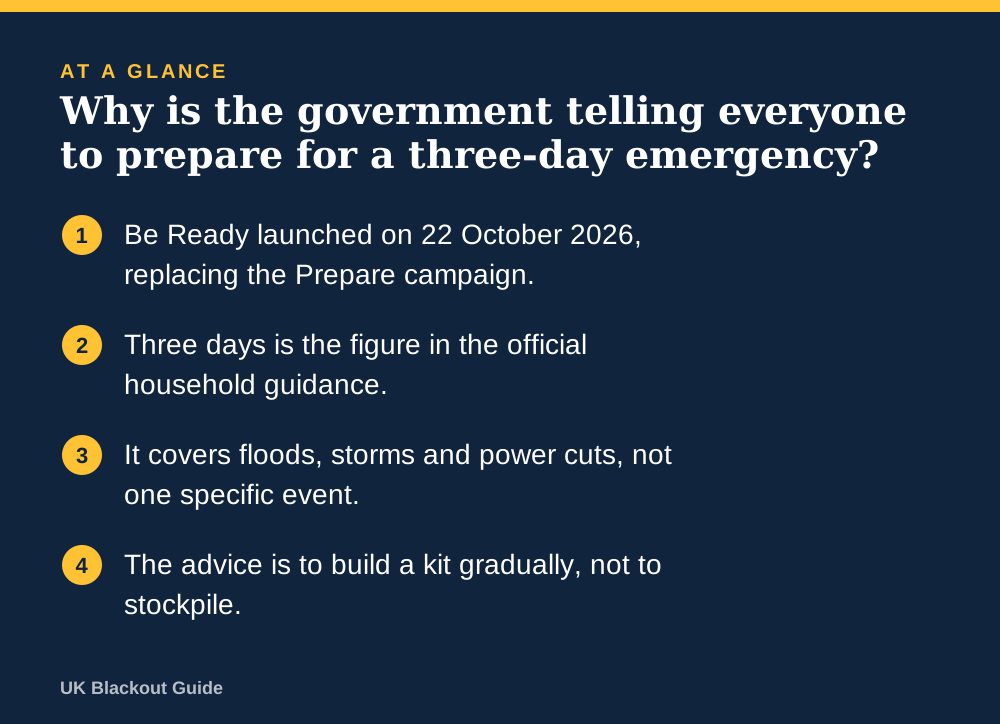
- Be Ready launched on 22 October 2026, replacing the Prepare campaign.
- Three days is the figure in the official household guidance.
- It covers floods, storms and power cuts, not one specific event.
- The advice is to build a kit gradually, not to stockpile.
What the three days is, and is not
Three days is the period the Be Ready campaign asks households to be able to manage for. The campaign presents it as general preparedness for emergencies of any kind. It is not an estimate of how long a power cut would last, and the government has not suggested that an outage of any particular length is expected.
We have not seen an official explanation that ties the figure to the electricity system. Separately, NESO, the system operator, must have the capability by 31 December 2026 to restore 60% of demand in each region within 24 hours and all of Great Britain's demand within five days. That standard was set in 2021 and concerns restoration capability, not household advice.
It is also a practical amount. The water and food for three days without power fit in a cupboard, even for a family.
Why now
The campaign is new in name only. It replaced an earlier government campaign called Prepare, and the launch under the new name on 22 October 2026 brought it more attention.
The government has not linked the launch to any expected event. Much of the current talk about blackouts mentions Storm Arwen in 2021, the Spain and Portugal blackout of 28 April 2025 and Exercise Mighty Oak, the national power outage exercise held in 2023. Those are things that happened, not signs of what will happen.
No national blackout is planned or predicted in anything the government has said about a UK blackout in 2026. The National Risk Register describes that risk as low likelihood but very high impact.
What the campaign asks for
The list, which we go through in our own emergency kit list, is short and ordinary: bottled water (3 litres per person per day for drinking), food that needs no cooking or fridge, a tin opener, a battery or wind-up torch, a battery or wind-up FM radio, a charged power bank, a first aid kit, essential medication, hand sanitiser and wet wipes, warm bedding, cash, and printed copies of key documents and contacts. Families add baby supplies and pet food.
The advice is to build it up gradually and check it every six months. A ready-made emergency kit is one way to start.
This is preparation, not stockpiling
Three days of supplies is a modest amount. It is closer to keeping a spare tyre than to building a bunker.
Nothing in the campaign asks you to clear shop shelves, and preparing without panic buying is simple. Adding a few tins and a pack of water to your normal shop over a month or two does the job and leaves enough for everyone else.
Common questions
Is Be Ready a government website?
Yes. The campaign site is beready.campaign.gov.uk. This site is independent and not connected to government.
Does the government know something it is not saying?
The campaign is presented as general preparedness. The National Risk Register rates a national outage as low likelihood but very high impact, and no blackout has been forecast or announced.
Is three days enough?
Three days is the official guidance, and the government has not asked households to prepare for longer. Some rural homes were without power for more than a week after Storm Arwen in 2021, so going further is a personal choice beyond the official advice.
- Be Ready campaign, UK government
- National Energy System Operator (NESO)
- National Risk Register, Cabinet Office
Reviewed against these sources on 18 November 2026. If official advice has changed since, follow the official advice.
General information only. This page is not professional, safety, medical, legal or financial advice, and it is not official guidance. No national blackout has been forecast or announced, and nothing here suggests one is expected. We are independent and have no connection to the government or any energy company. Always check the official sources linked on this page. Full disclaimer
Keep reading
 Explainer
The government's Be Ready campaign: what it asks households to do
The government's Be Ready campaign, launched 22 October 2026, asks every household to be able to manage for three days. The full kit list and what it means.
Read: The government's Be Ready campaign: what it Guide
How likely is a national blackout in the UK?
A national blackout in the UK is officially rated low likelihood but very high impact. Here is what that means, and how it compares with ordinary power cuts.
Read: How likely is a national blackout in the UK? Explainer
What the National Risk Register says about a national power outage
The National Risk Register rates a national power outage as low likelihood but very high impact. What it says would be disrupted, and for how long.
Read: What the National Risk Register says about a Explainer
The 'three-day blackout' claim, explained
The three day blackout claim explained: three days is how long Be Ready asks households to manage for. No official body has forecast a three day blackout.
Read: The 'three-day blackout' claim, explained