On this page
The government's National Risk Register rates a national power outage as low likelihood but very high impact. No national blackout has been forecast or announced, and the Be Ready campaign is general preparedness, not a forecast. Local power cuts from faults and storms are a separate, everyday matter. Be Ready asks households to be able to manage for three days.
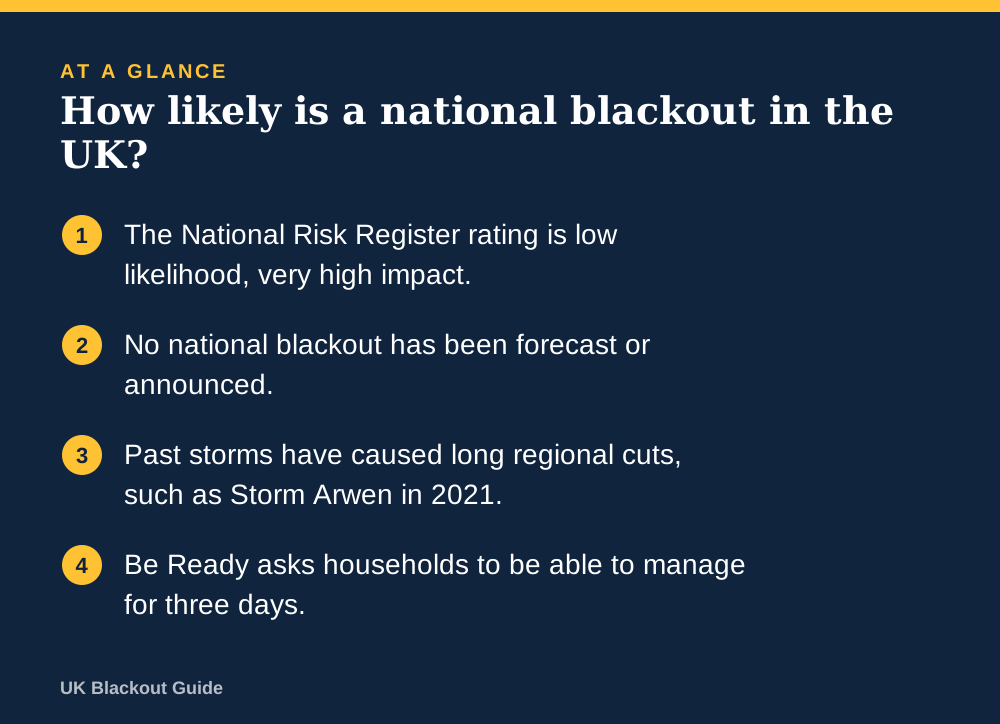
- The National Risk Register rating is low likelihood, very high impact.
- No national blackout has been forecast or announced.
- Past storms have caused long regional cuts, such as Storm Arwen in 2021.
- Be Ready asks households to be able to manage for three days.
What the official assessment says
The UK government publishes a National Risk Register that scores serious risks on two scales: how likely they are and how bad they would be. The risk register entry on power outages describes a national power outage as low likelihood but very high impact.
Low likelihood does not mean impossible. The register does not put a date or a season on it. Very high impact means that if it did happen, the effects would spread well beyond the lights, into water, mobile, internet, fuel, payments and transport.
The register is a planning tool, not a forecast. Risks are listed so that government, councils and utilities prepare for them, and a place on the list says nothing about timing.
Why the answer depends on the size of the cut
The official rating applies to one thing only: a national power outage. It helps to keep four different events apart, because only the last of them is what the risk register entry describes.
- A local power cut. These happen somewhere in the country every day, and most last minutes or hours.
- A regional cut from a storm. Storm Arwen in November 2021 cut power to about 1 million customers, and some rural homes in northern England and Scotland were off for more than a week.
- Rota power cuts. These would be used only in a national energy shortage. They would be planned, announced and limited to about three hours at a time. None has been announced.
- A full national blackout. The event the National Risk Register rates as low likelihood but very high impact. The modern grid in Great Britain has not had one.
Rural homes served by overhead lines were the ones that waited longest after Storm Arwen, and what happened in past UK storms covers that. Those storms are a record of what happened. No official body has described them as a sign of a national blackout to come.
How the system is protected
Great Britain's electricity system is run minute by minute by NESO, the National Energy System Operator. It keeps spare generation in reserve so that the sudden loss of a large power station or cable does not bring the system down. The grid is also built so that any single failure can be isolated, a basic part of how the electricity grid works.
The power cut of 9 August 2019 shows that protection at work. A lightning strike was followed by the loss of two generators. Automatic systems disconnected about 1 million customers to protect everyone else, and most were back on in under an hour. The system shed a small share of demand to avoid losing all of it.
What the government has and has not said about causes
The National Risk Register entry rates the outcome, a national power outage, and its knock-on effects. The official statements we rely on do not name any single cause as expected or probable.
One foreign event is often quoted. On 28 April 2025 the whole Iberian peninsula lost power. An expert panel later pointed to voltage-control problems and generators disconnecting in succession, and most supply was back by the early hours of the next day. That is an account of what happened there, not a sign of what will happen here.
Readers also ask about hacking and space weather. The government has not said that either is expected to cause a UK blackout. Our page on cyber attacks and the power grid describes how the system works in general terms and is not a forecast. The same applies to space weather, where solar storms and the grid are explained on the same basis.
What the official restoration figures say
Restarting a grid from nothing is slow, careful work. NESO is required to have the capability, by 31 December 2026, to restore 60% of demand in each region within 24 hours and 100% of Great Britain's demand within five days. The National Risk Register notes that restoring the transmission system could take up to about seven days.
Those are the only official figures on how long a national blackout could last that run longer than three days. Household guidance from the Be Ready campaign is three days. The government has not asked households to prepare for longer, and it has not suggested that an outage of any particular length is expected.
Why prepare for something unlikely
You already do this in other parts of life. House fires are rare, and you still fit a smoke alarm. The same supplies are also useful in ordinary disruptions such as a local power cut, a burst water main, heavy snow or a week of illness.
The government's Be Ready campaign, launched on 22 October 2026, asks every household to be able to manage for three days. It presents this as general preparedness, not a forecast. If you are wondering whether that makes you a prepper, we answer that in whether preparing is sensible or paranoid.
Three days of water at 3 litres per person per day, food that needs no cooking, a torch, a radio, a charged power bank, warm bedding and some cash are the core of the official Be Ready list. You can assemble it yourself from the full kit list. If you would rather start from a single box, our guide to emergency kits compares the ready-made options.
If you would rather spread the cost, our shortlist of power cut essentials puts the items in order of usefulness so you can buy one a month.
Common questions
Has the government said a blackout is coming?
No. The Be Ready campaign is presented as general preparedness. No national blackout is planned or predicted.
Is the risk higher in winter?
No official body has tied the risk of a national blackout to a season. Storms that bring down overhead lines are more frequent in autumn and winter, and any cut is harder to cope with in the cold.
Does living in a city make a blackout less likely?
Urban cables are mostly underground and less exposed to storm damage. The National Risk Register entry is about a national outage, which would affect cities and countryside alike.
Is Northern Ireland covered by the same assessment?
The National Risk Register is UK-wide, but Northern Ireland's grid is run separately from Great Britain's. Power cuts there are reported on 03457 643643.
- National Risk Register, Cabinet Office
- National Energy System Operator (NESO)
- Be Ready campaign, UK government
Reviewed against these sources on 18 November 2026. If official advice has changed since, follow the official advice.
General information only. This page is not professional, safety, medical, legal or financial advice, and it is not official guidance. No national blackout has been forecast or announced, and nothing here suggests one is expected. We are independent and have no connection to the government or any energy company. Always check the official sources linked on this page. Full disclaimer
Keep reading
 Explainer
The government's Be Ready campaign: what it asks households to do
The government's Be Ready campaign, launched 22 October 2026, asks every household to be able to manage for three days. The full kit list and what it means.
Read: The government's Be Ready campaign: what it Question
Is the UK going to have a blackout?
No national blackout is planned or predicted in the UK. The official risk rating is low likelihood. What the recent headlines mean and what is worth doing.
Read: Is the UK going to have a blackout? Explainer
What the National Risk Register says about a national power outage
The National Risk Register rates a national power outage as low likelihood but very high impact. What it says would be disrupted, and for how long.
Read: What the National Risk Register says about a Question
Should I be worried about a UK blackout?
Should you be worried about a UK blackout? Official sources rate a national outage as low likelihood, and none is forecast. What they say and what to do.
Read: Should I be worried about a UK blackout?