On this page
Electricity is generated at power stations, wind farms and solar farms, carried across the country at very high voltage on the transmission grid, then stepped down and delivered to homes by regional network operators. NESO balances supply and demand second by second. Your supplier only sells you the energy. When your power fails, the regional network operator fixes it.
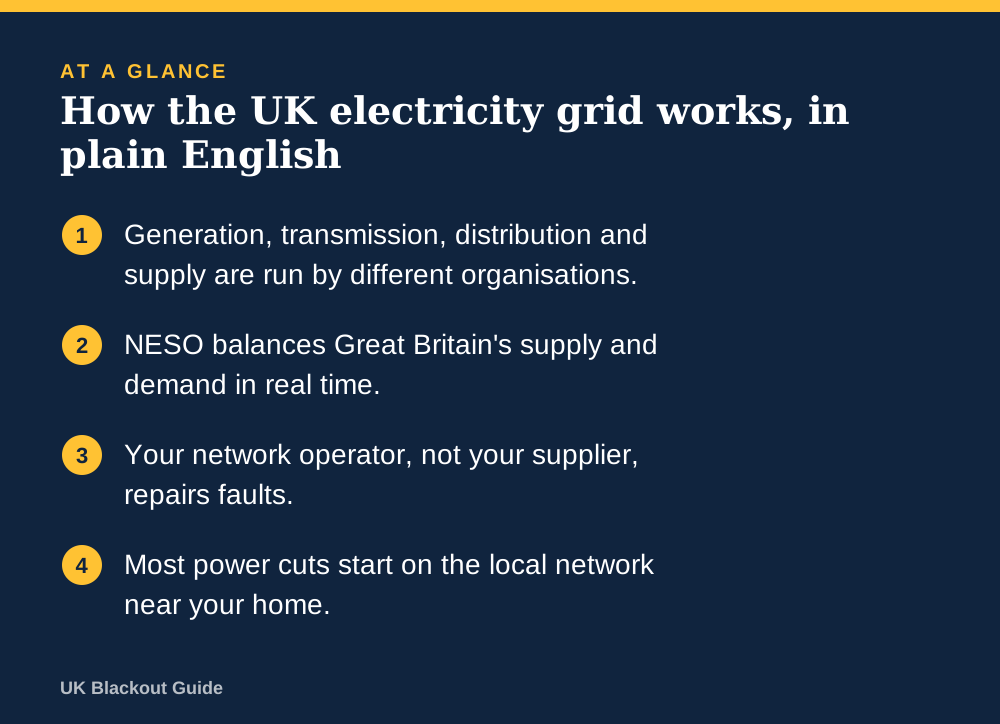
- Generation, transmission, distribution and supply are run by different organisations.
- NESO balances Great Britain's supply and demand in real time.
- Your network operator, not your supplier, repairs faults.
- Most power cuts start on the local network near your home.
The journey from power station to socket
Electricity cannot be stored in the wires. Every unit you use is being generated somewhere at that same moment, and it reaches you in four stages.
- Generation. Gas, nuclear, wind, solar, hydro and biomass plants produce the power. Some also arrives through undersea cables from neighbouring countries, called interconnectors.
- Transmission. The power is raised to very high voltage and sent long distances on the tall steel pylons you see crossing the countryside. High voltage wastes less energy over distance.
- Distribution. At large substations the voltage is stepped down and handed to the regional network, run by your network operator. Smaller pylons, wooden poles and underground cables carry it to towns and streets, stepping down again on the way.
- Your home. A final local substation or pole-mounted transformer brings it down to the 230 volts at your sockets. It enters through a service cable, the main fuse and your meter, then your consumer unit shares it between circuits.
Almost every power cut you will experience happens at stage three or four, where the usual causes of power cuts in the UK are found.
Who does what, and who to ring
The system was split into separate businesses decades ago, which is why it is confusing to know who is responsible for what.
| Organisation | Job | When you deal with them |
|---|---|---|
| Generators | Make the electricity | Never |
| NESO | Runs the system and balances supply with demand in Great Britain | Never directly |
| Transmission owners | Own and maintain the high-voltage grid | Never |
| Distribution network operator (DNO) | Owns the local cables and substations, fixes faults | Power cuts, via 105 |
| Supplier | Sells you energy, sends the bill, looks after the meter | Bills, tariffs, meter problems |
| Ofgem | Regulates the companies | Rarely, for complaints and compensation rules |
The practical point is that ringing your supplier about a power cut wastes time, and the answer to who to call in a power cut is the network operator. Call 105 in England, Scotland and Wales, and it routes you to the right one.
Northern Ireland has its own separate grid and operator, and power cuts there are reported on 03457 643643.
The balancing act at 50 hertz
The grid runs on alternating current at a frequency of 50 hertz. That number is the system's pulse. If demand rises above generation, the frequency drops. If generation runs ahead of demand, it climbs. Both directions damage equipment if they go too far.
NESO, the National Energy System Operator, keeps the frequency steady by instructing generators and batteries to raise or lower output, minute by minute, around the clock. It forecasts demand from weather, daylight and even television schedules, and it holds spare capacity ready to cover the sudden loss of a large power station or cable.
As more power comes from wind and solar, this job has changed. Output follows the weather, so the operator leans more on batteries, interconnectors and flexible demand to fill the gaps. A question readers often ask, about large new users, is covered in whether AI data centres could cause blackouts.
How the grid protects itself
The network is built with layers of automatic protection. A fault on one line trips switches at each end within a fraction of a second, isolating the damage. On many circuits the power can then be rerouted another way, sometimes automatically, which is why a cut may last only seconds.
If the whole system comes under strain, there is a final safeguard. When frequency falls too low, relays disconnect blocks of customers automatically to bring demand back in line with supply. This is what happened on 9 August 2019, when a lightning strike was followed by the loss of two generators. About 1 million customers were cut off, most for under an hour, and the rest of the country stayed on.
If there were a known shortage of generation lasting days, the same idea would be applied by hand, through planned rota cuts shared between load blocks.
How a complete shutdown would be restarted
A complete shutdown has not happened to the modern grid in Great Britain, and the National Risk Register rates a national outage as low likelihood but very high impact. There is a plan for it all the same. Most power stations need electricity from the grid to start up, so the restart begins with a small number of sites that can start unaided. They energise a section of the network, more stations join, and the islands of power are gradually linked together, a process known as a black start.
By 31 December 2026, NESO must have the capability to restore 60% of demand in each region within 24 hours and all of Great Britain's demand within five days. Separately, the government's Be Ready campaign asks households to be able to manage for three days. It presents that as general preparedness, not a forecast.
Where your home fits in
Knowing the layout helps you make sense of a power cut. If only your house is off, look at your own consumer unit, following the checks in why your power has gone off. If the street is off, it is a local fault and usually a matter of hours. If the cut covers a wide area and your phone signal fades, switch to a battery radio for news.
Home solar panels do not change this picture as much as people expect. Most systems shut off in a power cut unless they have battery backup able to run independently of the grid, as explained in why solar panels stop in a power cut.
Whatever the cause, the kit is the same. A torch within reach, a way to charge a phone and a radio cover the first evening. Our round-up of power cut essentials is a good place to start if you have none of them yet. If the phone is your main concern, our power bank guide explains what size suits a household and how many charges to expect.
Common questions
Is the National Grid the same as NESO?
No. NESO, the National Energy System Operator, runs and balances the electricity system in Great Britain. Separate companies own the transmission wires and pylons.
What does DNO stand for?
Distribution network operator. It is the regional company that owns the local cables and substations and repairs power cuts in your area.
Why can't I choose my network operator?
The local cables are a regional monopoly, so the operator is fixed by where you live. You can choose your supplier, which uses those cables to deliver your energy.
Does switching supplier affect power cuts?
No. The same cables and the same network operator serve your home whichever supplier you pay.
Reviewed against these sources on 18 November 2026. If official advice has changed since, follow the official advice.
General information only. This page is not professional, safety, medical, legal or financial advice, and it is not official guidance. No national blackout has been forecast or announced, and nothing here suggests one is expected. We are independent and have no connection to the government or any energy company. Always check the official sources linked on this page. Full disclaimer
Keep reading
 Explainer
The 9 August 2019 power cut: what happened
On 9 August 2019 a lightning strike and the loss of two generators cut power to about 1 million customers, most for under an hour. What happened and why.
Read: The 9 August 2019 power cut: what happened News
Amazon Web Services outage, May 2026: what happened and why
The Amazon Web Services outage of 7 May 2026 began when a US data centre overheated. What AWS said, who was affected, and what it means for UK households.
Read: Amazon Web Services outage, May 2026: what News
Amazon Web Services outage, October 2025: what happened and why
The Amazon Web Services outage of 20 October 2025 disrupted Lloyds, HMRC, Snapchat and many more. AWS blamed a DNS fault in its DynamoDB database service.
Read: Amazon Web Services outage, October 2025: Explainer
How the BBC plans to keep broadcasting in a blackout
A BBC report on 7 November 2026 set out how it would keep broadcasting on FM radio through a long blackout. What it said and what radio you need to hear it.
Read: How the BBC plans to keep broadcasting in a