On this page
Call 105. It is free from mobiles and landlines in England, Scotland and Wales and connects you to your local network operator, the company that repairs the cables. In Northern Ireland call 03457 643643. Do not call your energy supplier, which only handles bills and meters. Call 999 if there is a danger to life.
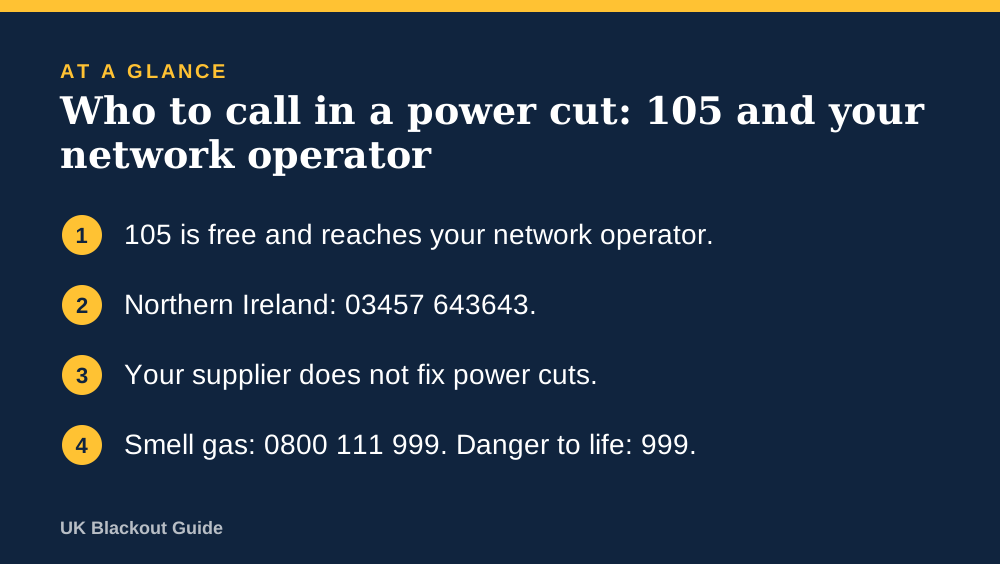
- 105 is free and reaches your network operator.
- Northern Ireland: 03457 643643.
- Your supplier does not fix power cuts.
- Smell gas: 0800 111 999. Danger to life: 999.
The numbers, in one place
| Situation | Who to contact | Number |
|---|---|---|
| Power cut (England, Scotland, Wales) | Your network operator | 105 |
| Power cut (Northern Ireland) | The network operator | 03457 643643 |
| Fallen power line, sparking or damaged equipment | Network operator, or 999 if anyone is in danger | 105 / 999 |
| Smell of gas or suspected carbon monoxide | Gas emergency service | 0800 111 999 |
| Fire, injury, risk to life | Emergency services | 999 or 112 |
| No water or low pressure | Your water company | On your water bill |
| Prepayment meter out of credit or faulty meter | Your energy supplier | On your energy bill |
Copy this table onto paper and keep it with your torch. A list saved only on a phone is no help when the phone is flat.
Check your own home before you ring
Two minutes of checking saves a wasted call. To work out why your power has gone off, look at your consumer unit (fuse box). If a switch has tripped, the fault is inside your home and the network operator cannot help. Reset it, and if it trips again unplug appliances until you find the cause.
Then look outside. If street lights and neighbours' windows are dark, it is a network fault. If only your home is off and nothing has tripped, still call 105, because the fault may be on the cable serving your house. If you have a prepayment meter, check the credit.
If you rent, the same rule applies. Call 105 for a network fault, and your landlord for a fault in the property's own wiring.
Why it is 105 and not your supplier
The company you pay for electricity does not own the wires. The cables, poles and substations in your area belong to a distribution network operator, a regional company you never chose and may never have heard of. It is the one with the engineers and vans.
105 was set up so you do not need to know which operator covers you. The call is routed by your location. You can also report a cut on your operator's website, and powercut105.com identifies the operator from your postcode. It helps to know who your network operator is in advance, because their website and social media feeds carry the most detailed updates.
What to say and what you will be told
When reporting a power cut, have your postcode ready. Say whether the whole area appears to be off or only your home, when it went off, and anything you saw or heard, such as a bang, a flash or a line down. Mention at the start if anyone in the house depends on medical equipment or is otherwise at risk.
If the fault is already known you will usually hear a recorded message with an estimated restoration time, and you can also check for power cuts in your area on the operator's website. Estimates move as engineers learn more, so treat them as a guide. If the fault is new, your report helps them pinpoint it. It is worth reporting even if you assume a neighbour already has.
When it is a 999 call
A power cut on its own is not an emergency. These are:
- A power line is down across a road, a car or a garden, and people are close to it.
- There is fire, smoke or arcing from electrical equipment.
- Someone who depends on powered medical equipment is in difficulty.
- Someone shows signs of hypothermia, such as shivering, confusion or slurred speech, or of carbon monoxide poisoning, such as headache, dizziness, nausea or collapse.
Keep away from fallen power lines and anything touching them, and assume they are live. Never try to move one.
From a mobile, 999 and 112 can roam onto any available network, so calling 999 in a power cut is worth trying even when your own network shows no service. If you are deaf, have hearing loss or cannot speak, you can text 999 through emergencySMS, but you must register first by texting the word register to 999. Do that today.
Making sure you can still make a call
The phone itself is the weak point, and whether a landline works in a power cut depends on the type. Digital landlines run through your broadband router and need mains power. Cordless handsets need a powered base. Mobile masts may work only temporarily on backup power in a wide-area cut.
If your home still has a traditional copper line, a basic corded phone that takes its power from the line may work when everything else is down, and it is on the official list of things to try.
For mobiles, a charged power bank is the fix. Keep one topped up. If you depend on a digital landline, ask your provider about a battery backup unit.
Get on the priority list before you need it
The Priority Services Register is free and tells your network operator that your household may need extra help. Many households qualify, including those with children under 5, older people, and people who rely on powered medical equipment. Members can get advance notice of planned cuts and priority contact during unplanned ones.
In England, Scotland and Wales you can join at thepsr.co.uk or through your supplier or network operator. Northern Ireland uses Customer Care Registers instead.
After a long cut you may be owed money, though whether you can get compensation for a power cut depends on the length of the cut and the weather under Ofgem's Guaranteed Standards. The rules change, so ask your network operator.
Checklist
Who to call in a power cut: 105 and your network operator
- Save 105 in every phone in the house
- Write the key numbers on paper and keep them with a torch
- Look up your network operator at powercut105.com
- Join the Priority Services Register if you qualify
- Register for emergencySMS by texting register to 999
- Keep a power bank charged
- Ask your landline provider about battery backup if you rely on it
Common questions
Is 105 free from a mobile?
Yes. Calls to 105 are free from mobiles and landlines in England, Scotland and Wales.
Can I report a power cut online?
Yes. Your network operator's website will have a reporting page and usually a live map. Find your operator at powercut105.com.
Should I call 105 if the power has only flickered?
A single flicker needs no call. Repeated flickering or dim lights that persist are worth reporting, as they can point to a developing fault.
Who do I call about a power cut in a block of flats?
Call 105 if the whole building or area is off. If only communal areas or your flat are affected, contact the managing agent or landlord as well.
Reviewed against these sources on 18 November 2026. If official advice has changed since, follow the official advice.
General information only. This page is not professional, safety, medical, legal or financial advice, and it is not official guidance. No national blackout has been forecast or announced, and nothing here suggests one is expected. We are independent and have no connection to the government or any energy company. Always check the official sources linked on this page. Full disclaimer
Keep reading
 Question
Do landlines still work in a power cut?
Digital landlines stop working in a power cut unless they have battery backup. A corded phone on a traditional line may still work. How to check yours.
Read: Do landlines still work in a power cut? Explainer
The 9 August 2019 power cut: what happened
On 9 August 2019 a lightning strike and the loss of two generators cut power to about 1 million customers, most for under an hour. What happened and why.
Read: The 9 August 2019 power cut: what happened News
Amazon Web Services outage, May 2026: what happened and why
The Amazon Web Services outage of 7 May 2026 began when a US data centre overheated. What AWS said, who was affected, and what it means for UK households.
Read: Amazon Web Services outage, May 2026: what News
Amazon Web Services outage, October 2025: what happened and why
The Amazon Web Services outage of 20 October 2025 disrupted Lloyds, HMRC, Snapchat and many more. AWS blamed a DNS fault in its DynamoDB database service.
Read: Amazon Web Services outage, October 2025: