On this page
Yes, for long unplanned cuts. Under Ofgem's Guaranteed Standards, your network operator must make a payment if it takes too long to restore your supply. The time limits and amounts depend on the weather category and are revised from time to time, so check the current figures with Ofgem or your network operator.
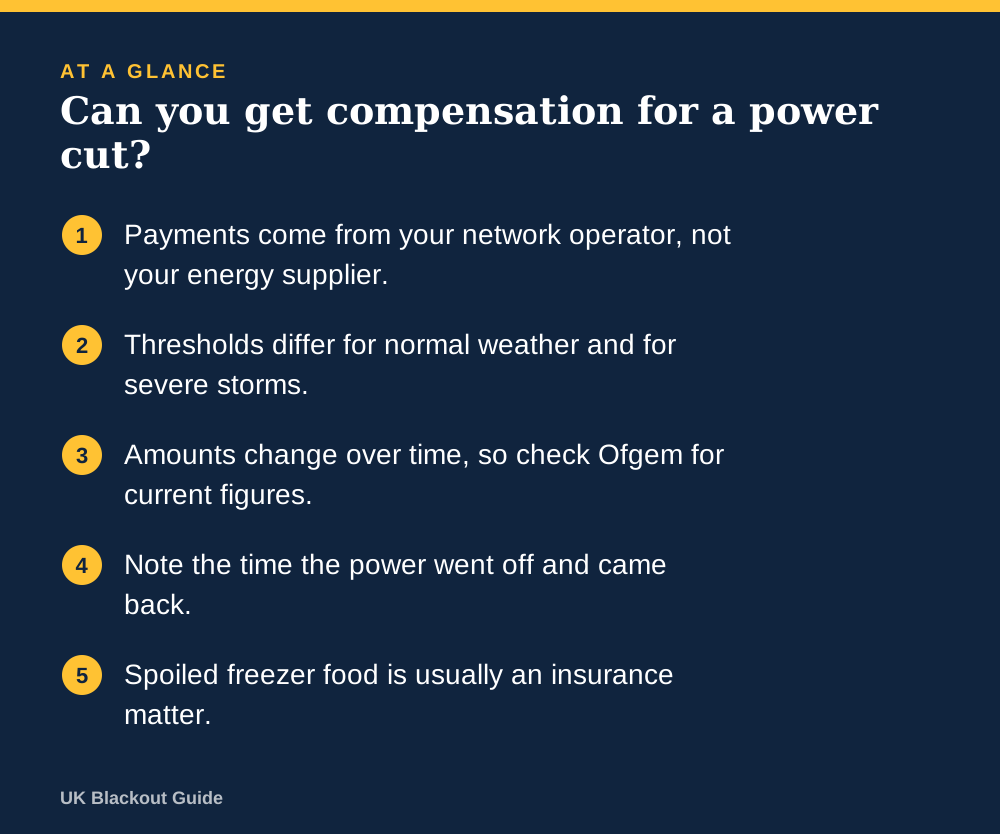
- Payments come from your network operator, not your energy supplier.
- Thresholds differ for normal weather and for severe storms.
- Amounts change over time, so check Ofgem for current figures.
- Note the time the power went off and came back.
- Spoiled freezer food is usually an insurance matter.
Who pays and under what rules
The rules are called the Guaranteed Standards. Ofgem, the energy regulator, sets them, and they apply to the company that runs the cables in your area. That is your network operator, not the supplier that bills you. If you do not know its name, see how to find your network operator.
The standards set time limits for getting customers back on supply. If the operator misses a limit, it owes you a payment. The limits are longer when the cause is severe weather, because a storm can damage hundreds of sites at once, and they differ again by how bad the storm was.
We do not quote the figures here because they are revised from time to time, and an out-of-date number is worse than none. Ofgem's website and your operator's website carry the current ones.
What usually qualifies and what does not
The standards are aimed at long, unplanned interruptions on the operator's network. A cut of an hour or two will not qualify. Nor will a fault inside your own home, such as a tripped fuse box or a failed appliance.
Planned maintenance has its own standard, which is about being given proper notice beforehand, as set out in what to expect from a planned power cut. If your supply is switched off for planned work without that notice, ask the operator about a payment.
Repeated cuts over a year can also qualify under a separate standard. If your power fails again and again, keep a dated list.
How to claim
Some payments are made automatically, but do not count on it. After a long cut, contact your operator through its website or by calling 105 and ask how to claim. There is normally a time limit for doing so, which is another figure to check on the operator's site. Our guide to power cut compensation takes you through the whole process, including what to do if a claim is refused.
A claim is easier with a few details to hand:
- the date and time the power went off, and when it came back
- the reference number from when you reported the cut
- your address and the name on the electricity account
- whether you are on the Priority Services Register
Households on the Priority Services Register can be treated differently under some standards, so mention it.
Losses the payment does not cover
A Guaranteed Standards payment is a fixed sum for the inconvenience. It is not a refund of what the cut cost you. A freezer full of spoiled food, a hotel bill or lost earnings are separate matters, and the first place to look is your home insurance, starting with whether insurance covers freezer food.
Evidence helps with an insurer. Photograph what you throw away, and note how long the power was off. A thermometer that records the highest temperature reached shows whether the food stayed safe, and the fridge and freezer thermometers we recommend include models that do this.
Common questions
Does my energy supplier pay power cut compensation?
No. The payment comes from your network operator, the company that owns the local cables. Your supplier is not responsible for restoring power.
Is compensation automatic?
Sometimes, but not always. Contact your network operator after a long cut and ask, because some payments must be claimed within a set period.
Can businesses claim as well as households?
The Guaranteed Standards cover both, with different amounts. Check the current figures with Ofgem or your network operator.
Reviewed against these sources on 18 November 2026. If official advice has changed since, follow the official advice.
General information only. This page is not professional, safety, medical, legal or financial advice, and it is not official guidance. No national blackout has been forecast or announced, and nothing here suggests one is expected. We are independent and have no connection to the government or any energy company. Always check the official sources linked on this page. Full disclaimer
Keep reading
 Explainer
The 9 August 2019 power cut: what happened
On 9 August 2019 a lightning strike and the loss of two generators cut power to about 1 million customers, most for under an hour. What happened and why.
Read: The 9 August 2019 power cut: what happened News
Amazon Web Services outage, May 2026: what happened and why
The Amazon Web Services outage of 7 May 2026 began when a US data centre overheated. What AWS said, who was affected, and what it means for UK households.
Read: Amazon Web Services outage, May 2026: what News
Amazon Web Services outage, October 2025: what happened and why
The Amazon Web Services outage of 20 October 2025 disrupted Lloyds, HMRC, Snapchat and many more. AWS blamed a DNS fault in its DynamoDB database service.
Read: Amazon Web Services outage, October 2025: Explainer
How the BBC plans to keep broadcasting in a blackout
A BBC report on 7 November 2026 set out how it would keep broadcasting on FM radio through a long blackout. What it said and what radio you need to hear it.
Read: How the BBC plans to keep broadcasting in a