On this page
You may be entitled to a payment if an unplanned power cut lasts beyond a set length of time. The rules are Ofgem's Guaranteed Standards, and the money comes from your network operator, not your energy supplier. Thresholds and amounts depend on the weather category and change over time, so check Ofgem or your network operator for current figures.
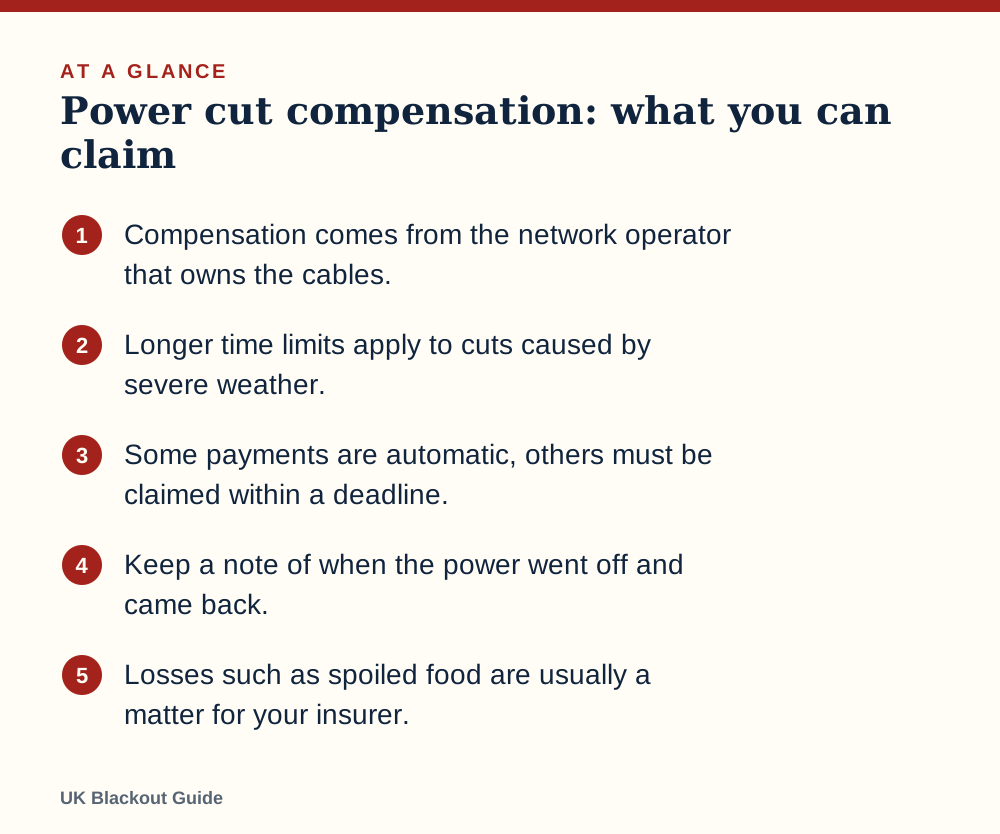
- Compensation comes from the network operator that owns the cables.
- Longer time limits apply to cuts caused by severe weather.
- Some payments are automatic, others must be claimed within a deadline.
- Keep a note of when the power went off and came back.
- Losses such as spoiled food are usually a matter for your insurer.
Who pays, and why it is not your supplier
Two different companies are involved in your electricity. Your supplier sells you the energy and sends the bill. Your network operator owns and repairs the cables, substations and overhead lines in your region.
Power cuts are network faults, so the network operator is the one bound by the Guaranteed Standards and the one that pays. Ringing your supplier about compensation usually ends with being redirected. If you do not know who your network operator is, powercut105.com will tell you from your postcode.
How the Guaranteed Standards work
Ofgem, the energy regulator for Great Britain, sets service levels that network operators must meet. If an operator misses one, the affected customer is due a fixed payment. They are standards of service, not a measure of what the cut cost you.
The main standard covers the time taken to restore supply after an unplanned cut. There is a time limit, and if your power is off for longer, a payment is due, with further payments as the cut goes on, up to a cap.
Other standards cover related failures. Examples include being cut off repeatedly over a year, and planned work carried out without the notice the operator is required to give. The current list, with thresholds and amounts for domestic and business customers, is published by Ofgem and by each operator.
We do not quote figures here because they are revised. Look for "Guaranteed Standards" on the Ofgem website or your operator's site for the amounts in force today.
Weather changes the clock
The time limit is not the same for every cut. In normal conditions the operator has a shorter window to get you back on. When a storm causes widespread damage, the standards put the event into a severe weather category, and the window before payment is due gets longer.
How severe a storm counts as depends on how many faults it causes across the operator's network, compared with a normal day. You cannot tell the category from your own street. The operator declares it, and usually says so on its website during the event.
This is why neighbours in different regions can have different outcomes from the same storm. After Storm Arwen in November 2021, when about 1 million customers lost power and some rural homes were off for more than a week, the time limits in the standards mattered to a lot of households.
Cuts that are treated differently
The standards contain exemptions. An operator may not have to pay where it could not reasonably reach the fault, where the customer's own equipment was the cause, or in certain exceptional events outside its control.
Planned power cuts for maintenance follow separate rules built around advance notice.
Rota power cuts are a different situation again. They are planned cuts of about three hours at a time that could be used in a national energy shortage, and none has been announced. We have found no official statement on how compensation would apply to them, so ask Ofgem or your network operator instead of assuming the fault rules carry over.
Northern Ireland has its own arrangements. The network there is run by NIE Networks and overseen by the Utility Regulator, not Ofgem, so check with them directly.
How to claim, step by step
- Record the times. Note when the power went off and when it returned. A photo of a clock or a text to yourself is enough.
- Report the cut. Call 105 or use your operator's website, even if neighbours already have. Reporting the power cut puts your address on record.
- Wait briefly for an automatic payment. Operators pay many claims without being asked, particularly where they hold your details, for instance through the Priority Services Register.
- Claim if nothing arrives. Use the claim form on the operator's website or ring them. There is a deadline for claiming, which differs between normal and severe weather, so do not leave it for months.
- Escalate if refused. Use the operator's complaints process. If that does not resolve it, the Energy Ombudsman can look at the case.
Payment is normally made to the person named on the electricity account, often by cheque or bank transfer. A genuine operator will not text you a link asking for card details, and power cut scams often imitate exactly that.
What the payment does not cover
A Guaranteed Standards payment is a flat sum for inconvenience. It is not worked out from your losses, and it is not meant to replace a freezer full of food, a hotel bill or a day's lost earnings. Whether insurance covers spoiled freezer food is a separate matter from the standards.
For those, look to your home insurance first. Some policies include freezer contents or alternative accommodation, so check the wording to see how your insurance treats power cuts.
Compensation arrives weeks later, so it does nothing for you on the night. A few inexpensive items do far more, and they are the ones gathered in the essentials worth having for a power cut. A fridge and freezer thermometer also gives you evidence of what happened to your food, which is one more reason to keep one in the fridge all year.
Common questions
Do I need to be the bill payer to claim?
Payments normally go to the electricity account holder. If you rent with bills included, speak to your landlord and the network operator about who should claim.
Can a business claim?
Yes. The Guaranteed Standards include non-domestic customers, with their own payment levels. Check the current figures with Ofgem or your operator.
Does being on the Priority Services Register change compensation?
The register is mainly about support during a cut, but it means the operator already holds your details, which can make automatic payment more likely.
Will I be compensated for a very short power cut?
A single short cut does not normally reach the time limit. Repeated cuts over a year can trigger a separate standard.
Reviewed against these sources on 18 November 2026. If official advice has changed since, follow the official advice.
General information only. This page is not professional, safety, medical, legal or financial advice, and it is not official guidance. No national blackout has been forecast or announced, and nothing here suggests one is expected. We are independent and have no connection to the government or any energy company. Always check the official sources linked on this page. Full disclaimer
Keep reading
 Buying guide
Best cash boxes for emergency cash at home
Lockable cash boxes for keeping emergency notes and coins ready at home for when card payments fail in a power cut. Eight Amazon UK listings compared.
Read: Best cash boxes for emergency cash at home Buying guide
Best fireproof document bags for emergency paperwork
Fire-resistant document bags for emergency paperwork: keep passports, policies, contacts and cash ready to grab. Seven Amazon UK listings compared.
Read: Best fireproof document bags for emergency Buying guide
Best multi-tools for home emergencies
Multi-tools for home emergencies: pliers, screwdrivers and a tin opener for the small jobs a power cut throws up. Seven Amazon UK listings compared.
Read: Best multi-tools for home emergencies Question
Do smart locks work in a power cut?
Most smart locks run on batteries and still lock and unlock in a power cut, but remote app control stops. What keeps working and how to avoid a lockout.
Read: Do smart locks work in a power cut?