On this page
Call 105. It is free from any phone in England, Scotland and Wales and connects you to the network operator for your area, which is the company that repairs faults. In Northern Ireland, call 03457 643643. You can also report a cut on your network operator's website. Do not call your energy supplier.
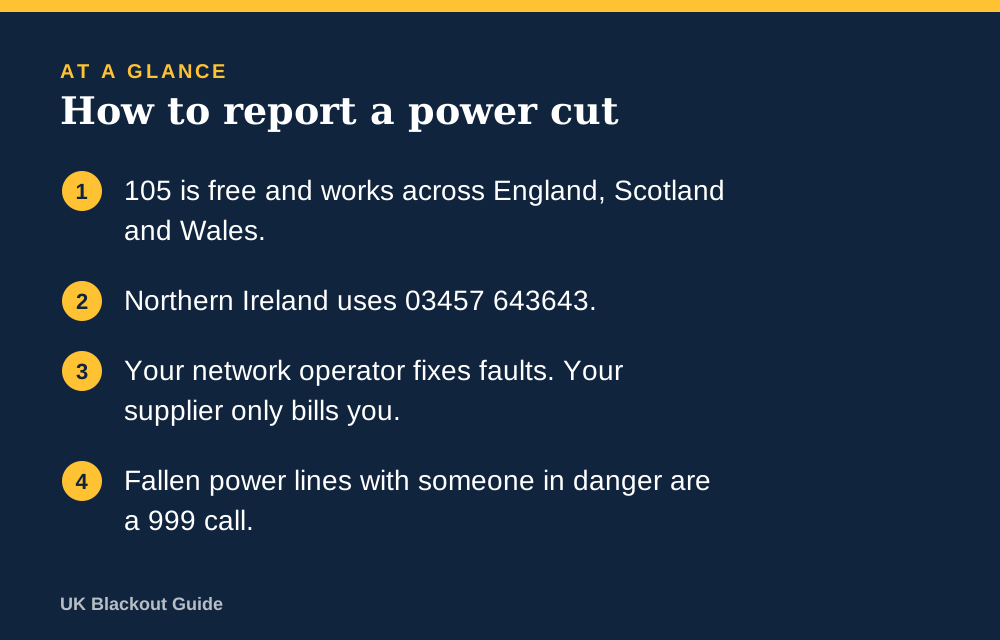
- 105 is free and works across England, Scotland and Wales.
- Northern Ireland uses 03457 643643.
- Your network operator fixes faults. Your supplier only bills you.
- Fallen power lines with someone in danger are a 999 call.
The number to call
105 is the national power cut line for England, Scotland and Wales. It costs nothing from a mobile or a landline, and it routes your call to whichever company runs the local electricity network where you are calling from.
In Northern Ireland, the number is 03457 643643.
Write both the number and your operator's name on paper and keep it by the fuse box or with your torch. It sounds unnecessary for a three-digit number until the night you are standing in a dark hallway trying to remember whether it was 101, 105 or 111.
Why you call the network, not your supplier
Two different companies are involved in getting electricity to your home. The supplier is the name on your bill. The network operator, sometimes called a DNO, owns and repairs the cables, poles and substations in your region. You cannot choose it and you may never have heard its name.
When the power fails, only the network operator can help. If you want to know which one covers your address, powercut105.com will tell you from your postcode, and we explain the regions in how to find your network operator.
Check your own home before you ring
Take a torch to your fuse box. If a switch has tripped, or the neighbours' lights are still on, the problem is probably inside your home and the operator cannot fix it. A tripped switch that will not stay up is a job for an electrician. If you rent, call your landlord.
Prepayment meter out of credit is the other common cause, and that one is a call to your supplier. If all your switches are on and the street is dark, report it.
What to tell them
Have these ready, and the call takes a couple of minutes:
- Your postcode and house number.
- When the power went off.
- Whether your neighbours and the street lights are off too.
- Anything you saw or heard: a loud bang, a flash, a damaged pole, a cable on the ground, sparks or smoke from a substation.
- Whether anyone in the home is vulnerable or relies on electrical medical equipment.
That last point matters. If you are on the Priority Services Register, the operator should already know, but say it anyway. If you are not on it and think you might qualify, our guide to joining the Priority Services Register explains the free sign-up.
Do not assume a neighbour has reported it. Each report helps the operator narrow down where the fault sits, and a single home off supply on a street that is otherwise fine will not be found unless that household calls.
Reporting online and tracking the repair
Every network operator has a website with a fault reporting form and a live map of known power cuts, usually with an estimated restoration time, which is the quickest way of checking for power cuts in your area. Many also offer text updates. If your phone has signal and battery, this is often quicker than waiting in a queue during a storm.
Bear in mind that your home broadband router will be off, so you will be relying on mobile data, and mobile masts may only work temporarily on backup power. That is the case for keeping a charged power bank in the house. Our list of the best power banks for power cuts covers sizes for one person up to a family.
A landline can be a good fallback, with one catch, and whether a landline works in a power cut depends on the type. Digital landlines run through your router and need mains power. An older corded phone on a traditional line may still work, and some providers give a free battery backup unit to customers who depend on their landline. If a corded handset would suit your line, see the corded phones we recommend.
When it is a 999 call instead
105 is for reporting faults and hazards. 999 is for immediate danger to life.
If a power line is down, stay well back and keep others away. Assume it is live even if it is not sparking, and do not touch anything in contact with it, including fences, trees and vehicles. Report it on 105 straight away. If someone has been injured or is in danger, or there is a fire, call 999.
The same applies if someone's medical equipment has failed and they are becoming unwell. That is a medical emergency, not a power enquiry.
After you have reported it
Note the time you called and any reference number. Then make the house safe: turn off cookers and heaters, unplug sensitive electronics and keep the fridge closed, as set out in our step-by-step power cut guide.
If the estimated time passes with no power and no update, call again. And if your home is still dark when the rest of the street comes back, report it as a new fault, because it may be a separate problem on the cable to your house.
For long unplanned cuts, power cut compensation is available under Ofgem's Guaranteed Standards. The thresholds depend on the weather category and change over time, so check the current rules with Ofgem or your operator.
Common questions
Is 105 free from a mobile?
Yes. Calls to 105 are free from mobiles and landlines in England, Scotland and Wales.
Can I report a power cut if I do not know my network operator?
Yes. 105 connects you to the right operator automatically, and powercut105.com will name it from your postcode.
Should I report a planned power cut?
No. If you were given notice of maintenance work, the operator already knows. Only call if the power stays off well past the stated end time.
What if I cannot get through on 105?
Lines are busy in storms. Try your operator's website or social media for updates, and keep trying by phone if you have a hazard to report.
Reviewed against these sources on 18 November 2026. If official advice has changed since, follow the official advice.
General information only. This page is not professional, safety, medical, legal or financial advice, and it is not official guidance. No national blackout has been forecast or announced, and nothing here suggests one is expected. We are independent and have no connection to the government or any energy company. Always check the official sources linked on this page. Full disclaimer
Keep reading
 Buying guide
Best power cut essentials: the blackout kit worth buying
The blackout kit worth buying for a UK power cut: a battery torch, a lantern, a power bank, a wind-up radio, an automatic light and a flask, with picks.
Read: Best power cut essentials: the blackout kit Buying guide
Best surge protectors for power cuts
Surge protectors for power cuts: extension leads that guard a TV, computer or router from the spike when the mains returns, chosen from Amazon UK listings.
Read: Best surge protectors for power cuts Question
Can a power cut damage appliances?
A power cut rarely harms appliances by itself. The risk comes from surges and flickering when supply returns, and from computers losing power mid-task.
Read: Can a power cut damage appliances? Question
Can I charge an electric car in a power cut?
You cannot charge an electric car at home in a power cut, as the charger needs mains power. Public chargers outside the affected area will still work.
Read: Can I charge an electric car in a power cut?