On this page
Your electricity network operator is the company that owns the cables and substations in your area and repairs them when the power fails. It is not the supplier that sends your bill. Enter your postcode at powercut105.com to find yours, or call 105 (free in England, Scotland and Wales) and you will be put through to it automatically.
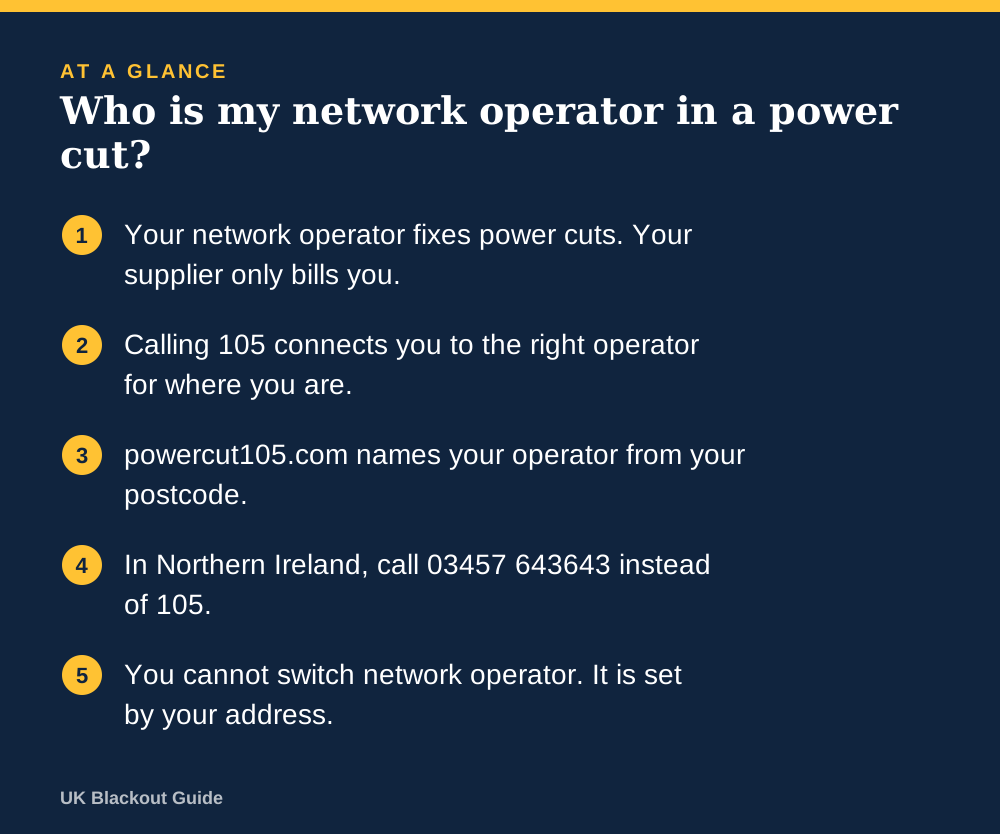
- Your network operator fixes power cuts. Your supplier only bills you.
- Calling 105 connects you to the right operator for where you are.
- powercut105.com names your operator from your postcode.
- In Northern Ireland, call 03457 643643 instead of 105.
- You cannot switch network operator. It is set by your address.
The quickest way to find your operator
Go to powercut105.com and type in your postcode. The site names the company that runs the local network and links to its power cut map and its page for reporting a power cut.
If the lights are already off and you have no internet, call 105 from a mobile or landline. The call is free and routes you to the operator for the area you are calling from, so you do not need to know its name first. In Northern Ireland the number is 03457 643643.
Some electricity bills also print the operator's name and emergency number, usually in the small print near the supply details.
Why your supplier cannot fix a power cut
Two different companies are involved in getting electricity to your sockets. Your supplier buys the energy and sends the bill. Your network operator, often shortened to DNO (distribution network operator), owns the physical kit: overhead lines, underground cables and local substations.
When a cable fails or a storm brings a line down, the operator's engineers do the repair. Ringing your supplier only adds a step, because they will tell you to call 105, and knowing who to call when the power goes off saves that time.
You can change supplier whenever you like. You cannot change network operator, because it comes with the address.
Which company covers which part of the UK
The table gives a rough picture. Boundaries follow the cables, not county lines, so treat it as a guide and confirm your own address with the postcode checker.
| Area | Network operator |
|---|---|
| London, South East and East of England | UK Power Networks |
| Midlands, South West England and South Wales | National Grid Electricity Distribution |
| North East England and Yorkshire | Northern Powergrid |
| North West England | Electricity North West |
| Central and southern Scotland, Merseyside, Cheshire and North Wales | SP Energy Networks |
| Northern Scotland and central southern England | Scottish and Southern Electricity Networks |
| Northern Ireland | NIE Networks |
What to write down now, while the power is on
A power cut is the worst time to start searching for a company name. Take two minutes today and note three things on paper: your operator's name, the number 105, and your load block letter. The letter decides when you would be switched off in a rota cut, and finding your load block letter starts at the same powercut105.com page.
Keep the note with your torch and the other power cut essentials worth keeping together.
Your operator is also who you deal with for two other things. It keeps its own copy of the Priority Services Register for households that need extra help in a cut, and it handles compensation claims for long power cuts.
Common questions
Is my network operator the same as National Grid?
Not necessarily. National Grid Electricity Distribution is the local operator for the Midlands, South West England and South Wales only. Other areas have different operators, so check your postcode.
Does my network operator change if I switch supplier?
No. The operator is fixed by where you live. Switching supplier changes who bills you and nothing else.
Do I need to know my operator to report a cut?
No. Calling 105 puts you through to the right one automatically. Knowing the name helps if you want to use its website or outage map.
Reviewed against these sources on 18 November 2026. If official advice has changed since, follow the official advice.
General information only. This page is not professional, safety, medical, legal or financial advice, and it is not official guidance. No national blackout has been forecast or announced, and nothing here suggests one is expected. We are independent and have no connection to the government or any energy company. Always check the official sources linked on this page. Full disclaimer
Keep reading
 Explainer
The 9 August 2019 power cut: what happened
On 9 August 2019 a lightning strike and the loss of two generators cut power to about 1 million customers, most for under an hour. What happened and why.
Read: The 9 August 2019 power cut: what happened News
Amazon Web Services outage, May 2026: what happened and why
The Amazon Web Services outage of 7 May 2026 began when a US data centre overheated. What AWS said, who was affected, and what it means for UK households.
Read: Amazon Web Services outage, May 2026: what News
Amazon Web Services outage, October 2025: what happened and why
The Amazon Web Services outage of 20 October 2025 disrupted Lloyds, HMRC, Snapchat and many more. AWS blamed a DNS fault in its DynamoDB database service.
Read: Amazon Web Services outage, October 2025: Explainer
How the BBC plans to keep broadcasting in a blackout
A BBC report on 7 November 2026 set out how it would keep broadcasting on FM radio through a long blackout. What it said and what radio you need to hear it.
Read: How the BBC plans to keep broadcasting in a