On this page
Your load block letter is a single letter of the alphabet assigned to your property by your network operator. If rota power cuts were ever needed in a national energy shortage, a timetable would show which letters lose power in each three-hour slot. Find yours by entering your postcode at powercut105.com, or look on your electricity bill, where some suppliers print it.
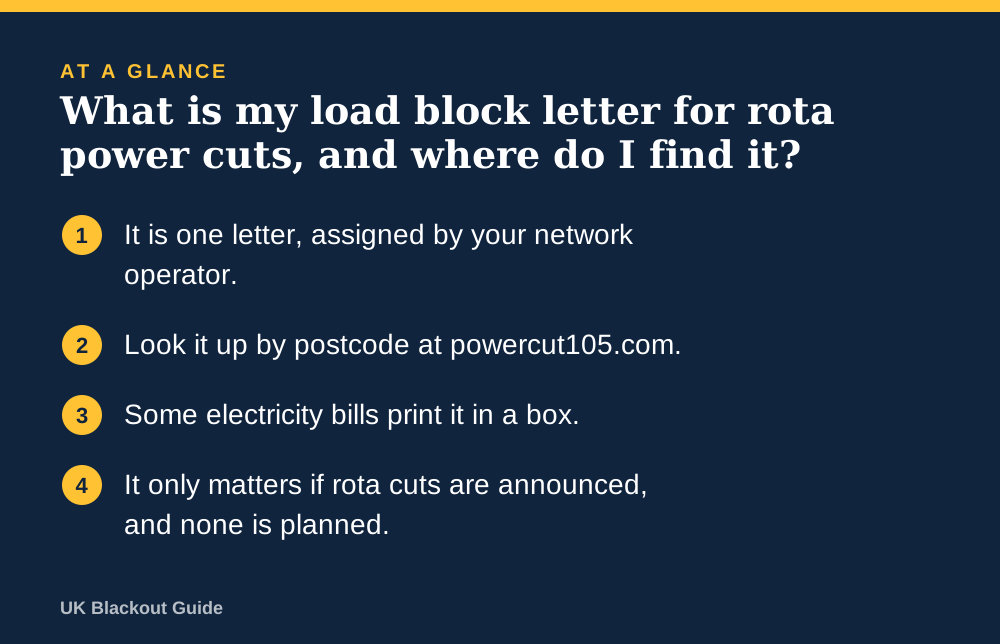
- It is one letter, assigned by your network operator.
- Look it up by postcode at powercut105.com.
- Some electricity bills print it in a box.
- It only matters if rota cuts are announced, and none is planned.
Three ways to find your letter
- Online. Go to powercut105.com and enter your postcode. The site identifies your network operator and is the official starting point for finding the block letter for your address.
- On your bill. Some suppliers print the letter on electricity bills, often as a single capital letter in a small box near your address or account details. Not every bill has one.
- By phone. Call 105 and ask your network operator. This is the best route if your postcode covers more than one block.
Write the letter on paper and keep it with your torch or inside a kitchen cupboard. If rota cuts were under way, your broadband might be off when you wanted to check it.
What the letter is for
In a national energy shortage, electricity could be rationed through rota power cuts, switching off groups of customers in turn for about three hours at a time. Those groups are the load blocks. A published rota would list which letters are off in which slot each day, so you could plan meals, charging and heating around your turn.
The letter does nothing in normal times. It has no effect on your tariff, your supplier or how quickly a fault is repaired. No rota cuts are currently planned.
Why your neighbour's letter may differ
Load blocks follow the electrical layout of the local network, not streets or postcodes. Homes fed from different circuits can have different letters even when they are next door. Flats in one building usually share a letter, but not always.
For the same reason, your letter can change if the operator reconfigures the network, so it is worth checking once a year. If you move house, look up the new address.
A few sites that protect life or essential services may be exempt from rota cuts. Ordinary homes are not, including those on the Priority Services Register, though joining the Priority Services Register is still worth doing for the advance notice and extra support.
What to do once you know it
Nothing urgent. Note it down, and tell the rest of the household where it is written. If rota cuts were announced, you would check the published timetable against your letter each day and follow the same routine as for any planned power cut.
A three-hour cut needs little kit: a lantern or other light for each room you use, a charged power bank and a flask of hot water. If you have none of those, start with light.
Common questions
Does Northern Ireland use load block letters?
The powercut105.com lookup covers England, Scotland and Wales. In Northern Ireland, contact the network operator on 03457 643643 for local arrangements.
Is the load block letter the same as my meter number?
No. Your meter number and supply number (MPAN) identify your connection. The block letter only places you in a rota group.
Can I ask to change my load block?
No. It is fixed by which part of the network supplies your property.
Reviewed against these sources on 18 November 2026. If official advice has changed since, follow the official advice.
General information only. This page is not professional, safety, medical, legal or financial advice, and it is not official guidance. No national blackout has been forecast or announced, and nothing here suggests one is expected. We are independent and have no connection to the government or any energy company. Always check the official sources linked on this page. Full disclaimer
Keep reading
 Explainer
The 9 August 2019 power cut: what happened
On 9 August 2019 a lightning strike and the loss of two generators cut power to about 1 million customers, most for under an hour. What happened and why.
Read: The 9 August 2019 power cut: what happened News
Amazon Web Services outage, May 2026: what happened and why
The Amazon Web Services outage of 7 May 2026 began when a US data centre overheated. What AWS said, who was affected, and what it means for UK households.
Read: Amazon Web Services outage, May 2026: what News
Amazon Web Services outage, October 2025: what happened and why
The Amazon Web Services outage of 20 October 2025 disrupted Lloyds, HMRC, Snapchat and many more. AWS blamed a DNS fault in its DynamoDB database service.
Read: Amazon Web Services outage, October 2025: Explainer
How the BBC plans to keep broadcasting in a blackout
A BBC report on 7 November 2026 set out how it would keep broadcasting on FM radio through a long blackout. What it said and what radio you need to hear it.
Read: How the BBC plans to keep broadcasting in a